MHH awards 119 doctoral degrees
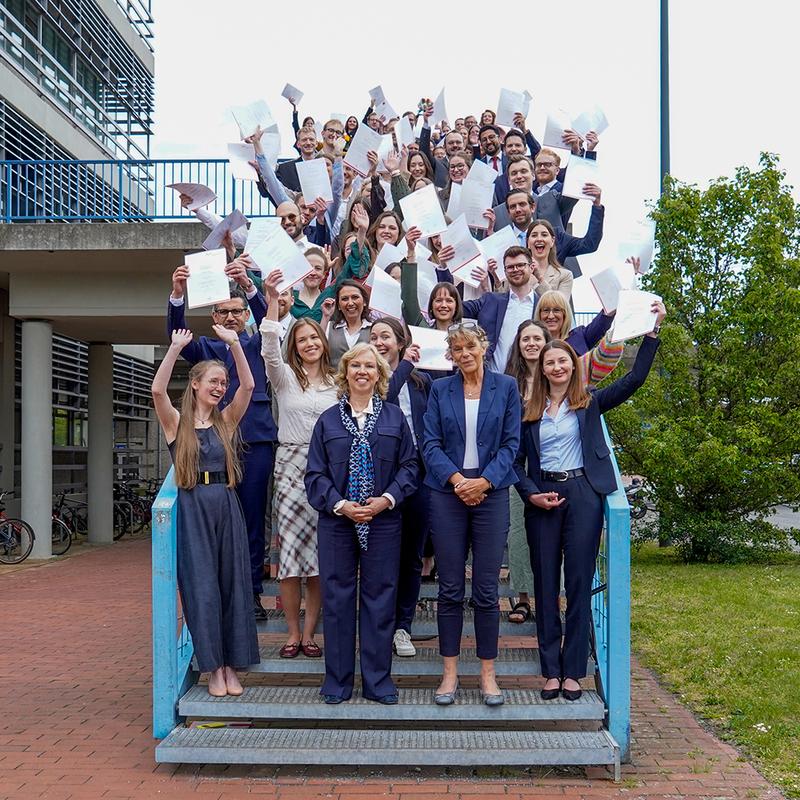
Research and passion in the spotlight: At its spring graduation ceremony, Hannover Medical School honoured 119 early-career researchers. Alongside moving words from MHH President Prof. Dr Denise Hilfiker-Kleiner, the focus was on outstanding research achievements and excellent doctoral theses. Two PhD graduates received doctoral awards from the Society of Friends of the MHH e.V.
Hannover Medical School (MHH) awarded 119 doctoral degrees at the spring graduation ceremony. All of the university’s disciplines were represented: among the 73 female and 46 male doctoral candidates were 40 female and 31 male doctors, eight female and ten male dentists, 19 female and four male scientists, four female and one male human biologists, and two female public health doctoral candidates. A total of 14 female and 12 male doctoral candidates graduated with distinction.
MHH President Prof. Dr Denise Hilfiker-Kleiner praised the doctoral candidates for their “scientific ability, perseverance and passion”, adding: “You have shown how much is possible when you believe in a goal and work consistently towards it.” She offered her congratulations with a quote from the world-renowned behavioural scientist Jane Goodall: “What you do makes a difference. And you have to decide what kind of difference you want to make.” The MHH President then invited all the doctoral candidates onto the stage and presented them with their doctoral certificates.
Two researchers honoured with awards
Two PhD graduates received the doctoral awards from the Society of Friends of the MHH e.V., each worth 2,500 euros. The awards for outstanding doctoral theses were presented by Prof. Dr Siegfried Piepenbrock, Chair of the Society of Friends of the MHH e.V., together with Dean of Research Prof. Dr Meike Stiesch. The prize winners are Dr. rer. nat. Fiona Engelke, Department of Rheumatology and Immunology, and Dr. rer. nat. Christine Ehlers, TWINCORE, Centre for Experimental and Clinical Infection Research.
The band Moonlight Trio – Adriana Soares de Almeida on vocals, Joel Marschner on piano and Marla Stier on double bass – provided a very special backdrop to the ceremony with a varied musical programme.
New approaches to the diagnosis of Sjögren’s syndrome
Dr. rer. nat. Fiona Engelke (30) studied for a Master’s degree in Biochemistry at the MHH and completed her PhD under the supervision of Prof. Dr Torsten Witte, Director of the Department of Rheumatology and Immunology, with a thesis entitled “Novel autoantibodies and their function in subgroups of Sjögren’s disease defined by omics approaches”, which examined the role of new autoantibodies in Sjögren’s syndrome. She is now a postdoctoral researcher in the Applied Genetics section at the Institute of Human Genetics at the MHH.
Sjögren’s syndrome is a chronic inflammatory autoimmune disease that can cause dry eyes and a dry mouth. In severe cases, organs such as the lungs may also be affected. Diagnosis is challenging, as it is primarily based on the symptoms of dryness and the detection of Ro/SSA antibodies in the blood. If these antibodies are absent, a tissue sample from the lip is often required; this is an invasive procedure and does not always yield clear results. Furthermore, the course of the disease varies greatly among those affected, which complicates the choice of appropriate treatment and the prediction of the disease’s progression.
In her doctoral thesis, Fiona Engelke investigated new approaches to improving diagnosis, treatment and prognosis for patients with Sjögren’s syndrome. In doing so, she identified novel antibodies as serological markers that represent a potential alternative to invasive lip biopsy. Some of these identified autoantibodies target structures found, amongst other places, in the salivary and lacrimal glands. Using functional, cell culture-based analyses, the mechanism of action of these autoantibodies was elucidated. This provides a possible explanation for the characteristic symptoms of dryness and simultaneously opens up new avenues for targeted therapeutic strategies.
Furthermore, typical disease patterns were identified, such as indications of specific immune system responses like inflammation and the involvement of certain immune cells. On this basis, patient groups with similar disease mechanisms could be identified, which enables a better understanding of the condition and creates a foundation for individually tailored therapies as well as a more accurate prognosis.
Fiona Engelke has already published parts of the findings in eight original papers, one of which she authored as first author.
Gentler treatments for inflammatory skin diseases
Dr. rer. nat. Christine Ehlers (31), a pharmacist, wrote her doctoral thesis entitled “The role of innate immunity in inflammatory skin diseases” on the role of myeloid cells in inflammatory skin diseases within the junior research group “Translational Immunology” at TWINCORE, the Centre for Experimental and Clinical Infection Research. Here she was supervised by Dr. med. Dr. rer. nat. Theresa Graalmann.
Rare diseases such as systemic sclerosis (SSc), scleromyxedema (SMX) and toxic epidermal necrolysis (TEN) are associated with severe symptoms, yet remain poorly understood and difficult to treat. Using modern methods such as spectral flow cytometry, Christine Ehlers specifically investigated immune cells of the innate immune system in the blood, skin and lungs of affected individuals. The results of the study show that both circulating and tissue-resident immune cells are involved in disease-specific inflammatory processes – a previously unknown connection. This improved understanding is important because current therapies suppress the immune system non-specifically, thereby increasing the risk of infection. The findings open up new approaches for more targeted, gentler treatments that could improve patient care.
Christine Ehlers’ research has resulted in several high-quality publications, including as first author in the internationally renowned rheumatology journals Arthritis & Rheumatology (Ehlers et al. 2025) and Rheumatology (Ehlers et al. 2025).
SERVICE
Dr Fiona Engelke’s original publication can be found here: https://www.frontiersin.org/journals/immunology/articles/10.3389/fimmu.2025.1524940/full
Dr Christine Ehlers’ original publications can be found here https://acrjournals.onlinelibrary.wiley.com/doi/10.1002/art.42964 and here https://academic.oup.com/rheumatology/article/64/8/4806/8115593
Ähnliche Pressemitteilungen im idw
