Pultrusion: The Best Is Yet to Come
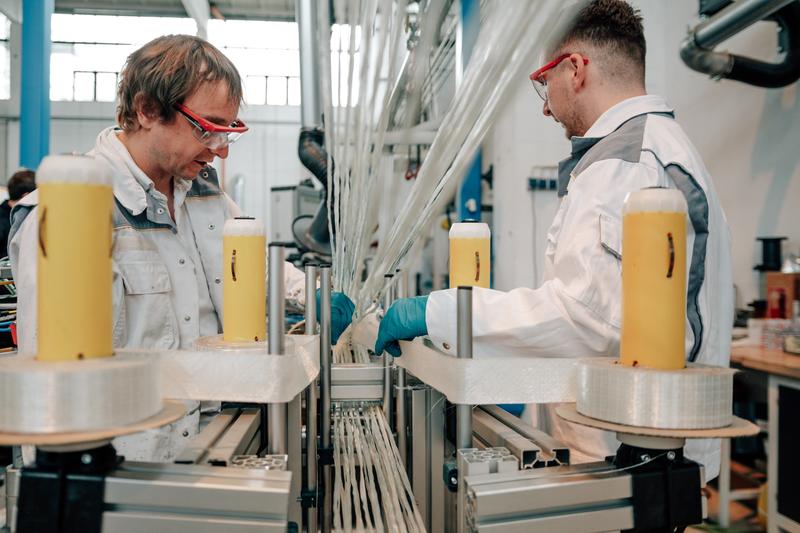
Pultrusion is a fully automated manufacturing process in which fibers are guided through a resin bath and then pulled as an impregnated material through a heated die. In the cured state, the result is a profile that shows exceptionally high mechanical strength. Profiles can be pulled directly into the desired geometry and produced with virtually any wall thickness, including hollow chambers or undercuts if required. By combining different fibers and resin systems, specific properties can be precisely tailored. High production speeds, low manufacturing costs, and consistently high quality make pultruded profiles attractive for entirely new applications
– for example, in solar systems, wind turbine rotor blades, or electric vehicle batteries.
In reinforced concrete structures, these profiles far exceed corrosion-prone steel as reinforcement material.
Renewable Energy, Infrastructure, E-Mobility, Transportation, Circular Economy
One reason for the additional “career prospects” of these exceptionally stiff yet lightweight profiles is the emergence of alternatives to non-recyclable thermoset resins. There is a clear trend toward sustainable solutions, such as thermoplastic matrix systems. These profiles can not only be fully recycled at the end of life but also reshaped after production when exposed to heat.
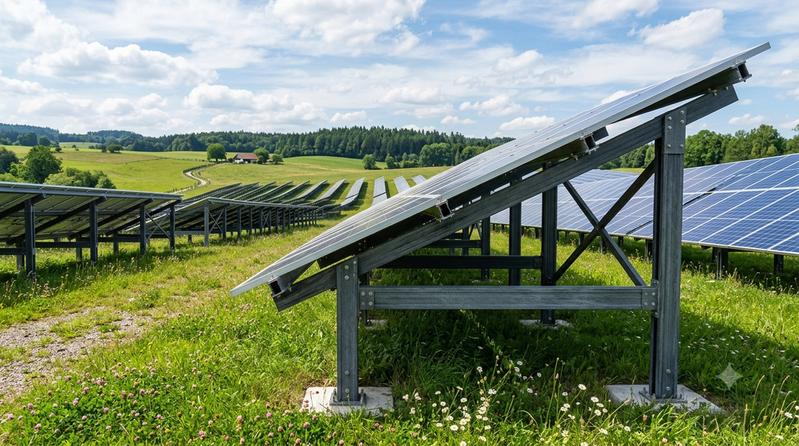
From an ecological standpoint, such profiles are ideally suited for substructures of solar installations, where high corrosion resistance must be combined with structural stability: large-area panels present a significant surface for wind loads. This is explicitly desirable in wind turbine rotor blades, where torsional rigidity is equally critical. Automated manufacturing processes offer significant advantages, particularly when skilled labor is rare or when labor-intensive process steps can be eliminated. In civil engineering, pultruded reinforcement bars (FRP rebars) are preferable to conventional structural steel due to their resistance to salt and corrosion, significantly extending the service life of bridges and tunnels. The material does not rot, is highly resistant to chemicals, and withstands environmental exposure. In battery housings and as underbody protection, lightweight, crash-resistant, and electrically insulating structures offer major advantages. In rail vehicles, cable routing and electronics can be directly integrated into complex, multifunctional pultruded profiles.
Fraunhofer IWU: Unique Expertise in Pultrusion
At Fraunhofer IWU, the process has been continuously refined over the past ten years. The institute’s strengths include complex profile structures at an industrial scale as well as a broad range of materials and equipment – from conventional resin bath processes and the processing of highly reactive two-component (2K) systems to thermoplastic pultrusion (reactive and melt-based). It is the only research institution worldwide capable of producing curved pultruded profiles. Researchers cover the entire value chain – from design using state-of-the-art simulation approaches to manufacturing and analytical characterization. The material spectrum now also includes highly reactive resin systems, thermoplastics, plus carbon and natural fibers. Fraunhofer IWU is working on variable cross-section profiles and graded structures. The aim is to precisely control the degree of curing at defined locations within a component and improve interfacial bonding. Metals and sensors can also be integrated as needed, and accompanying processes such as impregnation, curing, and warpage can be simulated.
“Shaping Lightweight Design”: Symposium Highlights
The sixth edition of the symposium on June 16–17, 2026, also marks the 10-year anniversary of pultrusion at Fraunhofer IWU. In addition to networking with experts, the event will focus on:
- Live pultrusion using a Proxxima™ resin system to produce an entirely new class of thermoset polyolefins (polymer chains are chemically crosslinked to form a non-meltable network with outstanding dimensional stability, temperature resistance, and mechanical stiffness). The system is based on Nobel Prize–winning catalyst technology and has a significantly lower CO₂ footprint compared to conventional thermosets. Extremely low viscosity and adjustable reactivity can further enhance cost efficiency.
- Hybrid profiles: presentation of results from a decade of research and development on the inline production of hybrid pultruded profiles. Several publicly funded large-scale projects have demonstrated that such profiles can absorb high levels of energy in crash scenarios and are compatible with conventional joining methods such as welding – thanks in part to modified and patented variations of the pultrusion process.
Pultrusion in a Nutshell
–
Pultrusion is a continuous manufacturing process for fiber-reinforced plastics in which fibers are drawn through a resin system and then pulled through a heated die, where they cure and form a profile with a constant cross-section. The term combines the words “pull” and “extrusion,” clearly describing the principle of pulling rather than pushing. Unlike extrusion, the material is not forced through a die but continuously drawn through it. This produces long, lightweight, and high-strength composite profiles. The first industrial applications of the process date back to the 1950s.
Wissenschaftlicher Ansprechpartner:
Dipl.-Ing. David Loepitz
Fraunhofer IWU
Reichenhainer Straße 88
D-09126 Chemnitz
David.Loepitz@iwu.fraunhofer.de
Phone +4937153971364
Originalpublikation:
https://www.iwu.fraunhofer.de/en/press/2026-pultrusion-the-best-is-yet-to-come.html
Weitere Informationen:
https://www.iwu.fraunhofer.de/de/veranstaltungen-und-messen/tagungen-und-workshops/symposium-leichtbau-ein-profil-geben.html For more information or to register for the Symposium "Shaping Lightweight Design" at Fraunhofer IWU, please visit our website.
Ähnliche Pressemitteilungen im idw
