
Study: “Hidden” contrails in cirrus clouds contribute to climate warming
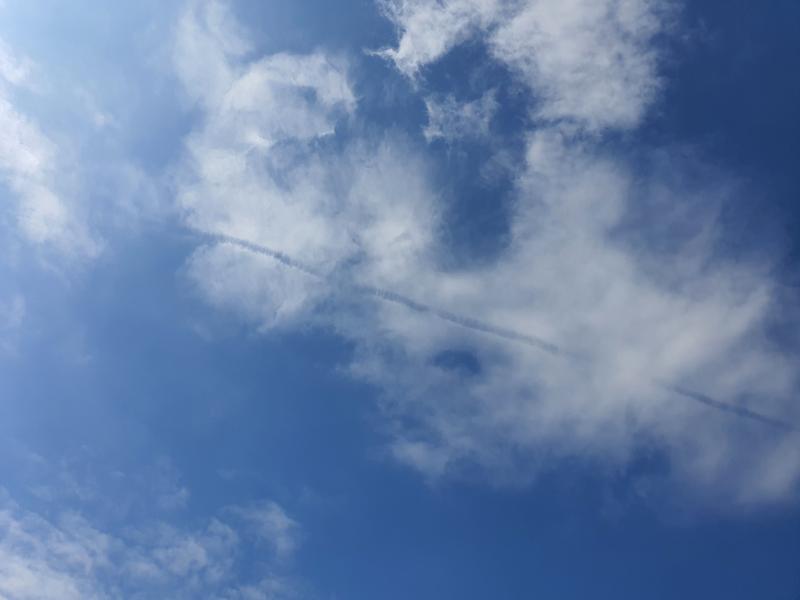
Researchers at the Institute for Meteorology at Leipzig University have, for the first time, determined the climatic impact of contrails that form within natural cirrus clouds. Contrails account for the largest share of aviation’s climate impact beyond carbon dioxide emissions. The Leipzig researchers have now shown that “hidden” contrails – previously not factored into such assessments – contribute up to ten per cent of the warming effect of normal, freely visible contrails.
This means that these embedded contrails, too, make a noticeable contribution to aviation-related climate change and should not be ignored. The researchers have just published their findings in the journal Nature Communications.
“Previously, there had been speculation that such contrails might in some cases even reverse the influence of cirrus clouds – meaning that the clouds would cool rather than warm. But we found no clear evidence for this. In other words, deliberately routing flights through cirrus clouds to reduce the climate impact of aviation is unlikely to work,” says the lead author of the study, Dr Matthias Tesche. The team’s analysis also clearly reflected the impact of the coronavirus pandemic, when air traffic fell sharply – something that was plainly visible in the data.
These findings are particularly important, Tesche adds, because another study appeared in the same journal at almost the same time. It shows that the conditions for contrail formation occur almost exclusively in the same regions as where cirrus clouds form. This suggests that most contrails very likely form within cirrus clouds rather than in cloud-free air – contrary to previous assumptions.
The research team combined aircraft data with satellite observations and computer models to calculate the radiative effect. “We compared the flight paths of individual aircraft with measurement data from a satellite-based laser. At the points where the flight trajectories and the satellite measurements intersected, we examined whether the cirrus clouds showed any changes attributable to the passing aircraft,” the meteorologist explains. Using this approach, they identified around 40,000 such cases and then used this data to estimate first the local impact and subsequently the global effect on the Earth’s radiative balance – that is, the warming or cooling caused by contrails within clouds.
“First, we now know that not only the visible contrails we see in the sky but also those that form within clouds need to be taken into account when assessing the impact of aviation on the climate. Second, it is clear that deliberately routing flights through cirrus clouds is not a suitable method for so-called ‘green flying’ – in other words, for reducing aviation’s impact by altering flight paths,” says Dr Torsten Seelig, the study’s first author, summing up the findings.
Heisenberg position for Dr Matthias Tesche
Since September 2025, the German Research Foundation has been funding a three-year Heisenberg position for Tesche, with the option of a two-year extension. The project examines how aerosol particles influence clouds and how these, in turn, affect the Earth’s energy balance. It draws on new methods developed in recent years by Tesche and his team at Leipzig University. Particular attention will be paid to ice clouds, meaning that the study published in Nature Communications also connects, in a broad sense, with the focus of the Heisenberg funding.
Wissenschaftlicher Ansprechpartner:
Dr Matthias Tesche
Leipzig University, Institute for Meteorology
Phone: +49 341 97-36660
matthias.tesche@uni-leipzig.de
Dr Torsten Seelig
Leipzig University, Institute for Meteorology
Phone: +49 341 97-36663
torsten.seelig@uni-leipzig.de
Originalpublikation:
https://www.nature.com/articles/s41467-025-66231-8, "Quantification of the radiative forcing of contrails embedded in cirrus clouds", Doi: 10.1038/s41467-025-66231
Ähnliche Pressemitteilungen im idw
