
The worldwide largest database for standardized bacterial information BacDive surpasses 100,000 strain mark!

The Bacterial Diversity Database BacDive is the worldwide largest knowledge base of standardized strain-level bacterial and archaeal information. The database is a comprehensive resource covering the phenotypic diversity of prokaryotes with data on taxonomy, morphology, physiology, cultivation, and more.
BacDive has been selected as an ELIXIR Core Data Resource as well as a Global Core Biodata Resource. Its mission is to mobilize and make freely available strain-level research data from various sources. BacDive is an central part of the DSMZ Digital Diversity platform, hosted by the Leibniz Institute DSMZ-German Collection of Bioresources and Cell Cultures in Braunschweig, Germany. With the 2025 release, BacDive has reached a special milestone: the database now contains information on more than 100,000 strains.
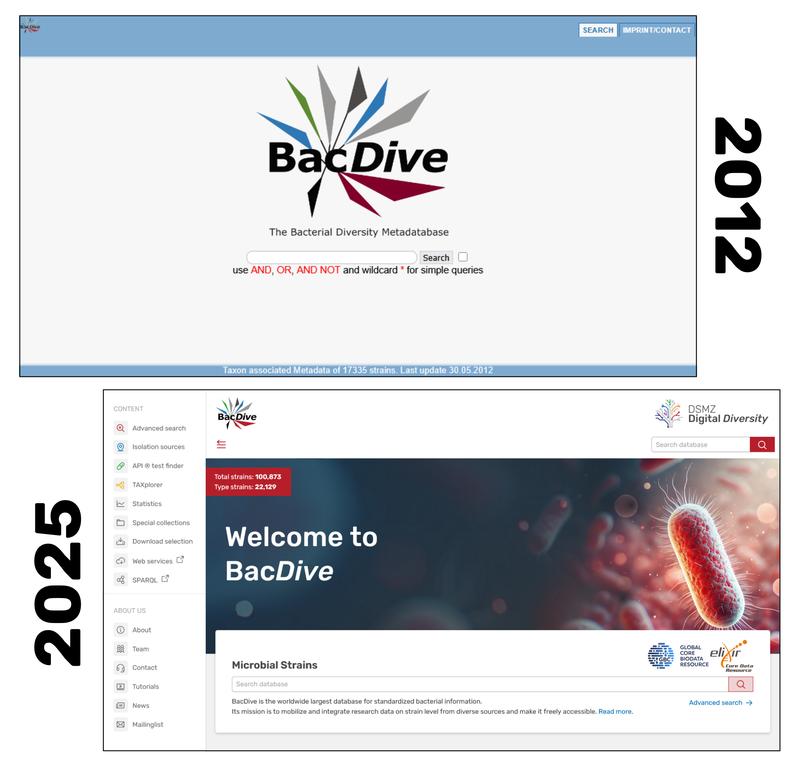
When BacDive was first published, in 2012, the database covered 17,335 strains from the bacterial collection of the Leibniz Institute DSMZ with information on their taxonomy, morphology, physiology, and sampling originating from internal files of the collection. Since then, new strains and information have been added year after year, not only from the DSMZ, but also from other trusted sources. These include primary literature, especially descriptions of new species, internal files of other culture collections like the Culture Collection at the University of Gothenburg and the Culture Collection of the Institut Pasteur, private strain collections, other databases, and more. For the latest update, new strain data provided by DSMZ and information on type strains of newly described species from the LPSN database were added. This update brought the current count of strains described in BacDive to 100,866.
New look and debut of genome browser
With this update, BacDive additionally receives a new look. The new website, which had been in beta test phase for the last six months, adopts the shared modern design of DSMZ Digital Diversity, which offers users an intuitive navigation and more clearly structured strain detail pages. BacDive is also taking a long-awaited leap into the world of genomics with the debut of a genome browser. As a database for phenotypic and isolation source data, BacDive has previously merely displayed sequence accession numbers and links to sequence databases. For the first time, BacDive now displays genomic information. The genome browser feature lists and visualizes Bakta annotations of INSDC genome assemblies. Users are able to navigate through the annotated genome, search through gene features, and view information on them.
Press contact:
PhDr. Sven-David Müller, Head of Public Relations, Leibniz Institute DSMZ-German Collection of Microorganisms and Cell Cultures GmbH
Phone: ++49 (0)531/2616-300
Mail: press@dsmz.de
About the Leibniz Institute DSMZ
The Leibniz Institute DSMZ-German Collection of Microorganisms and Cell Cultures is the world's most diverse collection of biological resources (bacteria, archaea, protists, yeasts, fungi, bacteriophages, plant viruses, genomic bacterial DNA as well as human and animal cell lines). Microorganisms and cell cultures are collected, investigated and archived at the DSMZ. As an institution of the Leibniz Association, the DSMZ with its extensive scientific services and biological resources has been a global partner for research, science and industry since 1969. The DSMZ was the first registered collection in Europe (Regulation (EU) No. 511/2014) and is certified according to the quality standard ISO 9001:2015. As a patent depository, it offers the only possibility in Germany to deposit biological material in accordance with the requirements of the Budapest Treaty. In addition to scientific services, research is the second pillar of the DSMZ. The institute, located on the Science Campus Braunschweig-Süd, accommodates more than 92,500 bioresources and has almost 230 employees. www.dsmz.de
The Leibniz Association
The Leibniz Association connects 96 independent research institutions that range in focus from natural, engineering and environmental sciences to economics, spatial and social sciences and the humanities. Leibniz Institutes address issues of social, economic and ecological relevance. They conduct basic and applied research, including in the interdisciplinary Leibniz Research Alliances, maintain scientific infrastructure, and provide research-based services. The Leibniz Association identifies focus areas for knowledge transfer, particularly with the Leibniz research museums. It advises and informs policymakers, science, industry and the general public. Leibniz institutions collaborate intensively with universities – including in the form of Leibniz ScienceCampi – as well as with industry and other partners at home and abroad. They are subject to a transparent, independent evaluation procedure. Because of their importance for the country as a whole, the Leibniz Association Institutes are funded jointly by Germany’s central and regional governments. The Leibniz Institutes employ around 21,400 people, including 12,170 researchers. The financial volume amounts to 2,3 billion euros. www.leibniz-gemeinschaft.de
Ähnliche Pressemitteilungen im idw
