
Multi million euro funding for research on messianism
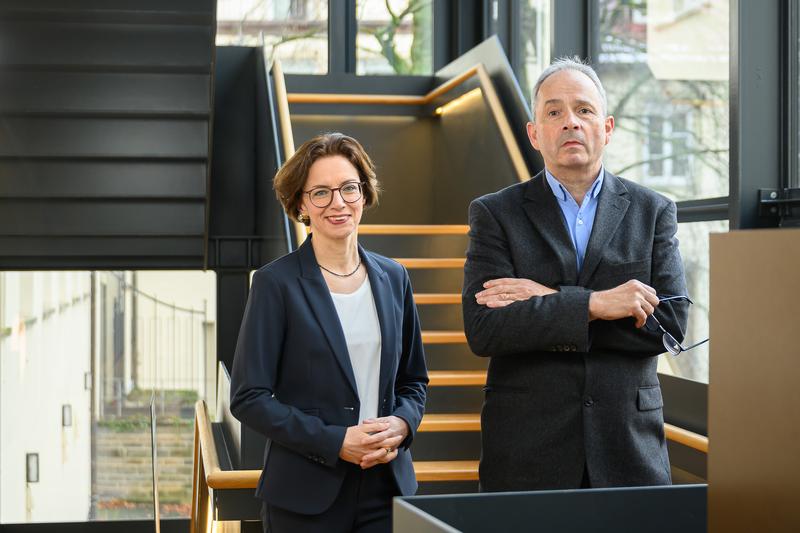
Gandhi, Putin, Trump: when people become messianic figures, similar mechanisms are always at work. The new Käte Hamburger International Centre at the University of Würzburg aims to uncover them.
A phenomenon cuts across nearly all cultures and eras: time and again, people revere a messiah — an individual seen as a bringer of salvation and a divinely sent redeemer. The messianic role can be religious, political, or cultural.
The most recent example is likely U.S. President Donald Trump. His portrayal as a messianic figure mobilised broad swaths of voters in his first campaign, and in his second campaign was further amplified by the failed assassination attempt in July 2024.
The Käte Hamburger International Centre, to be established at the University of Würzburg on 1 April 2026, will study messianic figures and discourses throughout history. The Federal Ministry of Research, Technology and Space (BMFTR) is funding the Centre with approximately 7.7 million euros for its first four years.
Educating and raising awareness in society
The Centre will investigate the conditions under which messianic concepts and figures exert influence. Its work also seeks to have an impact beyond academia, because while doctrines of salvation can foster community, they can also threaten democracies: they have the potential to encourage both egalitarian and totalitarian tendencies.
To this end, the research centre plans to launch initiatives in schools and other educational settings to promote political education and critical awareness. Students of all ages and adults alike should learn to recognise messianic phenomena and understand their dynamics. At this level, the project aims to contribute research based insights to the promotion of democratic engagement.
International collaboration with leading experts
The Centre is directed by Professor Barbara Schmitz and Professor Christian Wehr.
Barbara Schmitz holds the Chair of Old Testament and Biblical Oriental Languages and researches messianic concepts and power structures in the history of Judaism from antiquity to the present.
Christian Wehr, Chair of Spanish and French Literature, previously worked on a Volkswagen Foundation Opus Magnum project on messianism in Latin America from the colonial period to today.
Consistent with the design of the Käte Hamburger International Centres, each year the directors will invite ten outstanding scholars from around the world to Würzburg to advance research on messianism together. Fellows will be selected to complement Würzburg’s expertise, particularly in non European cultures with a focus on the Global South, including the Maghreb, sub Saharan Africa, India, and Islamic cultural regions.
Plans also include involving University of Würzburg researchers in the Centre’s studies. In addition, the fellows will be integrated into teaching to foster contact with students.
Proof of excellence in the humanities
JMU President Paul Pauli is delighted about the new centre: ‘Congratulations to Barbara Schmitz and Christian Wehr on this successful initiative! The fact that JMU now has a Käte Hamburger International Centre shows the excellence of the humanities at our university. This new project, along with our existing renowned and long-term academy programmes, are international flagships for our university.’
The director’s comments on the Käte Hamburger International Centre
Barbara Schmitz: “We are committed to examining and comparing the functionalisation of messianic narratives across history and cultures — not least to gain a more nuanced understanding of contemporary political appropriations of messianic narratives.”
Christian Wehr: “Messianic discourses repeatedly draw on the same narratives and images, yet they adapt to very different historical and cultural contexts. This recurrence is a key factor in their enduring power. It offers scholars in the study of texts and images a valuable opportunity to apply their analytical tools in areas beyond their traditional domains: politics, society, and religion. We anticipate that this will significantly enhance both the legitimacy and prestige of humanities theory.”
About the Käte Hamburger International Centres
Since 2008, the BMFTR has supported outstanding scholars with the freedom to pursue world class research in the humanities and social sciences through the Käte Hamburger International Centres. This programme is the Federal Ministry’s principal funding line for these academic fields and was evaluated as excellent in 2017. It is named after the Germanist, literary scholar, and philosopher Käte Hamburger (1896–1992).
Wissenschaftlicher Ansprechpartner:
Prof. Dr. Christian Wehr, christian.wehr@uni-wuerzburg.de
Prof. Dr. Barbara Schmitz, barbara.schmitz@uni-wuerzburg.de
Ähnliche Pressemitteilungen im idw
