
Why handedness helps in navigating
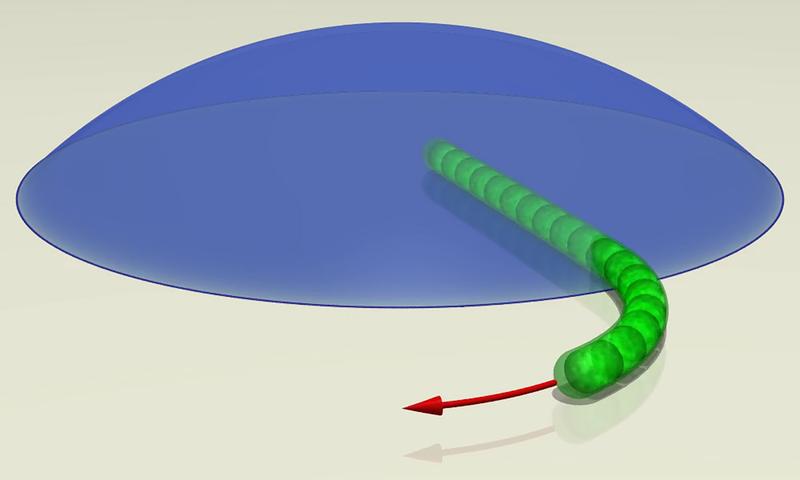
Filamentous cyanobacteria exhibit a unique navigation strategy due to their chiral gliding
• Cyanobacteria form long filaments that rotate around their axis while moving
• Upon change of the physical environment such as transitioning from a wet to a dry medium, this rotation causes the filament to bend
• Filaments can use this as a strategy to navigate back to their original aqueous environment
Cyanobacteria are among the most significant life forms in the history of our planet. As one of the first organisms to produce oxygen through photosynthesis, they shaped the early Earth and created the atmosphere in which complex life could develop. A new study shows that filamentous cyanobacteria also developed a navigation mechanism to control their movement when gliding across surfaces.
The bacterial filaments typically rotate clockwise around their axis creating a propelled forward motion. When moving through a uniform environment – like a liquid -, this rotation has no effect on its overall trajectory. However, as the filament reaches a different environment, as at the interface between a wet and a dry surface, the rear end experiences different frictional forces than the leading end. Consequently, the rotation causes the filament to bend and change direction. At the same time the created trajectory can be used by the bacterium to navigate back to its original medium.
“We discovered that cyanobacteria who rotate clockwise bend and move to the right upon transitioning to a different physical environment,” explains Vahid Nasirimarekani, group leader at MPI-DS and last author of the study. “The bacterium uses its own physical properties to steer in a self-reinforcing process: the path follows the curve, and the curve follows the path. In this way, a filament that has entered a dry surface can literally bend its way back into the wet medium,” he explains.
The study thus proposes a model of chiral motility that explains how asymmetry at the microscopic level such as clockwise rotation is translated into macroscopic movement of the entire organism. This way, even the smallest scales can determine the large-scale dynamics of an organism – a concept that is important for understanding pattern formation throughout the biological world.
Originalpublikation:
https://www.pnas.org/doi/10.1073/pnas.2534547123
Weitere Informationen:
https://www.ds.mpg.de/4115696/260227_chiral_gliding
Ähnliche Pressemitteilungen im idw
