HTWK Leipzig launches new degree programme in “3D Printing & Functional Surfaces”
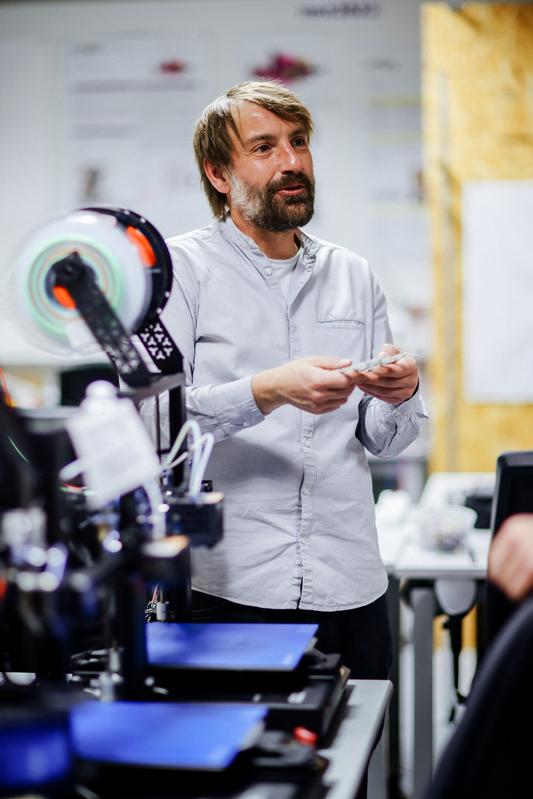
Smart materials, bio-printing and printed electronics: Bachelor’s degree programme in additive manufacturing prepares students for the future of industrial product development
Leipzig University of Applied Sciences (HTWK Leipzig) is responding to the profound transformation in industrial manufacturing and is launching a new degree programme for the 2026/27 wintersemester: “3D Printing & Functional Surfaces”. This innovative study programme, with its holistic technological approach, is unique in Germany. It imparts comprehensive skills in two- and three-dimensional additive manufacturing processes. The programme aims to harness the full potential of modern manufacturing technologies that are revolutionising traditional product development.
“With this programme, we are realising the true potential of printing technology. Whether using analogue or digital processes, whether in 2D or, very often, in successive 3D layers – printed layers are now a key component of many products in industrial manufacturing. Graduates of the programme understand materials, can develop new applications, implement technical solutions in the production process and thus play a decisive role in shaping the future of industry,” says Prof. Dr. Ingo Reinhold, Dean of Studies and Professor of Coating Processes.
The course covers the entire process from design to the final 3D object. Students learn which materials can be combined and how 3D printers work, enabling them to develop entirely new functional systems and intelligent applications for 3D printing.
3D printing is a technology of the future that does not cut three-dimensional objects out of a block or or cast them in a mould, but builds them up layer by layer – hence the term ‘additive manufacturing’.
This makes it possible to create almost anything – from complex microstructures to film sets and rocket engines. This not only enables the production of products that were previously difficult or impossible to manufacture, but also allows for customisation at no extra cost and the functionalisation of printed objects through the combination of different materials. A further advantage is that, as material is used only where necessary, waste is reduced compared to traditional manufacturing processes, meaning resources are used efficiently.
2D printing, on the other hand, focuses on the top layer. Nevertheless, the same coating expertise used in 3D printing is also applied to two-dimensional applications to ‘functionalise’ surfaces in a targeted manner. The basic principle is the precise application of wafer-thin layers that impart entirely new, crucial properties to an object or material. These finishes play a key role in countless areas of our lives – they are often invisible, yet always indispensable, for example in packaging with brilliant print images, in printed electronics in smartphones, or in medical devices that carry bioactive substances.
The synergy: Why 3D printing and functional surfaces go hand in hand
The technological bridge between these two fields is in-depth expertise in coating technology. Additive manufacturing and the functionalisation of surfaces are revolutionising industrial production and helping to tackle key societal challenges such as digitalisation and the call for greater sustainability.
Excellent career prospects
Graduates qualify as Bachelor of Engineering (B.Eng.) and are in high demand in industry due to the enormous range of applications for 2D and 3D printing processes. In addition to teaching, HTWK Leipzig is also continuing to focus its research efforts on 3D printing and will open the Additive Multimaterial Manufacturing Lab (AM³) in June 2026 – a state-of-the-art research facility dedicated to 3D printing.
Potential career fields and areas of application cover a broad spectrum, including:
· Production Engineering & Electronics (e.g. mass production, electronic components)
· Life Sciences & Medicine (e.g. personalised medical products, bio-printing)
· Smart Materials (e.g. modification of material properties, functional transistors)
· Packaging & Logistics (e.g. smart labels, smart packaging)
· Energy & Environment (e.g. solar modules, fuel cells)
· as well as in the fields of Research & Development and Application Engineering (Additive Manufacturing)
At a glance
Degree: Bachelor of Engineering (B.Eng.)
Standard duration of study: 7 semesters (including 1 practical semester)
Admission: Local numerus clausus (NC)
Application (online): 1 May–15 July 2026 (deadline) at htwk-leipzig.de/bewerbung
Tuition fees: none
Further information
Recent interview with Prof. Ingo Reinhold about the new degree programme in “HTWK.magazin”
About the programme
The programme will also be presented at the Leipzig University Day on 9 May
Weitere Informationen:
https://www.htwk-leipzig.de/studieren/studiengaenge/bachelorstudiengaenge/3d-druck-und-funktionale-oberflaechen about the programme
Ähnliche Pressemitteilungen im idw
