
Fraunhofer IAPT Launches AI Project on Recycling in Additive Manufacturing
Artificial intelligence to combine quality and profitability in additive manufacturing using recycled thermoplastics
Hamburg, Germany / May 6, 2026 – The Fraunhofer Research Institution for Additive Manufacturing Technologies IAPT is launching a research project on profitability and recycling in additive manufacturing (AM). The project aims to use recycled materials as a resource for the industrial 3D printing of high-quality components.
Currently, AM with recycled raw materials often results in scrap or high post-processing costs. A new project by Fraunhofer IAPT lays the foundation for the profitable use of recycled thermoplastics in AM and the expansion of production environments into industrial printer farms. Intelligent in-process control, digital twins, and other applications of artificial intelligence (AI) are intended to stabilize 3D printing with recycled raw materials and ensure cost-effectiveness.
Challenges in Additive Manufacturing with Recycled Raw Materials
Recycled polymers offer cost savings and more sustainable production. However, recycled materials vary from batch to batch, thereby amplifying two challenges in AM: On the one hand, most 3D printers follow a static G-code. After a job starts, the machine executes a defined toolpath and a set of fixed parameters. The actual conditions during the printing process are not taken into account. Yet the flow behavior, moisture content, and purity of the recycled raw materials—and thus the print result—vary.
On the other hand, individual wear and tear on machines also leads to inconsistent results. For example, nozzle wear, contaminants, and other machine-specific characteristics result in unstable extrusion and dimensional deviations.
Failure to account for the variance in recycled materials as well as differences from machine to machine increases scrap rates. The negative effect of static processes on cost-effectiveness is amplified as the production environment scales up.
Paradigm shift from open to closed loop
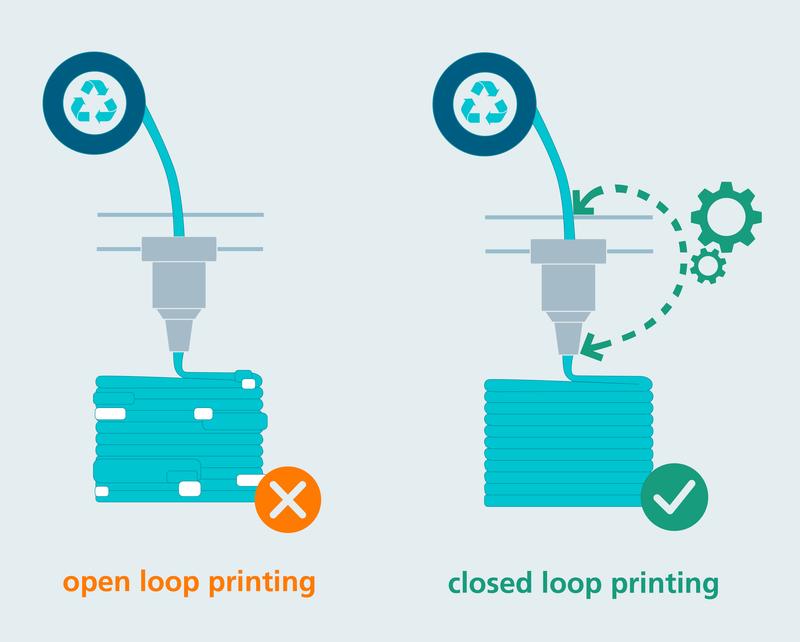
In the new AI project on sustainability and profitability in industrial 3D printing, experts at Fraunhofer IAPT are combining expertise in virtualization, digital twins, and industrial AI. The goal is a paradigm shift from an open-loop process—which does not account for the printing process—to a closed-loop system.
In the closed-loop process, observations regarding material quality or wear-related deviations in machine behavior are fed into the printing process in real time. »Closed-loop printing« uses the collected data to adjust the process parameters within a print layer to the quality of the recycled material.
Adaptive, data-driven processes instead of static G-codes
On the path to »closed-loop printing,« researchers at Fraunhofer IAPT are equipping 3D printers with sensors and computer vision. The systems monitor the print in real time and record, for example, layer height, extrusion width, vibration, and extrusion behavior. AI algorithms analyze the data during production and adjust parameters such as extrusion rate, speed, temperature, or laser power. In »closed-loop printing,« the 3D printer processes analysis results during the ongoing production process and continuously compensates for deviations—such as worn nozzles, environmental influences, or material fluctuations in recycled raw materials.
From »closed-loop printing« to a learning system
Another project goal is to develop 3D printers into learning systems. Digital twins of machines or machine parts are intended to identify the optimal parameter combinations for specific geometries, different material qualities, and machine conditions during operation. An intelligent data management system links the process data, geometry information, slicing parameters, and quality metrics collected in the digital twin.
Unlike isolated data in separate files, such as .stl, G-code, or logs, the intelligent management system transforms every print—whether successful or not—into training data. The learning systems go beyond directly reacting to deviations in »closed-loop printing«; they build up knowledge and apply it to future construction projects.
Scalable Architecture for Industrial Printer Farms
With an eye toward long-term profitability and seamless scaling, the Fraunhofer IAPT team is designing the project’s control strategies and data framework specifically for use in large printer farms. Edge devices on each machine handle local monitoring and control. A central platform aggregates data from all systems. For example, insights from one 3D printer regarding a specific recycled material can be transferred to dozens of other machines. Continuous optimization is achieved not only for individual 3D printers but at the fleet level.
Industrial Application Scenarios
The current AI project at Fraunhofer IAPT opens up entry points for companies of any size to use recycled materials and achieve more sustainable production.The combination of real-time control, virtual process understanding, and structured data establishes recycled materials as an integral part of industrial AM across the entire AM chain.
Dr. Matthias Brück, Head of the Virtualization Department at Fraunhofer IAPT, comments on the project’s starting point: »Recycling in AM today fails not because of material availability, but because of process uncertainty. With adaptive, data-driven control, we are transforming previous uncertainties into manageable variables. Sustainable 3D printing becomes predictable, certifiable, and economically viable.«
About Fraunhofer IAPT
The Fraunhofer Institute for Additive Production Technologies (IAPT) in Hamburg-Bergedorf conducts research on additive manufacturing (AM) and drives the technology forward to enable sustainable innovations for industry. Fraunhofer IAPT’s solutions reduce production costs, accelerate product development, bridge gaps in supply chains, and automate work steps in the face of staffing shortages and a lack of skilled workers.
The Fraunhofer IAPT portfolio encompasses research and development across the entire AM manufacturing process—from unique component designs and system solutions, including at the process and material levels, to factory planning and virtualization. From the initial concept and feasibility studies to industrial implementation in new or existing production environments, the experts at Fraunhofer IAPT provide comprehensive end-to-end coverage of all aspects of the additive manufacturing process.
A special focus is placed on socially relevant future-oriented fields such as life sciences, energy, mobility, as well as security and defense. Our overarching goal is the industrial application of additive manufacturing technologies as a significant contribution to increased productivity, resource conservation, resilience, and prosperity.
Alongside the TUHH and the IAMHH e.V. association, Fraunhofer IAPT is a core partner of the Fraunhofer IAMHH® Industrialized Additive Manufacturing Hub Hamburg.
Press Contact
M.A. Carola Dellmann
Head of Marketing & Communications
Fraunhofer Institute for Additive Manufacturing Technologies IAPT
Am Schleusengraben 14
21029 Hamburg
Email: marketing@iapt.fraunhofer.de
Phone +4940 484010-500
Wissenschaftlicher Ansprechpartner:
Dr. Matthias Brück, Head of the Virtualization Department at Fraunhofer IAPT
https://www.iapt.fraunhofer.de/en/Competences.html#Contact-Us
Weitere Informationen:
https://www.iapt.fraunhofer.de/en/press-media/annual-report/annual-report-2025/polymer-recycling-and-resource-efficient-production.html Learn about another research project on polymer recycling and resource-efficient production at Fraunhofer IAPT
Ähnliche Pressemitteilungen im idw
