Start-up sereact is making robots smarter and has raised 110 million dollars in funding
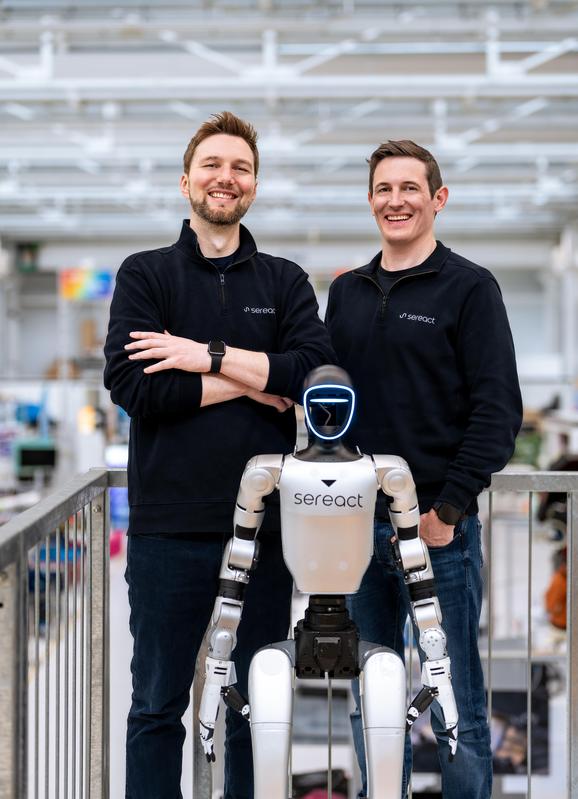

Ralf Gulde and Marc Tuscher, University of Stuttgart alumni, are using a proprietary AI model to turn gripper robots into smart assistants in warehouses and production facilities. Unlike previous models, it learns from real data. In 2021, the two founded the startup sereact; they have since collected more than a billion motion data points and created a unique neural network. It gives robots the ability to plan and act proactively – without any training. With 110 million dollars in funding, the founders are now planning to expand into the U.S. and optimize their technology for the healthcare sector.
The Stuttgart-based startup sereact is turning the robotics industry on its head with its AI model, Cortex 2.0. “We don’t build robots; we give them a brain,” says Ralf. Together with his co-founder Marc Tuscher, he teaches robots to think ahead and plan before they act.
“So far, in robotics, we've only had access to artificially generated data and simulations that don't accurately reflect the real world. And that’s exactly why robots aren’t efficient enough,” explains Gulde. “We train our AI model using real data – that’s what makes the difference.”
The world's largest and smartest robot brain
sereact's AI models have been in use by customers for the past three years. Not only among companies like Mercedes-Benz and BMW, but also among major fashion retailers and online supermarket chains like Knuspr.de. They learn to solve real-world problems in real-world settings, sort parts, or inspect returned items. Installation is easy: a robotic gripper can be up and running in just a few hours, and it can even handle unfamiliar tasks – without any training.
sereact has already collected more than a billion motion data points and fed them into a globally unique neural network – a “robot brain.” “We now have the world’s largest fleet of AI-powered robots, all connected to a centralized neural network,” says Gulde. With the update to Cortex 2.0 and a newly developed world model, the founders have solved one of the biggest problems in robotics: they are giving robots a real-world understanding of the world and the consequences of their actions. “Robots connected to our neural network learn with every movement. With Cortex 2.0, they are able to plan and act proactively.”
Building on its success since the beginning
The two alumni of the University of Stuttgart founded sereact in 2021. Today, five years later, they have more than 100 employees in Europe and the United States. “Ralf and Marc identified a problem and had the courage to launch a startup in one of the most competitive industries,” says Professor Alexander Brem, Vice Rector for Transfer and International Affairs at the University of Stuttgart. “Startups like sereact demonstrate that we have excellent opportunities in the Stuttgart region to turn ideas into unique innovations.”
“The University of Stuttgart offers truly outstanding technology transfer services.” “Without that support, we wouldn't be here today,” Gulde emphasizes. He and his co-founder want to encourage others to take the plunge and start their own business. “We would do it all over again in a heartbeat.”
From the production facility to hospitals
Today, the two founders generate annual revenue in the millions. They recently raised 110 million dollars in funding from several venture capital firms. The funds will be used to further develop their technology. “We want to work our way up from simple use cases to truly complex ones,” says Gulde.
The founders want to teach their AI model to operate in even more unpredictable environments, such as hospitals or laboratories. The first field studies involving humanoid robots in the healthcare sector are already underway.
Next stop - Boston
The founders also plan to use the funding to finance their expansion into the U.S. market. In Boston, one of the leading robotics hubs in the U.S., Gulde and Tuscher rented office space a few months ago and hired their first employees. “We believe we’re among the most exciting startups there and can attract top talent,” says Gulde. Stuttgart, however, remains the hub.
Ähnliche Pressemitteilungen im idw
