Focus on Gene and Cell Therapies: International Experts Highlight Opportunities and Challenges
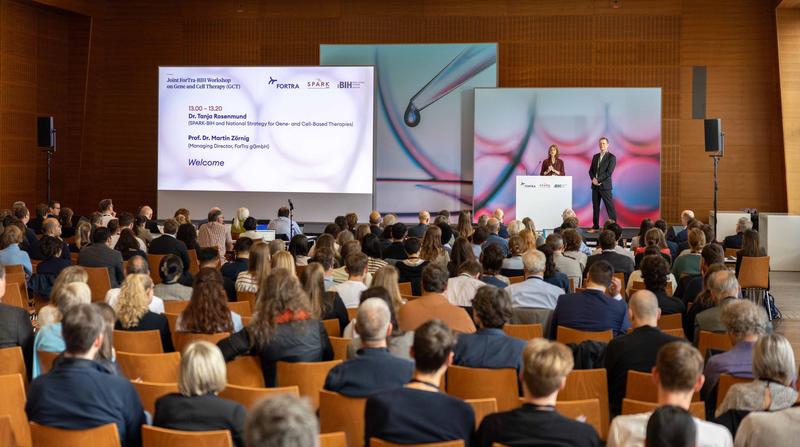
Whether it’s new treatment options for cancer, rare diseases, or age-related conditions—leading researchers and experts from clinical practice and industry are gathering in Frankfurt am Main to share their knowledge on modern gene and cell therapies.
JOINT PRESS RELEASE by the Berlin Institute of Health in der Charité (BIH) and ForTra gGmbH für Forschungstransfer der Else Kröner-Fresenius-Stiftung (ForTra)
Gene and cell-based therapies (GCT) are among the key technologies in biomedical research and healthcare. They open up new possibilities for treating severe and previously incurable diseases while simultaneously strengthening Germany’s position as a biotech hub. But how close are GCTs really to transforming everyday clinical practice? What hurdles still stand in the way? What can we learn from other countries? These and other questions were addressed at the two-day conference “Gene and Cell Therapy: Where do we stand and where do we want to go?”, which took place on May 18 and 19 in Frankfurt am Main. It was organized by ForTra gGmbH für Forschungstransfer der Else Kröner-Fresenius- Stiftung (ForTra) in collaboration with SPARK-BIH, the project funding program of the Berlin Institute of Health at Charité (BIH), as part of the National Strategy for Gene and Cell-Based Therapies. Leading international experts from academia, clinical practice, and industry gathered to present current breakthroughs and discuss how innovative therapies can reach patients more quickly.
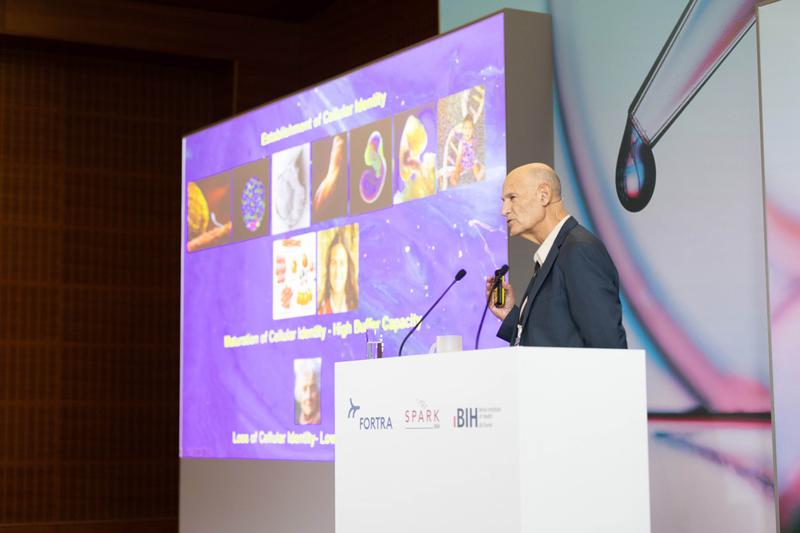
Among the internationally renowned researchers who have significantly shaped the development of modern gene and cell therapies are Prof. Dr. Juan Carlos Izpisua Belmonte (Institute of Science, Altos Labs, San Diego), Prof. Dr. Carl June (Perelman School of Medicine, University of Pennsylvania), and Prof. Dr. Alessandro Aiuti (San Raffaele Telethon Institute for Gene Therapy, Milan). In their keynote speeches, they provided insights into the latest developments in their research.
Prof. Izpisua Belmonte presented new approaches to cell reprogramming aimed at restoring cells to a younger, regenerative state in order to develop new therapeutic strategies for age-related diseases. Prof. June reported on advances in genetically modified immune cells for cancer treatment and the potential of so-called “off-the-shelf” cell therapies, which are produced in a standardized manner and could also be used against solid cancer tumors in the future. Prof. Aiuti used already approved treatments to demonstrate how gene therapies for rare genetic diseases have successfully made their way into clinical application.
In addition to the keynote presentations, participants discussed key challenges in biomedical translation – that is, the transfer of scientific findings from the laboratory into new therapies, products, or procedures. Topics included regulatory requirements and challenges for clinical trials, the manufacture of gene and cell therapeutics under GMP quality standards (GMP = Good Manufacturing Practice, which is a prerequisite for the use of new therapeutics in humans), as well as potential financing models for transforming an academic GCT project into a spin-off, particularly in the field of gene and cell therapy.
The “European Perspective Panel” also provided important insights with contributions from Spain, England, Sweden, and Germany. The discussion highlighted how closer European collaboration can help accelerate progress and utilize resources more efficiently. The outcome of the discussions included, among other things, the long-standing observation regarding potential cost-saving synergies and the acceleration of progress through desirable closer European collaboration.
Another focus was on new therapeutic approaches from academic research, which are currently being funded by ForTra and the SPARK-BIH program as part of the National Strategy GCT. Among other things, forward-looking gene therapy projects aimed at restoring hearing and treating rare diseases were presented. The focus also included new cell therapies for cancer, autoimmune diseases, and the regeneration of damaged corneas. Additionally, innovative RNA-based therapies were presented that can be used to treat liver fibrosis and airborne infectious diseases.
“The conference demonstrated that gene and cell therapies are among the most dynamic fields in modern medicine. At the same time, the path from scientific discovery to approved therapy remains complex and requires close collaboration between research, clinical practice, industry, and regulatory authorities. Furthermore, these promising therapeutic approaches must be developed and made available in a significantly more cost-effective manner in order to establish themselves in healthcare in the long term—only then will gene and cell therapies come into widespread use as the ‘medicine of tomorrow,’ explains Prof. Dr. Martin Zörnig, Managing Director of ForTra gGmbH für Forschungstransfer der EKFS.
“Gene and cell therapies have experienced an impressive surge in development in recent years, and we are now on the cusp of bringing many of these approaches into broader clinical use. It is now crucial to accelerate translation in a targeted manner, overcome regulatory and production-related hurdles, and make innovations safely available to patients. This is precisely where the National Strategy for Gene and Cell-Based Therapies comes in -and with this conference, we were able to further strengthen the collaboration between science, clinical practice, and industry,” says Prof. Dr. Christopher Baum, Chair of the BIH Board of Directors and Chief Translational Research Officer of Charité – Universitätsmedizin Berlin.
About ForTra gGmbH für Forschungstransfer der Else Kröner-Fresenius-Stiftung (ForTra)
ForTra is a non-profit subsidiary of the foundation Else Kröner-Fresenius-Stiftung. The purpose of the German limited liability company is the advancement of medical science and research along with the promotion and support of public health through the translation of medical research findings into clinical application to the benefit of both patients and public healthcare. You can find more information about projects funded by ForTra at: https://www.ekfs.de/en/scientific-funding/funding-lines/translational-research
About SPARK-BIH
SPARK is a global network with programs at more than 40 academic institutions worldwide. It combines financial support, mentoring, active project management, and practice-oriented, tailored training in translational research and spin-off creation, with the aim of turning groundbreaking scientific findings into clinically relevant therapies. SPARK was founded at Stanford University 20 years ago. The first European SPARK program was established in Berlin in 2015, and since 2018 SPARK-BIH has been based at the Berlin Institute of Health at Charité (BIH). For more information, please visit: www.spark-bih.de
Press Contacts
Berlin Institute of Health at Charité
Mirjam Kaplow
Phone: +49 30 450 543 343
Email: pressestelle-bih@bih-charite.de
Else Kröner-Fresenius-Stiftung
Bianka Jerke
Phone: + 49 6172 8975-24
Email: b.jerke@ekfs.de
Wissenschaftlicher Ansprechpartner:
Scientific Contacts
ForTra
Prof. Dr. Martin Zörnig
Managing Director of ForTra gGmbH
Phone: +49 6172 8975-12
Email: m.zoernig@fortra-forschungstransfer.de
SPARK-BIH
Dr. Tanja Rosenmund, MBA
Director of SPARK-BIH, Berlin Institute of Health at Charité (BIH)
Phone: +49 30 450 543 056
Email: tanja.rosenmund@bih-charite.de
Weitere Informationen:
https://www.bihealth.org/en/notices/focus-on-gene-and-cell-therapies-international-experts-highlight-opportunities-and-challenges - Press Release on the BIH website
https://ekfs.de/en/current-topics/press/focus-gene-and-cell-therapies-international-experts-highlight-opportunities - Press Release on the EKFS website
Ähnliche Pressemitteilungen im idw
