AI at the Quay: Bremen Brings Research to Port Operations
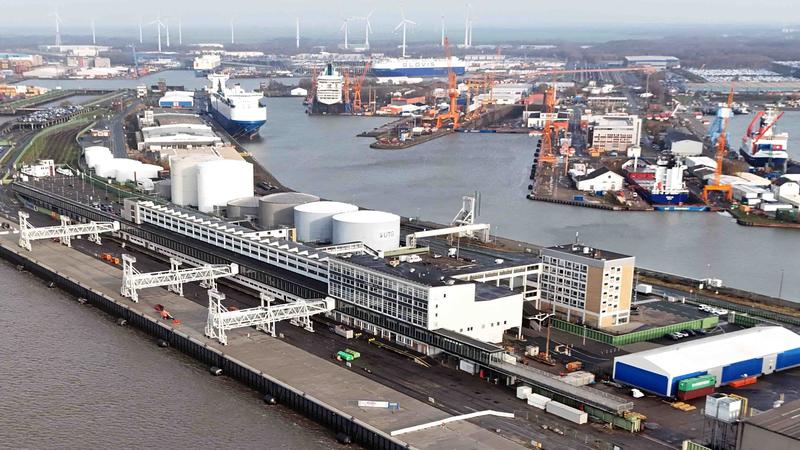
Bremen is a strong hub for AI and technology transfer. The port industry is a prime example of how research, business and government collaborate on digital, resilient and secure infrastructure. IJCAI-ECAI 2026 will present this strength to an international audience.
When the 35th International Joint Conference on Artificial Intelligence, or IJCAI for short, comes to Bremen from August 15 to 21, 2026, it will take place in a city that closely links AI research and application. This is particularly evident in the maritime industry.
The port industry and logistics are considered the backbone of the economy in Bremen and Bremerhaven: With around 1,800 companies, 41,000 direct employees, and an annual turnover of approximately eight billion euros, the sector is a key area for digitalization, automation, and AI. IJCAI-ECAI topics such as Human-Centered AI, AI and Robotics, AI4Tech, and AI and Social Good have a concrete connection here: to intelligent infrastructures, autonomous systems, resilient logistics chains, and secure human-technology interfaces.
Smartport Strategy: A Common Framework for the Port of the Future
The Smartport Strategy of the ports of Bremen, adopted in 2024, sets out the strategic framework for this. This strategy outlines the path to an intelligent, connected and sustainable port. Developed under the coordination of Bremenports, it was created through a participatory process involving over 70 companies and organisations from the port industry, academia, government and other sectors. In terms of research, implementation is based on two central pillars: the Smartport Living Lab, which is being developed as a research infrastructure; and the DATIpilot innovation community, 'Smartport Transfer' (SPorT), which brings academia and industry together to work on practical applications.
Matthias Hinz, Smartport Coordinator at bremenports, comments:
“The Smartport Initiative provides the ports of Bremen with a shared framework for digital transformation, sustainability and resilience. In collaboration with academia, we are developing concrete solutions for port operations. We are particularly proud of the active knowledge transfer between academia and industry, for example through our DATIpilot innovation community, SPorT, and the Smartport Living Lab. These initiatives help us to test AI, robotics, and autonomous systems in realistic conditions, demonstrate their added value for safe, efficient, and sustainable port processes, and contribute to the goals of our Smartport strategy.”
Smartport Living Lab: Real-world laboratory for AI, robotics, and autonomous systems
How can AI and autonomous systems be developed to meet the demands of port operations? This is precisely where the Smartport Living Lab comes in. It provides the technical infrastructure to test new digital technologies in the ports of Bremen under realistic conditions. The aim is to establish test and development environments that will facilitate future research and transfer activities within the port.
Participants include the Bremen Institute for Production and Logistics (BIBA), the German Research Center for Artificial Intelligence (DFKI), the DLR Institute for the Protection of Maritime Infrastructure (DLR-MI), the Institute for Maritime Transport Economics and Logistics, and TOPAS Industrial Mathematics Innovation. These partners are establishing decentralised real-world laboratories in which demonstrators for air, water and land are being developed. The project runs from 2025 until the end of 2029, with funding of up to 2.77 million euros provided by the European Regional Development Fund (ERDF) and state funds.
As part of the Smartport Living Lab, DFKI is implementing a control center platform for maritime port operations. This platform integrates digital twins, secure logistics processes, resilient IT infrastructures, and robotic and drone-based systems into a unified situational overview. This enables processes to be monitored, simulated, and visualized in the virtual Smartport. The goal is to create a technical foundation that enables the secure and traceable integration of AI-supported systems into complex port infrastructures.
“The maritime industry faces the challenge of having to operate increasingly complex processes in a way that is simultaneously safe, efficient, and resilient—from port logistics and offshore infrastructure to autonomous systems on and underwater. With the ‘Maritime Control Center’ real-world lab, we are creating the opportunity to integrate modern AI methods into maritime applications in a practical manner together with industry and research partners and to test them under realistic conditions. It is particularly crucial for Northern Germany as a hub of innovation that artificial intelligence finds its way more quickly from research into concrete maritime technologies and operational processes,” explains Dr. Leif Christensen, Team Leader of Maritime Robotics at DFKI.
Another focus is on autonomous systems in the port. To this end, TOPAS is setting up a test field where demonstrators for shuttle buses, ships, and drones can be tested under realistic conditions. The DLR-MI is developing modular sensor platforms that can be integrated into such systems. These are intended to help monitor the environment, better assess risks, and make maritime infrastructure safer.
Dr.-Ing. Mitja Echim, CEO of TOPAS Industriemathematik, therefore sees a key role for the Smartport Living Lab: “Autonomous systems only create added value in the port if they are integrated into existing processes in a safe, traceable, and reliable manner. This is precisely why the Smartport Living Lab offers realistic test environments where new solutions can evolve step by step from the demonstrator to practical application.”
Transfer Requires Cooperation
The structures created in the Smartport Living Lab form the basis for concrete transfer projects implemented within the framework of the SPoRT Innovation Community. This brings together stakeholders from research, industry, and port operations to jointly develop innovative solutions for the Ports of Bremen. The focus is on human-centeredness, coopetition, and resilience as central guiding principles. SPoRT is funded under DATIpilot, the funding program of the Federal Ministry of Research, Technology, and Space aimed at strengthening transfer and innovation networks. Up to 3.5 million euros are available for this purpose through 2028.
One example is the SharePort project. It aims to make the ports of Bremen more resilient by enabling port stakeholders to share available resources with one another on short notice. BIBA, DFKI, DLR, and Bremerhaven University of Applied Sciences are developing security models for this purpose that regulate which information and options for action stakeholders receive based on their trust relationships.
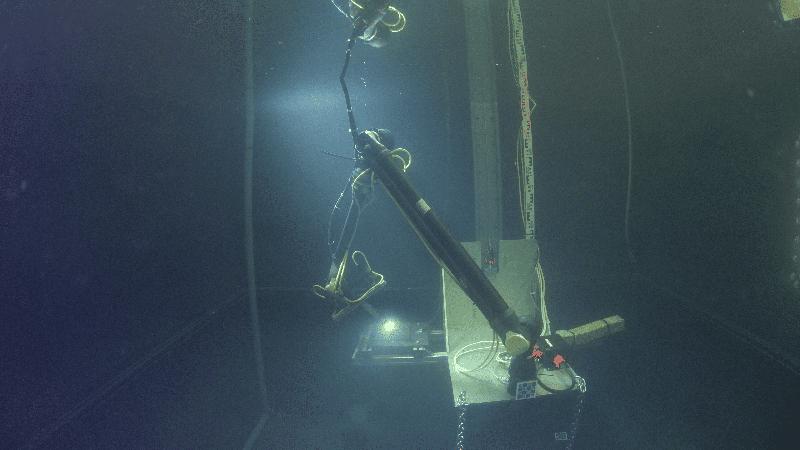
The SPorT project UWS, led by DFKI, demonstrates that maritime AI in Bremen extends beyond port logistics. Together with industry and research partners, a robot-assisted underwater welding process is being tested and further developed under realistic conditions in the port. The system was developed as part of the MARIOW (Maritime AI-Guided & Remote Operated Welding) project, funded by the Federal Ministry for Economic Affairs and Energy, and is intended to support divers in the future during high-risk maintenance work on port facilities, offshore structures, and other metal structures.
All examples demonstrate that in Bremen and Bremerhaven, AI is developed and tested precisely where it is intended to have a concrete impact: in real-world processes, in safety-critical infrastructure, and in collaboration with stakeholders in the port industry. Short distances and strong cooperation ensure that research, technology development, and transfer come together early on. When the international AI community comes to Bremen for the IJCAI-ECAI in August 2026, it will find a location that strengthens precisely this connection.
About the U Bremen Research Alliance
The U Bremen Research Alliance brings together the University of Bremen with thirteen non-university research institutions from all four major German scientific organizations—the Fraunhofer Society, the Helmholtz Association, the Leibniz Association, and the Max Planck Society—as well as the German Research Center for Artificial Intelligence (DFKI). Together, the partner institutions create a coordinated space for research, infrastructure, and innovation—“from the deep sea to outer space.”
Contact:
IJCAI-ECAI 2026 Local Press Office
The Local Press Office of IJCAI-ECAI 2026 coordinates press relations for the conference in Bremen. It is supported by the U Bremen Research Alliance, the German Research Center for Artificial Intelligence (DFKI), and the German Informatics Society (GI), as well as the Publicity Chairs Prof. Dr. Ralf Möller (University of Hamburg, German Informatics Society) and Prof. Dr. Rolf Drechsler (University of Bremen, German Research Center for Artificial Intelligence).
As the central point of contact for the media, the Press Office provides communications support for IJCAI-ECAI 2026 and is available to media representatives from Bremen and throughout Germany for inquiries both now and during the conference.
Email for inquiries: press@2026.ijcai.org
Copyright: Photo material may be used
Weitere Informationen:
https://www.bremenports.de/fileadmin/bremenports/Haefen/Innovation/20240228_Smartport_Statements/SmartportStrategie140324.pdf State of Bremen’s Smartport Strategy
https://www.smartport-livinglab.de/ Smartport Living Lab
https://www.dfki.de/web/forschung/projekte-publikationen/projekt/rest-shareport REST Share Por
https://robotik.dfki-bremen.de/de/forschung/projekte/mariow DFKI MARIOW Project
https://smartport-transfer.de/ Smartport Transfer
Ähnliche Pressemitteilungen im idw
