Jung Foundation Honors Research on Pain Therapy, AI in Cancer Surgery, and the Diagnosis of Rare Diseases
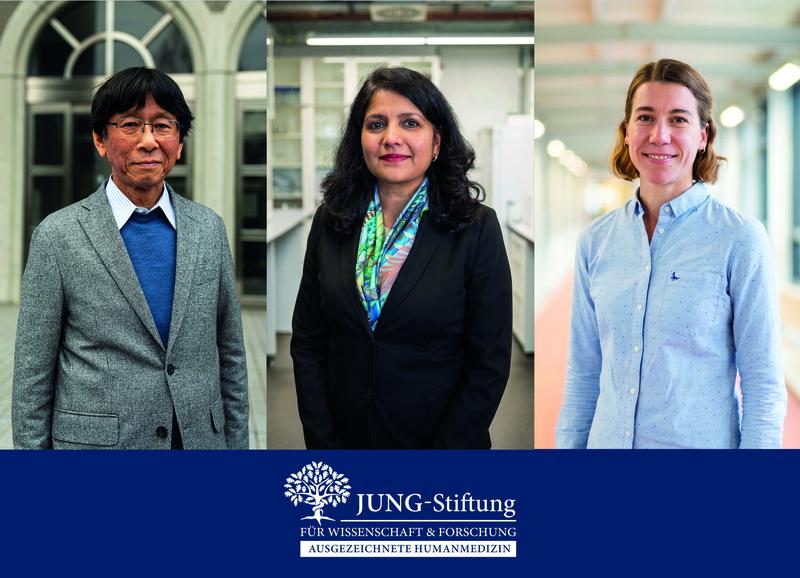
Rohini Kuner (Heidelberg) receives the Jung Prize for Medicine (€300,000)
Fiona Kolbinger (Dresden) is awarded the Jung Career Advancement Award (€210,000)
Taroh Kinoshita (Osaka) is honoured with the Jung Gold Medal for Medicine
Hamburg, May 21, 2026. The Jung Foundation for Science and Research honours three researchers for their work in pain research, AI-assisted cancer surgery, and the diagnosis of rare diseases. The medical awards, endowed with a total of more than €500,000, will be presented this evening in Hamburg.
The 2026 Jung Prize for Medicine is awarded to pharmacologist Rohini Kuner of Heidelberg University. The 2026 Jung Career Advancement Award goes to physician-scientist Fiona Kolbinger from University Medicine Dresden. The 2026 Jung Gold Medal for Medicine is awarded to molecular biologist Taroh Kinoshita of The University of Osaka. The award-winning research shares a common goal: the development of new therapeutic approaches.
Pain Research: Rohini Kuner Receives the Jung Prize for Medicine 2026
Professor Rohini Kuner (55), Institute of Pharmacology, Heidelberg Medical Faculty of Heidelberg University, investigates how the nervous system changes under persistent stimuli and how chronic pain develops as a result. Her work focuses on neuronal plasticity – the ability of nerve cells to adapt structurally and functionally. Her research demonstrates how pain is stored and amplified in the body, opening up new avenues for therapies that are more targeted and provide long-term efficacy. For these findings, Kuner is awarded the Jung Prize for Medicine 2026, endowed with €300,000.
Kuner is originally from India and moved to the USA in 1991 to pursue her PhD. In 1995, her academic career took her to the Heidelberg University, where she completed her habilitation in 2005. Thanks in part to several mentors, the multi-award-winning pharmacologist quickly moved into neuroscience and pain research there. Since 2015, Kuner has been leading a major Collaborative Research Centre that brings together preclinical and clinical research into chronic pain, and within her own multidisciplinary group she focuses in particular on translational research. “I’m happiest when I’m in the lab, right at the heart of the research.”
AI in Cancer Surgery: Fiona Kolbinger Receives the Jung Career Advancement Award 2026
Dr. Fiona Kolbinger (30) works as a physician-scientist at the Department for Visceral, Thoracic and Vascular Surgery at the Carl Gustav Carus and Faculty of Medicine, TUD Dresden University of Technology, at the interface of surgery, data science, and artificial intelligence. Her research project analyzes treatment outcomes in oncologic rectal surgery using causal models. The aim is to identify the root of complications and to enable more precise surgical planning. This research is intended to make procedures safer and improve patient care. For this work, the Jung Foundation awards Kolbinger the Jung Career Advancement Award 2026, endowed with €210,000.
Kolbinger combines clinical practice with data-driven research and international collaboration. Her scientific work has been embedded in Dresden’s interdisciplinary research ecosystem, where she collaborated with the Else Kröner Fresenius Center (EKFZ) for Digital Health at TUD and the National Center for Tumor Diseases (NCT/UCC) Dresden for several years. Since 2023, she has been leading an independent research group at Purdue University, a leading engineering university in the United States, in which physicians, data scientists, and engineers collaborate. Her approach to both research and life is guided by a clear conviction: “Just because no one has taken a certain path before does not mean it will not lead to the goal.”
Rare Diseases: Taroh Kinoshita Receives the Jung Gold Medal for Medicine 2026
Professor Taroh Kinoshita (74), Center for Infectious Disease Education and Research (CiDER), The University of Osaka, elucidated the biosynthetic pathway of so-called GPI anchors. These molecules ensure that proteins are correctly anchored to cell membranes – a fundamental process for the function of many cells. His research has significantly contributed to a better understanding of disease mechanisms, particularly in rare and complex disorders. It provides a foundation for more precise diagnostics and new therapeutic approaches. In recognition of his lifetime scientific achievements, Kinoshita is awarded the Jung Gold Medal for Medicine 2026. The award is accompanied by €30,000 to support an early-career researcher.
Over decades, Kinoshita has shaped molecular biology research and set clear scientific goals early in his career. By elucidating key mechanisms of GPI biosynthesis, he has consistently achieved these aims. Reflecting on his career, he offers a matter-of-fact assessment: “When I stepped back from active research, I had achieved my goals.” Today, he uses his experience to actively support the next generation of researchers.
50 Years of the Jung Prize for Medicine
The Jung Foundation awards its medical prizes annually for outstanding research with clinical relevance. The Jung Prize for Medicine was first awarded in 1976 – exactly 50 years ago. To mark this anniversary, this year’s award ceremony will be accompanied by an official Senate Reception for invited guests at Hamburg City Hall.
Ähnliche Pressemitteilungen im idw
