
New pilot plant combines solar power generation with agriculture
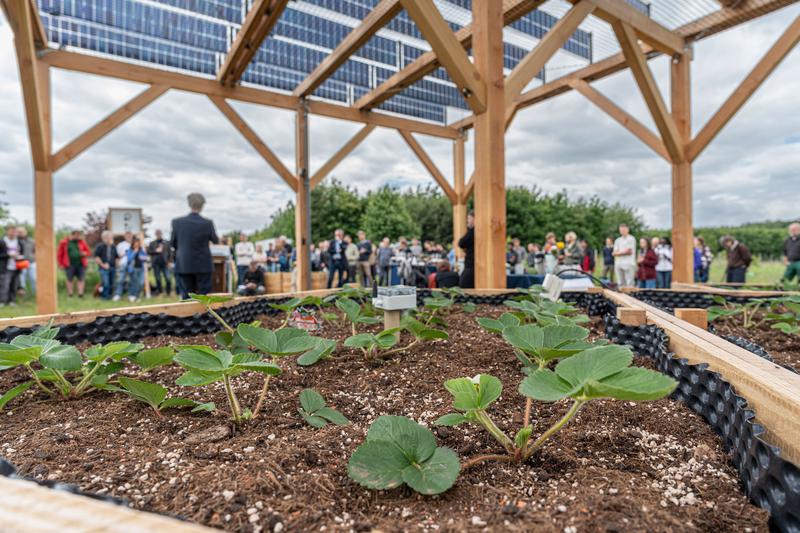
On 20 May 2026, an agrivoltaic pilot plant was inaugurated on the grounds of the Faculty of Engineering at the University of Freiburg. In addition to generating scientific insights, it aims to spark interest in a key future topic in the energy sector. The project is being led by a group of researchers from the University of Freiburg and Fraunhofer ISE.
Agrivoltaics, or Agri-PV for short, combines agricultural production with the generation of solar power. Against a backdrop of limited land availability and the challenges posed by the energy transition, Agri-PV is regarded as a promising technology for the energy supply of the future. An interdisciplinary research group on the topic of Agri-PV was formed at the University of Freiburg in October 2025; it is being funded by the Freiburg Institute for Advanced Studies (FRIAS) with €35,000 until December 2026. The FRIAS Agri-PV project group comprises representatives from the fields of biology, computer science, engineering, forestry and economics, and collaborates with researchers from the Fraunhofer Institute for Solar Energy Systems ISE (Fraunhofer ISE).
“What makes this project group particularly valuable is that the University of Freiburg and Fraunhofer ISE are combining their expertise in a targeted manner. Fraunhofer ISE provides application-oriented research, PV module technologies and many years of experience in the field of agri-PV, whilst the University contributes fundamental research from various disciplines. Together, we can develop new technological solutions that explain plant growth processes more precisely and provide a better understanding of how Agri-PV fits into political and social frameworks,” said the spokesperson for the FRIAS Agri-PV project group, Prof. Dr. Tim Krieger, at the inauguration of an Agri-PV pilot plant on the grounds of the University of Freiburg’s Faculty of Engineering on 20 May 2026.
The pilot plant was developed by the Centre for Renewable Energy (ZEE) at the University of Freiburg, whose director, Prof. Dr Moritz Diehl, is also a member of the FRIAS Agri-PV project group, and has now been completed as part of the funding phase. Initially, strawberries are to be grown in raised beds between the photovoltaic modules, whilst electricity is generated above them. Sensors will record factors such as light availability, air temperature, soil moisture and humidity, and compare these values with an unshaded reference area. “The pilot plant serves not only as a research tool, but also as an eye-catcher designed to make the topic tangible for students and visitors,” says Diehl. “The complete decarbonisation of our economy continues to require a significant expansion of PV installations, but we do not yet know exactly how this can be achieved in the most landscape-friendly way. My dream is that here in Freiburg, over the coming years, we will set up many different new agri-PV systems as demonstrators that combine aesthetics, ecology, grid-friendly electricity generation and agricultural use in various ways, to help society find acceptable pathways to sustainable energy production.”
FRIAS project group strengthens interdisciplinary collaboration
Through the ‘FRIAS Project Groups’ funding programme, FRIAS is strengthening interdisciplinary collaboration at the University of Freiburg. The programme brings together researchers from different disciplines to develop forward-looking research ideas at a very early stage. It provides a space for experimental approaches and new perspectives that go beyond established research structures.
Info box Agri-PV
The concept of agri-PV can be traced back to the physicist Adolf Goetzberger, who conducted research at Fraunhofer ISE in the early 1980s and, in his essay “Kartoffeln unter dem Kollektor” (“Potatoes under the Collector”), first developed the idea of arranging solar collectors over farmland in such a way that farming could continue beneath them. Research into agri-PV has increased significantly, particularly in the 2010s. A key milestone is the publication of the German pre-standard DIN SPEC 91434 in 2021, which for the first time defines more precisely what constitutes an agri-PV system. A key criterion is that, following the construction of the agri-PV system, the land must still yield at least 66% of the agricultural output that would be possible without additional energy generation.
Members of the FRIAS project group Agri-PV
Prof. Dr Tim Krieger (Spokesperson)
Holder of the Wilfried Guth Endowed Chair in Regulatory and Competition Policy at the University of Freiburg
Dr Max Trommsdorff (Deputy spokesperson)
Agri-PV expert at the Fraunhofer ISE and research associate at the Chair of Regulatory and Competition Policy at the University of Freiburg
Prof. Dr Moritz Diehl
Head of the Systems Control and Optimization Laboratory at the Department of Microsystems Technology (IMTEK) at the University of Freiburg and Managing Director of the Centre for Renewable Energy (ZEE) at the University of Freiburg
Prof. Dr Stefan Glunz
Professor of Photovoltaic Energy Conversion at the University of Freiburg and Director of the Photovoltaics Division at the Fraunhofer Institute for Solar Energy Systems ISE.
Prof. Dr Alexandra-Maria Klein
Holder of the Chair of Nature Conservation and Landscape Ecology at the University of Freiburg
Dr Christoph Morhart
Researcher at the Chair of Forest Growth and Dendroecology at the University of Freiburg
Contact
University and Science Communications
University of Freiburg
Tel.: +49 761 203 4302
E-Mail: kommunikation@zv.uni-freiburg.de
Weitere Informationen:
https://uni-freiburg.de/en/new-pilot-plant-combines-solar-power-generation-with-agriculture/
Ähnliche Pressemitteilungen im idw
