
SynCell-nExUs: Training Europe's Next Generation of Leaders in Synthetic Cell Research
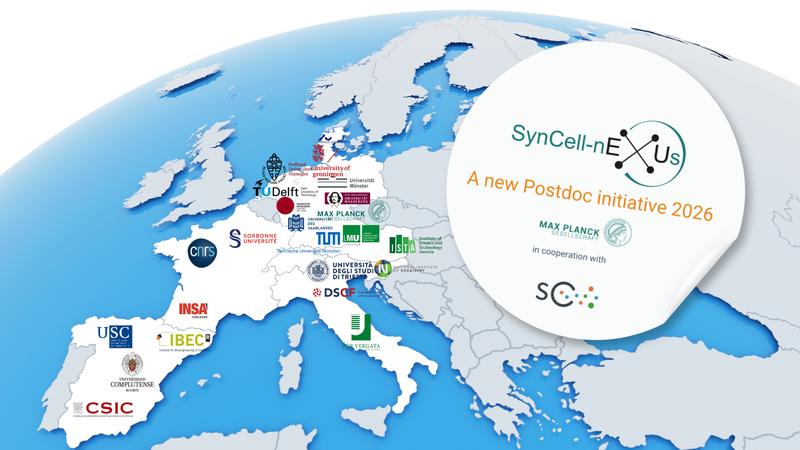
On 1 August 2026, the Max Planck Society (MPG) will launch the SynCell nExUs postdoctoral programme. The five-year programme, coordinated by the Max Planck Institute (MPI) of Biochemistry and the MPI for Terrestrial Microbiology in collaboration with 22 research institutions across Europe, offers 40 postdoctoral positions in nine countries. Co-funded by the European Commission under “Horizon Europe” and through MSCA-COFUND, the programme aims to train the next generation of leaders in synthetic biology and related disciplines and offer them diverse career opportunities.
What is life? How does it function? And how can insights from living systems, particularly cells, help us develop efficient and sustainable technologies? From capturing carbon dioxide to producing biofuels and designing new medicines, synthetic cell research holds the potential to address these questions.
Synthetic cell researchers develop cell-like systems from scratch that mimic the essential functions of living cells, such as their ability to replicate, convert nutrients into energy, process information, learn, and adapt. This represents one of the most exciting challenges of our time, with the potential to lead to major applications in the health, materials, energy, environment and food sectors. While Europe is already at the forefront in this field, future progress and technological development require new interdisciplinary approaches, long-term and larger-scale collaborations, and new talents.
A European programme to develop new talents
Forty three-year postdoctoral positions across nine countries will be offered to train new talent in synthetic biology and related disciplines. The program is jointly coordinated by the MPI of Biochemistry and the MPI for Terrestrial Microbiology, in collaboration with 22 research institutions throughout Europe.
“Living cells are incredibly complex, making it very difficult to work with them and particularly, to build technology based on them. Recreating functional cells from simple building blocks is a promising approach to a more quantitative understanding of life processes. However, this requires interdisciplinary and intersectoral competencies. SynCell nExUs will provide an outstanding research environment to develop the next generation of leaders in synthetic cell research”, explained Professor Petra Schwille, Director at the MPI of Biochemistry. She leads the SynCell-nExUs network together with Professor Tobias Erb, from the MPI for Terrestrial Microbiology, who added: “Importantly, SynCell nExUs will not only enable our fellows to explore exciting new scientific directions, but also offer career opportunities outside academia through cooperation with various partners in the private sector.”
Over the next three years of their project, participants will engage in skill-building training modules, get secondment opportunities, and cooperate with SynCell-nExUs’s industrial partners to explore more applied research.
Recruitment will be conducted in two rounds, starting later this year, and coordinated by the MPI of Biochemistry and the MPI for Terrestrial Microbiology, with support from the European Synthetic Cell Initiative (SynCellEU). Applicants may express their preferences regarding supervisors and are encouraged to propose their own innovative project ideas. Final placements will be determined by a selection committee.
A European programme to boost research and innovation
Tobias Erb is excited about the European perspective of SynCell-nExUs: “With this programme, we are keeping Europe at the forefront of synthetic cell research. Beyond the excellent career prospects for our fellows, this programme will reinforce existing research collaborations in Europe and allow us to tackle the most fundamental questions together across more than eight countries.”
SynCell-nExUs will cover four key research themes: metabolism and energy, division and replication, information processing and evolution, and enabling technologies.
MPG and its partner research organisations are also committed to supporting new technological developments and applications. “By stimulating the development of new products, processes and services across various sectors, the newly gained knowledge and tools will help accelerate a competitive and sustainable economy and drive societal transformation,” Petra Schwille commented.
About the European Synthetic Cell Initiative
The SynCellEU is a network of excellent European laboratories, institutions and companies that have joined forces to advance synthetic cell research and accelerate the development of technologies resulting from this research.
About the Marie Skłodowska-Curie COFUND action
The Marie Skłodowska-Curie Actions (MSCA) represent the European Union's key funding programme for doctoral education and postdoctoral training, encouraging researchers to collaborate and develop their work across borders, sectors and disciplines.
The COFUND action provides funding for regional, national and international programmes for training and career development, through co-funding mechanisms. The COFUND Postdoctoral Programmes propose individual advanced research training and career development fellowships for postdoctoral researchers.
---
Glossary:
SynCell-nExUs: Abbreviation for: SynCellEU programme for recruiting next generation European leaders in Synthetic Cell research
Wissenschaftlicher Ansprechpartner:
Sara Šreibr, PhD
Grants Office
Max Planck Institute of Biochemistry &
MPI for Biological Intelligence
Am Klopferspitz 18
82152 Martinsried/Planegg
Email: sreibr@biochem.mpg.de
www.biochem.mpg.de/grants_office
Originalpublikation:
https://www.biochem.mpg.de/syncell-nexus-launch-of-a-new-postdoctoral-programme - Press release of the website of the MPI of Biochemistry
Ähnliche Pressemitteilungen im idw
