
Trees in Cattle Pastures Boost Biodiversity
Global Study Shows Strong Positive Impact of Agroforestry on Biodiversity—But Restoration Measures Are Not a Substitute for Forest Conservation
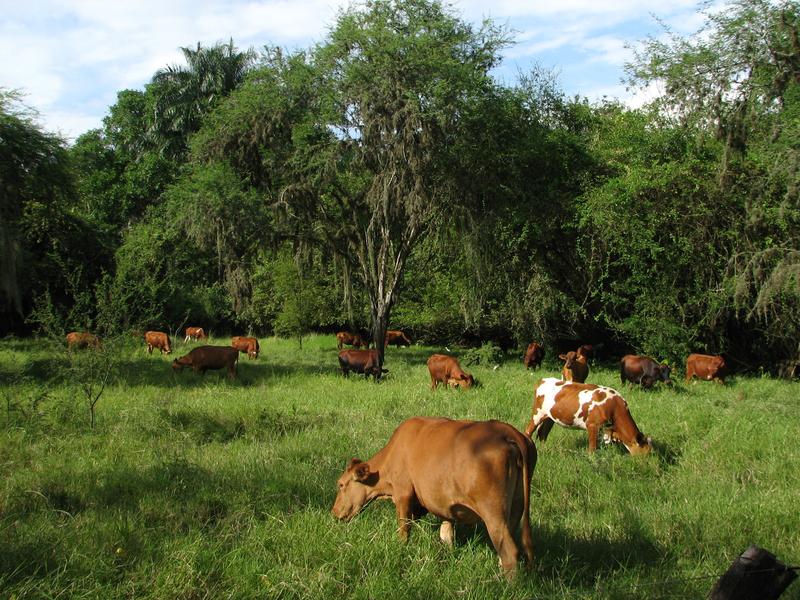
Cattle ranching is the biggest driver of tropical deforestation, but it is also a key livelihood for nearly one billion smallholder farmers. A global study by Justus Liebig University Giessen (JLU) shows that this tension can be eased by reintroducing trees into pastureland. Planting trees in cattle pastures nearly doubles biodiversity compared to conventional pastures. However, these plantings cannot replace the protection of native forests. The study was published in the journal “Ecological Applications.”
This study offers the first global quantitative synthesis of silvopastoral systems, which refer to farms that intentionally integrate trees into pastureland. In their meta-analysis of 45 studies from 15 countries and four biogeographic regions, the researchers found that silvopastoral systems host 44 percent more species and nearly twice as many individual animals as treeless pastures. In terms of species richness, they often approach the diversity levels of nearby native forests.
“We knew that trees make a difference,” says Dr. Ricardo Perez-Alvarez of the Institute of Animal Ecology and Systematics at JLU, the study’s lead author. “But we were surprised that this difference was so great—and across so many different landscapes.” Agroforestry has long been promoted as a tool for nature conservation, though mostly in connection with the cultivation of coffee or cacao. “We show here that this logic also applies to cattle farming,” says Dr. Perez-Alvarez. “Pastureland covers a far larger area than cropland. Converting even a fraction of degraded pastures into silvopastoral systems could yield biodiversity benefits on a scale that is simply hard to match with other agroforestry systems.”
Not all species benefit equally
The study also showed that not all species benefit equally from trees in pastures. The greatest increases were observed in plants (89 percent higher) and small invertebrates that inhabit the soil (81 percent higher). The latter include insect larvae, earthworms, isopods, snails, and arachnids. These animals and plants are sensitive to their environment and move very little, if at all. For insects, the researchers recorded a 68 percent increase. In contrast, birds, mammals, and soil microorganisms showed no significant difference between pastures with and without trees.
Geographically, these benefits were most pronounced in tropical and subtropical regions. Silvopastoral systems here exhibited 40 percent (tropical regions) and 42 percent (subtropical regions) higher biodiversity. “This is particularly significant because these landscapes have experienced the greatest loss of biodiversity due to the expansion of cattle ranching,” explains Dr. Perez-Alvarez. In Mediterranean and temperate regions, however, pastures with and without trees exhibited comparable biodiversity levels. In their study, the researchers only examined areas where pastures are intermixed with native forest—savannas or natural grassland regions were not included.
A tool for restoration—not a substitute for forests
Although silvopastoral systems and native forests exhibited similar biodiversity levels across all regions, they are not ecologically equivalent. “Native forests remain irreplaceable refuges for rare species, forest specialists, and animals that require large, undisturbed habitats—something that managed agricultural operations cannot fully provide,” emphasizes Prof. Dr. Emily Poppenborg Martin, Professor of Animal Ecology at JLU and senior author of the publication. “Rather than being seen as a substitute for forest conservation, silvopastoral systems should be understood as an effective complement to it. They create secondary habitats between forest fragments, improving landscape continuity and restoring the ecological function of degraded pastures. In this way, these systems can enhance the conservation value of surrounding protected areas.”
This distinction is significant for policymakers seeking to achieve ambitious global restoration goals. “Integrating trees into cattle pastures represents a scientifically sound strategy for restoring biodiversity on agricultural land, but only if it is implemented strategically and with consideration for geography, species, and local context,” says Prof. Poppenborg Martin. “It is also important that the promotion of silvopastoral systems does not inadvertently contribute to further deforestation.” However, when carefully implemented, silvopastoral systems offer a promising way to reconcile the competing demands of food production and biodiversity conservation in the world’s most threatened landscapes.
Wissenschaftlicher Ansprechpartner:
Dr. Ricardo Perez-Alvarez
Institute of Animal Ecology and Systematics
E-Mail: Ricardo.Perez-Alvarez@allzool.bio.uni-giessen.de
Originalpublikation:
Perez-Alvarez, Ricardo, Julián Chará, Lauren D. Snyder, Michelle Bonatti, Stefan Sieber, and Emily A. Martin. 2026. “Meta-Analysis Shows Overall Benefits of Cattle Silvopastoral Systems for Biodiversity in Fragmented Forest Landscapes.” Ecological Applications36(3): e70255. https://doi.org/10.1002/eap.70255
Ähnliche Pressemitteilungen im idw
