IOW research uses AI and drones to improve early warning systems for Vibrio bacteria in the Baltic Sea

The presence of the marine bacterium Vibrio vulnificus, which is potentially dangerous to humans, can now be predicted up to five weeks in advance in the Baltic Sea using artificial intelligence (AI). A research team led by the Leibniz Institute for Baltic Sea Research Warnemünde (IOW) reached this conclusion by combining high-resolution environmental, satellite, and microbiome data in an AI-based analysis. The study, recently published in “Water Research,” shows that this approach allows for a much more precise identification of risk periods than was previously possible. Furthermore, the IOW is testing an AI-supported drone measurement program for local Vibrio warning systems.
Vibrio bacteria are naturally found in marine bacterial communities and are particularly prevalent in warm coastal and brackish waters. There are over 150 known species, about 10 % of which are pathogenic and cause infections in humans, fish, or shellfish. Vibrio vulnificus is one of these. The pathogen can enter the body through even the smallest skin wounds while swimming and, in the worst case, cause life-threatening infections or sepsis. Older people and those with weakened immune systems are particularly at risk. Since rising sea temperatures favour the reproduction of vibrios, the Baltic Sea is now considered one of Europe’s high-risk regions for Vibrio infections.
High-resolution environmental data provide AI with crucial early warning signals
In the study recently published in “Water Research”, the IOW team sampled a total of 15 monitoring stations along the Baltic Sea coast and the Warnow estuary in the Rostock area from April 2022 to May 2023. Twice a week, they collected water, which they analysed using molecular biological and microbiological methods. The measurements were supplemented by environmental, weather, and satellite data on water temperature, salinity, nutrients, chlorophyll levels, and currents.
The researchers analysed a good 1,500 water samples in total. This revealed a clear seasonal pattern: They found Vibrio vulnificus almost exclusively during the summer months between late June and early September. The bacterium was particularly common at water temperatures above 18 °C and salinity levels between approximately 12 and 18 ‰ – conditions that frequently occur in the southern Baltic Sea during the summer.
The data set’s greatest strength lay not only in the sheer number of measurements, but also in their high temporal and spatial resolution. This allowed the researchers to track in detail how microbial communities and environmental conditions changed prior to an increased occurrence of Vibrio vulnificus. “We were able to show that the occurrence of the potentially dangerous vibrios is signalled early on by characteristic ecological changes,” explains the study’s lead author, Conor Christopher Glackin, who is pursuing his PhD on this topic at the IOW.
The research team used these biological early warning signs to specifically train various AI models. The goal was for them to predict whether and when vibrios would appear at a given location at a later point in time. “Artificial intelligence can recognize exactly these kinds of patterns and use them for predictions,” explains Glackin. The best AI-based models provided reliable forecasts of the occurrence of Vibrio vulnificus up to four or five weeks in advance. Models that took into account changes in microbial communities in addition to physical environmental factors proved to be particularly effective.
Notably, freely available satellite data also showed great potential for operational early-warning systems. The analyses suggest that microbial succession processes following massive algal blooms play a key role because the decomposition of large quantities of phytoplankton releases organic substances that create favorable Vibrio growth conditions.
“Our findings show that microbiological processes in coastal waters can be predicted much more accurately than previously thought: For the first time we are able to make specific predictions about the risk periods for Vibrio bacteria throughout the year,” says Matthias Labrenz, environmental microbiologist at the IOW and study leader. “This brings an early-warning system within practical reach that can support health authorities or beach resorts in making specific warning decisions.”
The aim: An AI-based, locally precise warning systems supported by drones
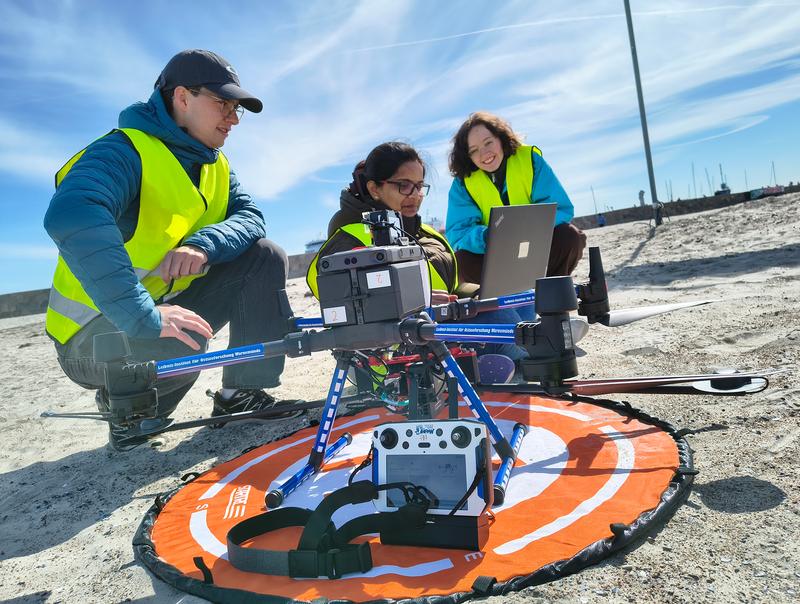
The IOW is now also working on an application-oriented version of such a system: Since April, researchers led by environmental microbiologist Daniel Herlemann have been testing an AI-supported drone monitoring program for the local assessment of Vibrio risks along the coast of the German state of Mecklenburg-Western Pomerania. Drones collect high-resolution environmental data such as water temperature and salinity as well as information on currents and blue-green algae blooms in the bathing zone off Warnemünde Beach. The data are automatically transmitted to a server and evaluated there by AI. The goal is to develop a local Vibrio environmental index with a color-coded system that can provide a site-specific risk assessment within minutes after a drone flight.
The KIVib Coast project (short for “Digitalized and AI-driven Vibrio assessment of coastal waters”) builds directly on the findings of the recent study and earlier IOW analyses on the occurrence of vibrios. In the long term, the researchers hope that previously rather general warnings can be replaced by locally precise and rapidly updated risk assessments. “In light of climate change, the issue is becoming increasingly relevant: Warmer summers are extending the annual Vibrio season, while at the same time demographic trends are increasing the number of people at particularly high risk. In the German Baltic Sea region, a major tourist destination with millions of visitors every year, it is therefore important – both for public health and from an economic perspective – to be able to distinguish risk periods as clearly as possible from generally safe conditions for swimming and water sports,” Matthias Labrenz concludes.
IOW Media contact:
Dr. Kristin Beck | Tel.: +49 (0)381 – 5197 135 | presse@iow.de
The Leibniz Institute for Baltic Sea Research Warnemünde (IOW) investigates natural and anthropogenic changes in coastal and marginal seas using a system-wide and interdisciplinary approach, ranging from fundamental to applied research. The Baltic Sea serves as an ideal case study on the institute’s doorstep. An important mission of the IOW is to engage in knowledge-based dialogue with policy-makers, stakeholders, and society, thereby contributing to the sustainable development of coastal seas. https://www.iow.de
Wissenschaftlicher Ansprechpartner:
Prof. Dr. Matthias Labrenz | Tel.: +49 (0)381 5197 - 378 | matthias.labrenz@iow.de
Dr. Daniel Herlemann | Tel.: +49 (0)381 5197 - 356 | daniel.herlemann@iow.de
Originalpublikation:
Conor Christopher Glackin, David Riedinger, Erik Zschaubitz, Lukas Vogel, Theodor Sperlea, Heike Benterbusch, Clara Nietz, Matthias Labrenz (2026): AI-driven forecasting of Vibrio vulnificus in the Southern Baltic Sea using high-resolution data. Water Research 297, 125647. https://doi.org/10.1016/j.watres.2026.125647
Ähnliche Pressemitteilungen im idw
