
Improving the Availability of mRNA-Based Drugs
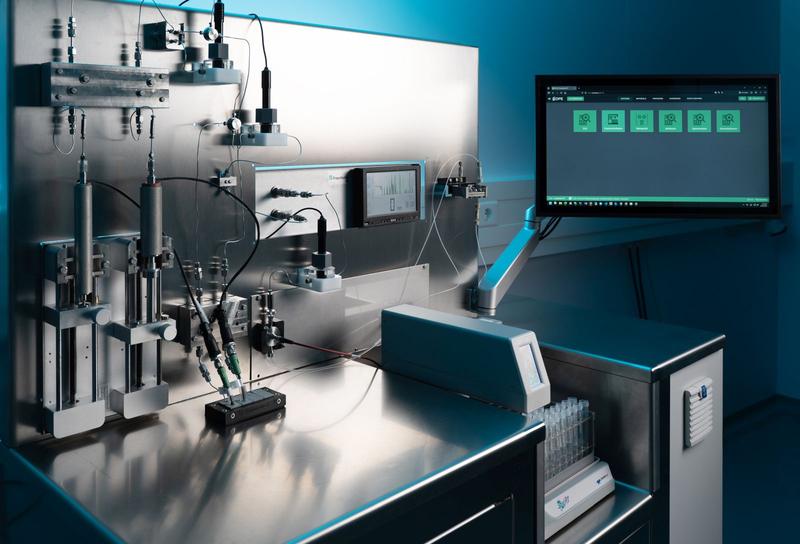
Innovative mRNA-based therapeutics and vaccines offer hope in the fight against cancer, genetic disorders and infections. However, their development and production are complex, slow and difficult to scale. Seven Fraunhofer institutes are working to change this situation. In the RNAuto project, they have now developed an automated, digitally controlled production system that is fast, flexible and cost-effective.
Medical research has made great progress in developing mRNA-based drugs (RNA is ribonucleic acid, and the “m” stands for “messenger”). Their active ingredients can transport a protein’s blueprint, i.e., its genetic information, into cells. They are used in medicine in vaccines, gene and cell therapies, which are all highly effective treatments for infectious and genetic diseases or cancer.
However, production cannot keep pace with rising demand. The production of these innovative active ingredients is also complex, requiring frequent manual checks and intermediate steps.
In the RNAuto project, Fraunhofer researchers have developed a solution that enables automated, digitally controlled production in a modular system. Quality control is integrated in the system and takes place during ongoing production. mRNA-based therapeutics can thus be manufactured many times faster compared to conventional methods, while larger quantities can be produced in a single pass.
The RNAuto project involved the collaboration of a total of seven Fraunhofer institutes. The project was headed by Ulrike Köhl, an expert in immunooncology and Director of the Fraunhofer Institute for Cell Therapy and Immunology IZI in Leipzig. Drawing on many years of experience from multiple past projects, the research teams at Fraunhofer IZI offer deep expertise in molecular biological design and the development of bioprocesses for novel drugs. “Among other things, the project produced a high-quality process for mRNA development for cell and gene therapies,” explains molecular biologist Sandy Tretbar.
Protective nanocapsules for mRNA-based active ingredients
The mRNA-based active ingredients are sensitive and degrade quickly. They are therefore enclosed in a protective lipid capsule. The structure of lipid nanoparticles is similar to that of cell membranes, enabling them to fuse with the cell and release the active ingredient.
During production, a micromixer is used to continuously formulate the mRNA molecules with lipids into lipid nanoparticles under controlled conditions. The particles are then stabilized in solution, neutralized and filtered. The final product is generated in a single continuous process next to the production line with no interruptions or intermediate checks.
Each component of the system is assigned a digital twin that holds its technical attributes. The digital twin collects data from the integrated sensors during production. The most important elements are the micromixer that serves as the formulation module and the DLS (dynamic light scattering) analysis that yields information on the size and distribution of the nanoparticles, acting as sensor-based quality control. These technology modules were developed and provided by the Fraunhofer Institute for Microengineering and Microsystems IMM. The integration of quality control in the bioprocess eliminates the need to interrupt the process to manually collect and analyze samples.
“All process data is systematically recorded and stored in structured digital documentation, establishing a strong foundation for the data-driven optimization of subsequent production cycles,” explains researcher Rolf Hendrik van Lengen from the Fraunhofer Institute for Experimental Software Engineering IESE. Niels König from the Fraunhofer Institute for Production Technology IPT, where the system prototype was built, adds: “The modular design of the system enables flexible adaptation to new bioprocesses and different variants of an active ingredient.”
Cost-effective production
The Fraunhofer researchers have focused on optimizing product and process quality in the RNAuto project, paving the way for fast, scalable and cost-effective production. The relevant standards in accordance with good manufacturing practice (GMP) were already accounted for in every manufacturing step to ensure safety and quality without compromise.
The RNAuto technology platform is ideal for drug developers and manufacturers looking to develop variants of an active ingredient in gene or cell therapy or a modified vaccine and start corresponding test series. For this purpose, customized bioprocesses and production solutions can be offered to industrial customers for rapid development of new mRNA-based active ingredients.
Weitere Informationen:
https://www.fraunhofer.de/en/press/research-news/2026/june-2026/improving-the-availability-of-mrna-based-drugs.html
Ähnliche Pressemitteilungen im idw
