Fraunhofer IST expands process chain for high-performance boride coatings

When glowing-hot steel is forged or precision components with near-net-shape profiles are manufactured from high-temperature materials, tools are subjected to extreme stresses. High temperatures, wear, and aggressive media significantly determine their service life. Modern surface technologies therefore play a central role in efficient, cost-effective, and resource-conserving production processes. This is precisely where the Fraunhofer Institute for Surface Engineering and Thin Films IST comes in. With an expanded infrastructure, the institute can now map the entire process chain for the development of boride-based high-performance surfaces at its own site.
For industrial project partners and clients, this means that all relevant process steps can be developed and tested in an integrated, reproducible, and application-oriented manner – from thermochemical diffusion treatments and modern coating technologies to high-temperature tests under realistic conditions.
Modernized PECVD system expands coating capabilities
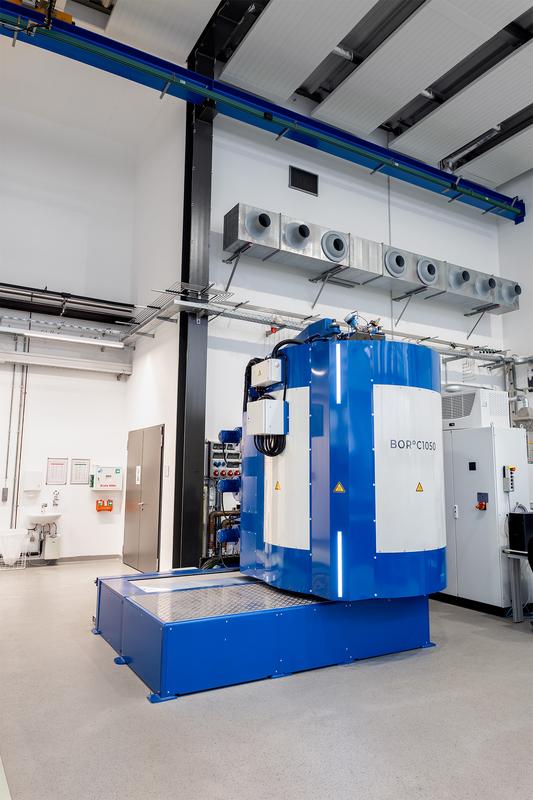
The centerpiece is a completely refurbished PECVD system, which will be put back into operation by mid-year with modernized equipment. In addition to a modern control system, both visualization and data acquisition systems have also been updated. The integrated and now expanded precursor system enables the development of new multi-component coatings, such as nanocomposite layers based on titanium, silicon, boron, carbon, and nitrogen (Ti-Si-B-C-N). These coatings are characterized by high hardness, thermal stability, and oxidation resistance up to approximately 900 °C. The comparatively low coating temperatures of around 520 to 540 °C also allow the uniform coating of complex-shaped components – a clear advantage for demanding industrial geometries.
To further improve mechanical stability, coating processes can be combined with upstream treatment steps, e.g., in so-called duplex processes. In these processes, a diffusion zone created beforehand in the edge area ensures a stable transition between the substrate and the coating.
Gas-phase boriding enables precisely controllable diffusion processes
In addition, a completely newly developed gas boriding system is available at the site. It enables the development and optimization of boron diffusion processes from the gas phase using boron trichloride (BCl₃) at temperatures up to 1050 °C. Compared to solid- or paste-based methods, gas-phase boriding offers decisive advantages: Boron activity and layer growth can be precisely controlled via gas composition through defined addition of hydrogen and nitrogen. This allows highly accurate process control and increases reproducibility. At the same time, the process does not require plasma excitation, which simplifies the equipment design and reduces investment costs. The resulting diffusion layers are also characterized by good material adhesion and outstanding tribological properties at high temperatures, which can reduce wear and extend maintenance intervals or tool replacement cycles in many technical applications.
Following the boriding process, the mechanical properties of steel materials are optimally adjusted through hardening and tempering, and further increases in hardness are achieved through phase transformations. For nickel-based materials, heat treatment steps for precipitation hardening can also be integrated directly into the treatment process; post-hardening is not required. Other material classes, such as CoCrMo or Mo alloys, can also be gas borided without difficulty.
Dry electropolishing as a supplementary process step
For a high-gloss polish or to specifically adjust the surface topography, the process chain can also be supplemented with dry electropolishing. The method is suitable both for polishing complex geometries prior to subsequent surface treatment and for finishing the surface of applied coatings. This enables the reproducible achievement of very high surface quality levels, ranging up to Rz ≤ 0.5 µm depending on the material and initial condition. A dry electrolyte granulate with a low acid content is used, which distinguishes the process from conventional wet chemical methods through its good automatability, high surface quality requirements, low material removal, and more environmentally friendly process control.
High-temperature testing under realistic operating conditions
An additional component of the expanded process chain is a new high-temperature vacuum furnace. It enables testing at temperatures up to 1600 °C and pressures below 10⁻⁵ mbar, as well as in defined atmospheres, such as hydrogen or inert gas mixtures. In addition, a high-temperature tribometer is available, which can be used to specifically investigate the tribological behavior of materials, coatings, and diffusion layers to determine friction coefficients and wear patterns at temperatures up to 1000 °C. This allows customers and project partners to evaluate the performance of materials, coatings, and diffusion layers under realistic operating conditions even before components enter production.
Efficiency gains for industrial applications
The improved surface properties can contribute to efficiency gains in numerous industrial applications. For example, forging tools in hot forming can be used significantly longer, or in copper extrusion processes, material adhesion and scrap rates can be reduced. Further applications can be found, for instance, in the manufacture of high-quality aluminum components, in the bending of stainless steel, or in the production of precision fittings and valves.
In addition, the Fraunhofer IST is opening up new fields of research and development with its new infrastructure. New gaseous precursor materials enable the development of further nanocomposite coatings in carbon-free quaternary systems such as Ti-Si-B-N. In addition, the institute is expanding its expertise in electrochemical characterization to enable the early evaluation and targeted optimization of the corrosion behavior of surfaces.
With its expanded infrastructure, Fraunhofer IST offers an integrated development platform – from the initial idea through process development to validation under realistic conditions. This shortens development times and accelerates the transfer of highly durable surfaces into industrial applications.
Weitere Informationen:
https://www.ist.fraunhofer.de/en/press-media/2026/fraunhofer-ist-expands-process-chain-for-high-performance-boride-coatings.html?utm_campaign=pkbs-i
Ähnliche Pressemitteilungen im idw
