
How chickens got their many colours
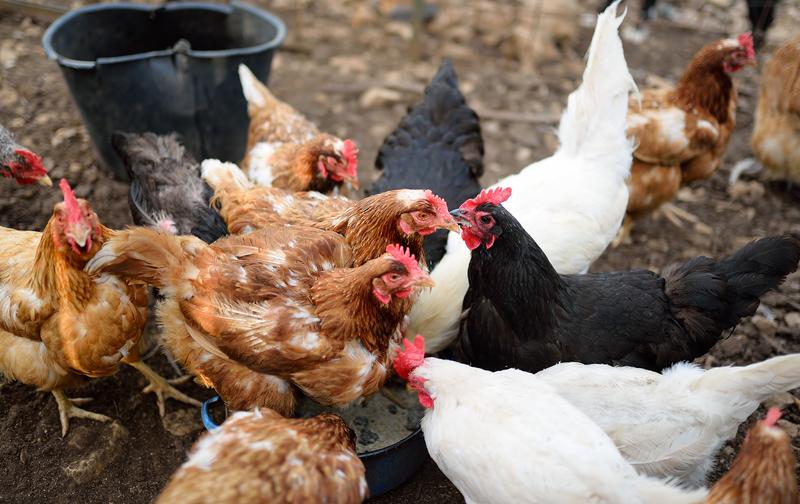

From snow white and jet black to golden brown – domestic chickens display a wider range of plumage colours than almost any other livestock species. A new international study, with researchers from Leipzig University playing a key role, explains why: a single gene is capable of producing this full spectrum. The study provides an example of how genetic diversity and visible traits can emerge within a short evolutionary period. The findings have now been published in the journal PNAS.
A research team from Leipzig University, Charité – Universitätsmedizin Berlin and Uppsala University in Sweden has shown how the remarkable colour diversity of domestic chickens arises at the molecular level. The study focused on the melanocortin-1 receptor (MC1R), a protein molecule that controls colour formation in the skin cells of vertebrates. The gene that encodes this pigmentation receptor has undergone an unusually high degree of change in domestic chickens since their domestication. The research team identified 18 different variants of the gene – a level of diversity not found in wild birds. “We show that the accumulation and recombination of mutations within a single gene has given rise to numerous new variants, with directly visible effects on the birds’ appearance,” says PD Dr Claudia Stäubert, a researcher at Leipzig University's Rudolf Schönheimer Institute of Biochemistry.
MC1R functions like a molecular switch: depending on how active it is, a cell produces either more dark pigment or more light pigment. Using cell cultures, the researchers demonstrated that individual gene mutations can either increase or decrease the activity of this switch. When several mutations occur together, they can reinforce or counteract one another, creating colour patterns that none of the individual changes could produce on their own.
The research originated from a genome study conducted by Uppsala University, in which the genomes of more than 10,000 chickens were analysed. The study identified MC1R as a particularly variable genetic locus. At Leipzig University’s Rudolf Schönheimer Institute of Biochemistry, PD Dr Claudia Stäubert and Aenne-Dorothea Liebing contributed their extensive expertise in the functional analysis of receptor molecules to elucidate the relationship between genetic variants of MC1R, their effects on receptor function and the resulting plumage colours. Complementing this work, the team led by Dr Patrick Scheerer at Charité – Universitätsmedizin Berlin investigated the structural consequences of the identified mutations. The collaboration between Leipzig and Berlin that led to this publication was established within the framework of Collaborative Research Centre 1423, Structural Dynamics of GPCR Activation and Signaling, which is based at Leipzig University.
The study demonstrates how new genetic variants can emerge and spread – a fundamental principle of evolution that is particularly evident here over the relatively short evolutionary timespan of just a few thousand years. The findings are not only valuable for basic research but could also help animal breeders better predict and selectively influence colour traits. In future studies, the researchers plan to investigate whether evolutionary patterns similar to those observed in domestic chickens also occur in other vertebrates.
Translation: Matthew Rockey
Wissenschaftlicher Ansprechpartner:
PD Dr. rer. nat. Claudia Stäubert
Faculty of Medicine, Leipzig University
Group leader, Rudolf Schönheimer Institute of Biochemistry
Email: claudia.staeubert@medizin.uni-leipzig.de
Tel.: +49341 9722 157
Originalpublikation:
Original publication in PNAS: Ultrarapid MC1R protein and associated plumage color evolution in the domestic chicken. DOI: https://www.pnas.org/doi/10.1073/pnas.2605288123
Weitere Informationen:
https://research.uni-leipzig.de/sfb1423/
Ähnliche Pressemitteilungen im idw
