
When the map needs an update – A Bonn study shows how the brain stores new information on familiar routes
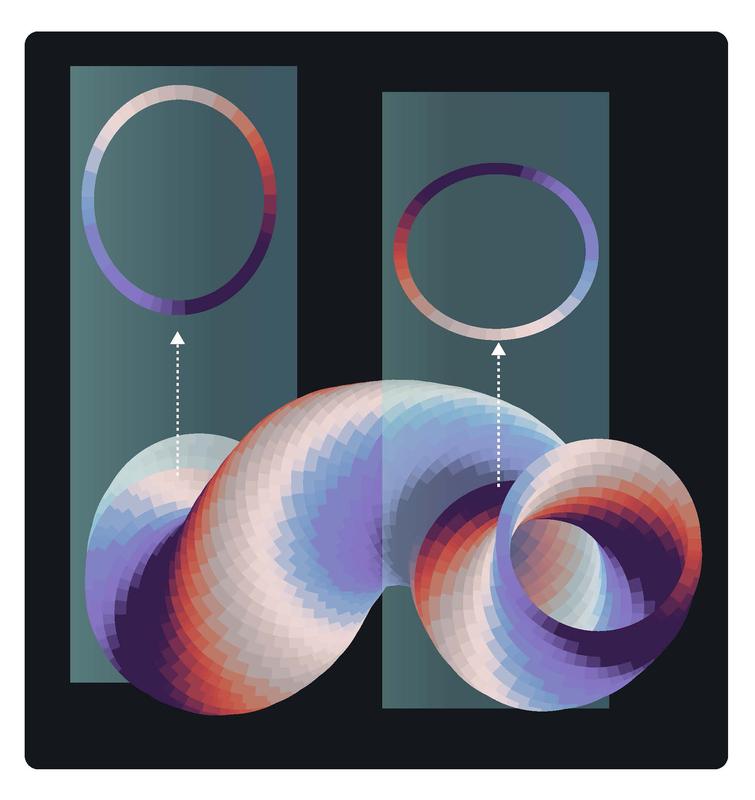
Every time we move through a familiar environment, the hippocampus consults an internal map, a detailed spatial representation that is built up through repeated experience. But what happens when something unexpected occurs on a well-known route? Researchers at the University Hospital Bonn (UKB) and the University of Bonn were able to demonstrate in a mouse model that the brain does not redraw its maps from scratch. Instead, it annotates them: preserving the underlying spatial layout while overlaying new information on top of the existing map. Their findings have now been published in the journal PNAS.
The hippocampus, the brain’s working memory, is shaped like a seahorse and is located in the temporal lobe of both the left and right hemispheres. Hippocampal CA3 circuits, which link information and support the recognition of memories, keep their spatial maps stable while layering new annotations on top, much like a navigation app that preserves your route while flagging an incident ahead. A Bonn-based research team has now arrived at these findings. To do so, they recorded the activity of CA3 axons in mice traversing a familiar linear running route. At a fixed point along the route, the scientists introduced a mildly aversive but harmless air puff stimulus, comparable to an unexpected obstacle on a road, and tracked how the hippocampal network updated its representation before, during, and after the event.
“What surprised us most was that the spatial map itself never changed. The basic spatial map remained completely intact, while the network simultaneously incorporated a new annotation. It’s as if the hippocampus has a versioning system that writes new experiences as a separate layer over a map,” says co-senior author Prof. Heinz Beck from the Institute for Experimental Epileptology and Cognitive Sciences at the UKB. He is a member of the ImmunoSensation Cluster of Excellence3 and the Transdisciplinary Research Area (TRA) “Life & Health” at the University of Bonn
Nevertheless, the system did not react blindly to the new event. “We found that the gust of air generated systematic geometric deformations in the shared manifold of population dynamics that reliably marked the location and time of the event. However, these deformations did not overwrite the underlying spatial map but rather superimposed themselves on it,” says first author Albert Miguel-López. “The result functioned simultaneously as a positional map and as an event log, so that both levels could be read independently of one another.”
Updating the maps is a collaborative effort of the neural network
The study compared two different types of CA3 axons, each connecting the dorsal hippocampus, which is responsible for memory recollection and orientation, of one hemisphere to the dorsal hippocampus of the other hemisphere. Both circuits updated their maps in a similar manner and distributed the update signal evenly across place cells, which are responsible for orientation in the environment, and non-place cells. These results suggest that the hippocampus does not leave map revisions to a small team of specialized neurons, but rather distributes the update across the entire network of nerve cells, thereby ensuring that the new annotation is stably integrated into the existing map. “Our findings make it clear that hippocampal maps do not represent a static image of the environment, but rather evolve in subtle, continuous steps, constantly embedding new information while the basic geometric structure of the space remains intact,” says co-senior author Prof. Tatjana Tchumatchenko from the Institute for Experimental Epileptology and Cognitive Research at the UKB. She is a spokesperson for the TRA “Life & Health” and a member of the TRA “Modeling” at the University of Bonn. “The mathematical separability of the spatial map and the annotation layer shows that while the brain stores these two types of information together, it organizes them in such a way that they do not overwrite each other. This expand our understanding of how the brain structures information and how it ensures both stability and flexibility at the same time.”
Funding: The study was funded by the German Research Foundation (DFG) as part of the Collaborative Research Center (SFB) 1089 on the function of synaptic micro-networks and their disruptions in diseases of the central nervous system. This project has received funding from the programme “Netzwerke 2021,” an initiative of the Ministry of Culture and Science of the State of Northrhine Westphalia.
Publication: Albert Miguel-Lopeza, Negar Nikbahkt, Carlos Wert-Carvajal, Lena Johanna Gschossmann, Martin Pofahla, Heinz Beck, and Tatjana Tchumatchenko; Transformations of the spatial activity manifold convey aversive information in CA3; PNAS; DOI: 10.1073/pnas.2517639123; https://www.pnas.org/doi/10.1073/pnas.2517639123
Press contact:
Dr. Inka Väth
Deputy Press Officer at the University Hospital Bonn (UKB)
Public Relations and Corporate Communication at UKB
Phone: (+49) 228 287-10596
E-mail: inka.vaeth@ukbonn.de
About the University Hospital Bonn: As one of Germany’s leading university hospitals, Bonn University Hospital (UKB) combines excellence in medical care and research with high-quality teaching. Every year, UKB treats more than half a million outpatients and inpatients. Around 3,500 students are enrolled in medicine and dentistry, and over 600 individuals receive training in healthcare professions annually. With around 9,900 employees, UKB is the third-largest employer in the Bonn/Rhein-Sieg region. In the „Focus hospital rankings“, UKB is rated the top university hospital in North Rhine-Westphalia and has the second-highest case mix index (an indicator of treatment complexity) of all university hospitals nationwide. In 2025, UKB secured nearly €100 million in third-party funding for research, transfer, and teaching. For the fourth consecutive year, the F.A.Z. Institute recognized UKB as both “Germany’s Training Champion” and “Germany’s Most Desirable Employer.” For current figures and further information, please refer to the annual report at: geschaeftsbericht.ukbonn.de
Wissenschaftlicher Ansprechpartner:
Prof. Tatjana Tchumatchenko
Institute for Experimental Epileptology and Cognitive Research
University Hospital Bonn
TRA “Modelling” and TRA “Life & Health”, University of Bonn
Email: tatjana.tchumatchenko@uni-bonn.de
Originalpublikation:
Albert Miguel-Lopeza, Negar Nikbahkt, Carlos Wert-Carvajal, Lena Johanna Gschossmann, Martin Pofahla, Heinz Beck, and Tatjana Tchumatchenko; Transformations of the spatial activity manifold convey aversive information in CA3; PNAS; DOI: 10.1073/pnas.2517639123
Weitere Informationen:
https://www.pnas.org/doi/10.1073/pnas.2517639123 Publication
Ähnliche Pressemitteilungen im idw
