
Jena Researchers Develop Stable Sensor Surfaces for Light-Based Drug Measurements in Blood Plasma
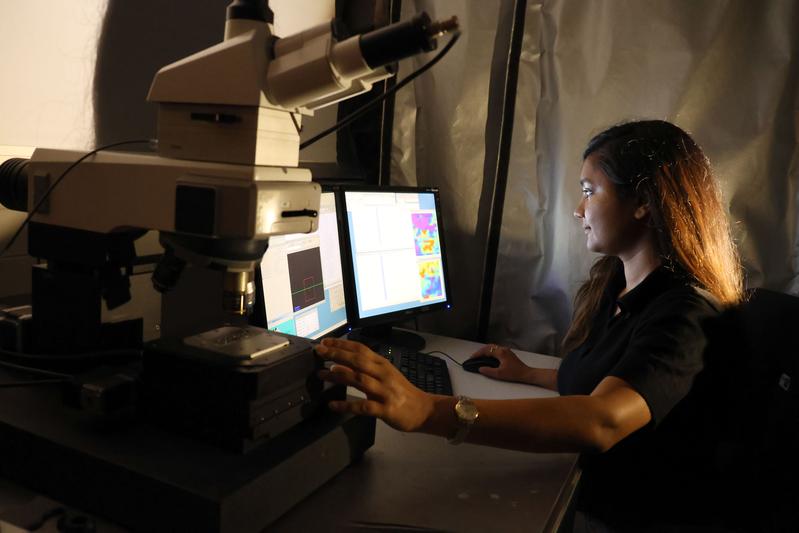

Medications can save lives. Yet for some drugs, the concentration in a patient’s bloodstream determines whether a treatment is effective or whether harmful side effects may occur. Researchers at the Leibniz Institute of Photonic Technology (Leibniz IPHT) in Jena, Germany, have now developed a sensor surface capable of detecting drugs in blood plasma with high sensitivity while offering significantly greater stability than comparable silver-based surfaces. Their findings have been published in the prestigious journal Advanced Science.
Drug concentrations in the blood can vary considerably between patients, even when they receive the same dose. Monitoring drug levels is therefore particularly important in intensive care medicine, cancer therapy, and the treatment of severe infections. Today, therapeutic drug monitoring is typically performed using sophisticated laboratory methods. While highly accurate, these techniques require time, specialized equipment, and trained personnel.
Researchers at Leibniz IPHT are working to complement such approaches with faster, light-based methods. One of the institute’s key research areas is Raman spectroscopy, which is being advanced for applications in cancer and infection diagnostics. This technique uses laser light to identify molecules based on their characteristic optical signatures. The newly published study employs an especially sensitive variant known as surface-enhanced Raman spectroscopy, or SERS.
Making Weak Signals Visible
In Raman spectroscopy, laser light interacts with a sample and returns with subtle changes that depend on the molecules present. These changes create a characteristic spectral pattern that can be used to identify chemical substances.
In medical samples such as blood plasma, however, these signals are often extremely weak. Detecting small amounts of a drug reliably therefore remains a major challenge.
SERS makes such signals measurable by using nanoscale metal structures. Silver is particularly effective for this purpose, but it comes with a drawback: the material gradually changes when exposed to air. As a result, measurement performance can deteriorate over time. For future use in hospitals and clinical laboratories, sensor surfaces must remain stable during storage and provide consistent results over extended periods.
Silver That Delivers Reliable Measurements for Longer
To address this challenge, the research teams led by Dr. Dana Cialla-May and Dr. Vladimir Sivakov, together with first author Aradhana Dwivedi, developed a new chemical approach. The work was carried out as part of a project funded by the German Research Foundation (DFG) and jointly led by Cialla-May and Sivakov.
The researchers grew tiny, highly branched silver structures on a supporting substrate. Under the microscope, these structures resemble miniature trees. Their many branches create numerous sites where molecular signals can be enhanced.
A key element of the process is the addition of sulfate ions. These ions perform two functions simultaneously: they guide the growth of the dendritic silver structures and protect their surfaces from oxidation. The result is a SERS substrate that combines high sensitivity, excellent reproducibility, and long-term stability. In the study, the sensor surfaces remained fully functional for at least seven months under standard storage conditions. The researchers confirmed the high surface stability and the origin of the strong SERS response using, among other methods, high-resolution X-ray photoelectron spectroscopy at the BESSY II synchrotron radiation facility at Helmholtz-Zentrum Berlin.
“Silver is one of the most powerful materials for SERS, but its limited stability has long been a barrier to practical applications,” says Aradhana Dwivedi, first author of the study.
“With our approach, we were able to demonstrate that highly branched silver structures can be fabricated that not only provide highly sensitive measurements but also remain significantly more robust,” adds Dr. Vladimir Sivakov.
“For real-world applications, sensitivity alone is not enough,” says Dr. Dana Cialla-May, head of the research group. “What matters is whether a sensor can deliver reliable signals in complex biological samples and be integrated into realistic clinical workflows. That is exactly the direction in which we want to advance SERS.”
Cialla-May specializes in SERS-based bioanalytics and has spent many years developing methods that use light to extract information from biological samples. Her research focuses on sensor surfaces capable of revealing even trace amounts of molecules. The study brings together several areas of expertise closely connected at Leibniz IPHT: materials research, X-ray and Raman spectroscopy, and biomedical analytics.
Tested with Cancer and Anti-Infective Drugs
In their study, the researchers evaluated the new sensor surface using five pharmaceutical compounds, including anticancer drugs and an antibiotic. The substances were first measured in water and subsequently in human blood plasma.
Blood plasma presents a particularly challenging environment because it contains proteins, salts, and numerous other components that can interfere with analytical measurements. Using a simple sample preparation step, the researchers successfully detected all tested drugs.
The study demonstrates that stable silver-based SERS substrates could become an important building block for therapeutic drug monitoring in the future, enabling faster assessments of whether a drug concentration remains within the desired therapeutic range.
“The next step is to work closely with clinical partners,” says Dana Cialla-May. “We want to determine which clinical questions are best suited for SERS, how the method compares with established laboratory techniques, and how it can be integrated into real healthcare workflows. I would be delighted to collaborate with clinical research teams to advance this work.”
Toward Bedside Applications
Before the technology can be used at the patient’s bedside, further developments are required. Sample preparation for blood plasma and serum must become simpler, sensor production must be scalable and reproducible, and standardized instrumentation and measurement protocols will be needed. In addition, robust data analysis methods capable of reliably identifying optical signals — ideally in an automated manner — must be established.
Portable Raman devices may play an important role in this process. At Leibniz IPHT, compact Raman systems are already being developed for near-patient diagnostics, including applications related to the institute’s RamanBioAssay®, a laser-based rapid test designed to identify pathogens and determine effective antibiotics from a single sample.
Particularly in life-threatening infections, such technologies could help accelerate medical decision-making and improve patient care. The new SERS study contributes an important component to this vision by providing a stable sensor surface that could eventually be combined with portable Raman instrumentation and streamlined point-of-care workflows.
Wissenschaftlicher Ansprechpartner:
https://www.leibniz-ipht.de/en/departments/spectroscopy-and-imaging/work-groups/plasmon-enhanced-bioanalytics/
Dr. Dana Cialla-May
Head of Working Group Plasmon-enhanced Bioanalytics
Leibniz Institute of Photonic Technology (Leibniz IPHT)
Originalpublikation:
A. Dwivedi, J. Dellith, A. Makarova, S. F. El-Mashtoly, J. Popp, V. Sivakov, D. Cialla-May: “Sulfate-Directed Silver Dendrites with Enhanced Stability for Ultrasensitive SERS-Based Therapeutic Drug Monitoring.” Advanced Science 2026, e17092. https://doi.org/10.1002/advs.202517092
Ähnliche Pressemitteilungen im idw
