
Natural Shields Against Mercury
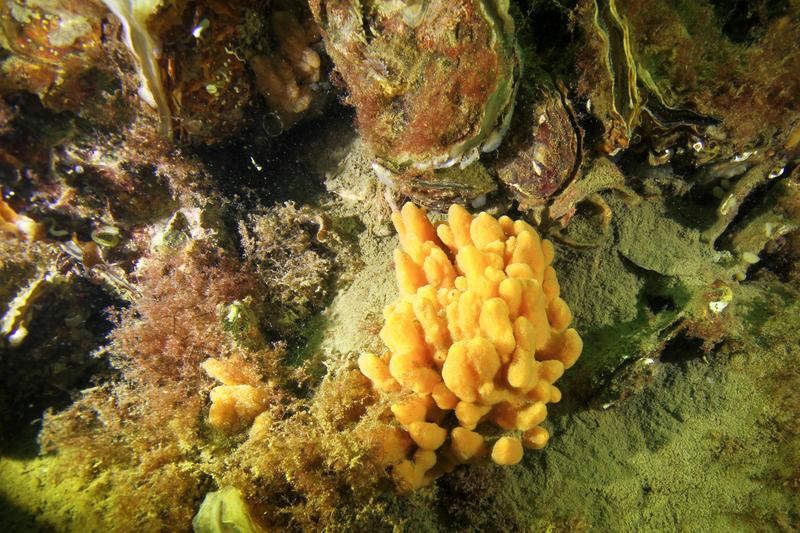
Marine sponges may play an important, previously underestimated role in reducing methylmercury contamination in marine food webs. In a new modelling study, researchers at Helmholtz-Zentrum Hereon have shown that sponges can significantly influence the spread of this environmental toxin through ecosystems. The findings suggest that the animals’ unique feeding behavior helps reduce methylmercury levels and may lower contamination in fish. The study was recently published in the journal Biogeosciences.
Methylmercury is among the most dangerous environmental pollutants. A potent neurotoxin, it accumulates along the food chain and reaches particularly high concentrations in fish. As a result, it poses not only an environmental challenge but also a risk to human health.
A Puzzling Pattern in Sponges
For years, researchers have observed an unusual phenomenon: compared with many other marine animals, sponges contain only low levels of methylmercury while at the same time exhibiting elevated concentrations of inorganic mercury. Until now, it was widely assumed that microorganisms living in close symbiosis with sponges were responsible for this effect. According to this hypothesis, certain bacteria actively break down methylmercury, thereby preventing its accumulation. Using a newly developed ecosystem and bioaccumulation model, the researchers were able to demonstrate that the feeding behavior of sponges alone may be sufficient to produce the observed patterns.
“Our modelling shows that the feeding strategy of sponges itself can provide a plausible explanation,” says David Amptmeijer, researcher at Hereon’s Institute of Coastal Systems – Analysis and Modeling and lead author of the study. “Our findings suggest that we may need to reassess the role of sponges in the cycling of pollutants.”
Impact on the Pollutant Cycle
For their investigations, the research team used the GOTM-ECOSMO E2E-MERCY model, which simulates different forms of mercury and their transport through food webs. The model assumes that sponges absorb large amounts of dissolved organic matter from the surrounding water. This process causes them to take up proportionally more inorganic mercury while simultaneously reducing their uptake of methylmercury—particularly in sponge species that host abundant microbial symbionts, organisms that live in close association with them. This mechanism alone was able to reproduce the concentration patterns observed in nature, even without assuming active biological degradation of methylmercury.
The implications extend far beyond sponges themselves. As key organisms in many seafloor ecosystems and important components at the base of marine food webs, sponges also influence contaminant exposure in other species. According to the researchers, sponge feeding behavior could reduce methylmercury concentrations in bottom-dwelling fish species by more than 50 percent. Methylmercury contamination is estimated to impose annual socioeconomic costs of billions of euros across Europe. The researchers therefore see their findings as an additional argument for protecting marine habitats.
A Model for Future Research
Looking ahead, the team plans to expand its current one-dimensional modelling approach into a three-dimensional model. This will make it possible to investigate the effects of sponge communities under more realistic environmental conditions and across larger marine areas. At the same time, the researchers hope their findings will stimulate new empirical studies. Because the results are based on modelling and still require experimental validation, they expect the study to encourage further investigations into the role of sponges in the cycling of environmental pollutants.
Cutting-edge research for a changing world
The aim of the research at the Helmholtz-Zentrum Hereon is to preserve a world worth living in. To this end, approximately 1,000 staff members generate knowledge and explore new technologies to enhance resilience and sustainability – for the benefit of the climate, the coast and people. The path from idea to innovation involves a continuous interplay between experimental studies, modelling and artificial intelligence, culminating in digital twins that replicate the myriad parameters of climate and coastal environments or human biology within a computer. This takes an interdisciplinary approach, bridging the gap between a fundamental scientific understanding of complex systems and practical applications and real-world scenarios. As an active member of national and international research networks and the Helmholtz Association, Hereon supports policymakers, industry and society in shaping a sustainable future by sharing the expertise it has gained.
Wissenschaftlicher Ansprechpartner:
David Amptmeijer
Scientist
Institute of Coastal Systems – Analysis and Modeling
Tel.: +49 (0)4152 87 – 2344
Mail: david.amptmeijer@hereon.de
Originalpublikation:
https://doi.org/10.5194/bg-23-4057-2026
Weitere Informationen:
https://www.hereon.de/institutes/coastal_systems_analysis_modeling/index.php.en
Ähnliche Pressemitteilungen im idw
