Green Lime: Reducing Carbon Emissions in the Construction Materials Industry
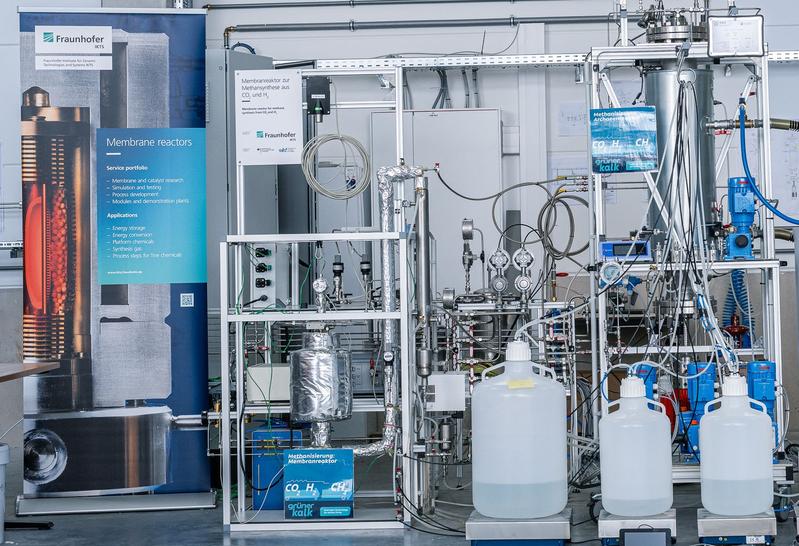
Lime, a key component in cement, can be used for both interior and exterior plastering. However, the production of this versatile building material generates significant emissions. Researchers at the Fraunhofer Institute for Ceramic Technologies and Systems IKTS in Hermsdorf, Thuringia, are devel-oping a membrane reactor that enables climate-neutral lime production while also recovering new raw materials.
The construction materials industry accounts for about a quarter of global greenhouse gas emissions, making it one of the largest sources of CO2. Cement and lime production, in particular, consumes a lot of energy and also causes substantial emissions: Exhaust gases from cement plants contain up to 33 percent CO2, while those from lime plants often exceed 40 percent.
Lime must be burned before it can be used as a construction material — a process that accounts for most of the CO2 emissions generated during the entire manufacturing cycle. For climate-neutral production, it is therefore not enough to simply replace the fuel gas or use an electric furnace, since CO2 is released from the material itself.
Climate-neutral lime from the membrane reactor
Researchers at Fraunhofer IKTS in Hermsdorf are working on an eco-friendly solution to address this: “As part of the Green Lime project, we are collaborating with our partners to develop a plant for climate-neutral lime production,” explains chemist Benjamin Jäger, who manages the project.
The team aims to capture the CO2 produced during lime calcination rather than merely venting it into the atmosphere. They use green hydrogen to produce methane from CO2, which is then broken down into hydrogen and valuable elemental carbon (carbon black) through pyrolysis.
To achieve this, the team combines a specially developed membrane reactor with a sealed electric furnace, where the CO2 is released from the lime and captured. The system feeds the hydrogen required for methanation into the reactor using a pressure-controlled dosing system to facilitate the catalytic reaction that produces methane. The product stream is then dried and pyrolyzed, meaning the methane is broken down into hydrogen and carbon. The elemental carbon can later be used, for instance, in the chemical industry or as a fertilizer in agriculture, while the hydrogen released is recirculated back into the plant.
“Our technology not only allows us to drastically reduce emissions at the lime plant but also recover new raw materials,” Benjamin Jäger summarizes. “We operate according to the carbon capture and utilization (CCU) approach, that is, we capture CO2 from industrial exhaust gases or the air to reuse it as a raw material.”
To date, the only efforts currently recognized by policymakers as decarbonization are the removal of CO2 from the carbon cycle and its long-term storage. Jäger would like to see greater awareness among policymakers of the environmental potential of technologies that utilize carbon in the process cycle. He argues that this is the only way to ensure that industries where carbon emissions are unavoidable can transition toward climate-friendly operations in the long run.
The reactor concept has already been successfully tested by project partner HySON – Institut für Angewandte Wasserstoffforschung Sonnenberg gGmbH, with Johann Bergmann GmbH & Co. developing the system’s new electric furnace. Next, the researchers plan to implement the technology on an industrial scale together with industry partners. The Green Lime project received funding from the German Federal Ministry of Research, Technology and Space (BMFTR).
“Our membrane reactor draws on Fraunhofer IKTS’s core areas of expertise in materials development, plant design and system integration. This technology offers promising prospects not only for lime production but also for fields such as waste management and the cement industry,” Jäger emphasizes.
Weitere Informationen:
https://www.fraunhofer.de/en/press/research-news/2026/july-2026/green-lime-reducing-carbon-emissions-in-the-construction-materials-industry.html
Ähnliche Pressemitteilungen im idw
