
Safe Use of Electronic Devices on Planes
Lithium-ion batteries in personal electronic devices (PEDs) such as laptops, smartphones, powerbanks and electronic cigarettes can pose a serious safety risk in air travel. Damaged or overheated batteries can combust or ex-plode. In the LOKI-PED project, the Fraunhofer Institute for High-Speed Dynamics, Ernst-Mach-Institut, EMI and the Fraunhofer Institute for Building Physics IBP cooperated with Airbus to examine the consequences of smoke and fire occurring in aircraft cabins and cockpits. This first scientifically substantiated risk assessment will contribute to a safer use of electronic devices in air travel.
Many people travel to their vacation destinations by plane, especially in summer. Travelers tend to take various electronic devices such as laptops, tablets, powerbanks and e-book readers on their trips. These can be a safety hazard: Lithium-ion batteries in such PEDs can become hot and swollen when they get trapped between seats or overheat while charging. In extreme cases, they can emit hot, toxic and flammable gases that can put passengers and crew members at risk. Incidents involving PEDs are on the rise. The American Federal Aviation Administration FAA reports between one and two incidents per week, in which a lithium-ion battery overheats, emits smoke or actually catches fire on board an aircraft.
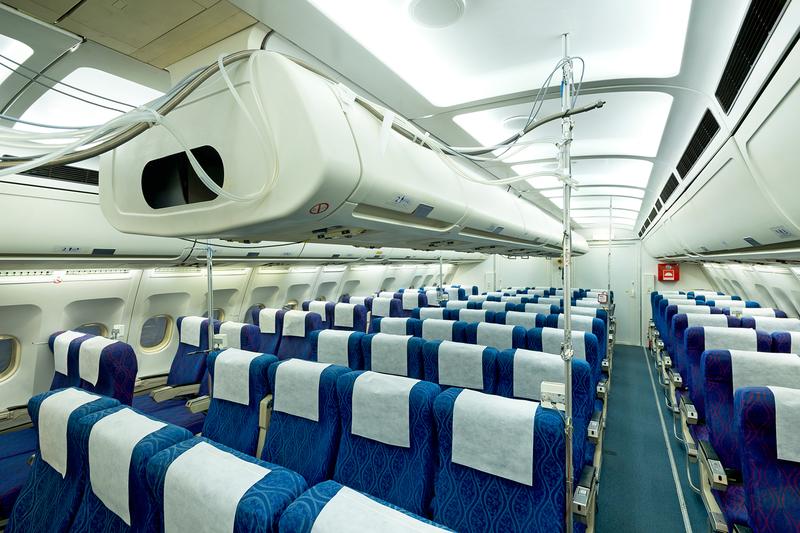
It was not least due to this recent increase in incidents that the LOKI-PED project was launched with support from the European Union Aviation Safety Agency EASA. The project was realized by the Fraunhofer Institute for High-Speed Dynamics, Ernst-Mach-Institut, EMI and the Fraunhofer Institute for Building Physics IBP in cooperation with Airbus Operations GmbH. The consequences of smoke and fire caused by PEDs were explored using a number of different testing facilities, such as the TEVLIB battery testing center at Fraunhofer EMI, an A320 mockup for cabin fire testing and the Flight Test Facility of Fraunhofer IBP that is the only one of its kind in Europe. The A320 mockup and the flight test facility at Fraunhofer IBP are realistic aircraft environments featuring the type of cabin ventilation typical of airplanes. The experiments served as a basis for numeric simulations and the subsequent risk assessment. Among other things, the activities included a characterization of the main risks associated with PEDs, experiments designed for characterizing the combustion gases that form, a risk assessment concerning the number and energy content of PEDs, assessment of emergency measures and additional countermeasures, such as fire extinguishers and special bags, and identification of regulatory gaps. EASA has published the study’s results on its website.
In the first phase of the project, the researchers performed battery abuse tests at the TEVLIB battery testing center at Fraunhofer EMI and in the A320 mockup, in which laptops, tablets and smartphones were heated up to provoke thermal runaway. This is a process in which the lithium-ion battery burns away, releasing all the chemical energy from the cell in a very short time. An internal short circuit in the battery cell causes a drastic rise in temperature. This starts a chain reaction in which the heat that develops in one cell propagates to neighbouring cells and leads to consecutive thermal runaway events.
Batteries’ energy content determines heat and gas release
“How much heat and gas is released when a PED overheats depends on the batteries’ energy content,” says Simon Holz, a project manager at Fraunhofer EMI. PEDs that can be brought on board are currently limited to 100 watt-hours (Wh). Current laptop models come very close to this threshold, and it is very likely that new battery technology will exceed this limit. “It is therefore necessary to perform scientifically substantiated assessments of the guidelines and measures designed to minimize risk. In our tests and simulations, we were able to demonstrate that the 100 Wh limit for PEDs continues to be adequate,” Simon Holz states.
Gases released do not exceed health-related threshold values
By provoking thermal runaway, the researchers were also able to quantify the emitted carbon dioxide and toxic compounds such as carbon monoxide, formaldehyde, hydrogen fluoride and hydrogen chloride. They then correlated these measured values with the carbon dioxide peak concentrations before using a validated zonal simulation model of a cabin to predict the temporal and spatial spread of gases and smoke. The results showed that cabin ventilation keeps exposure below the health-related threshold values. “A burning battery does release harmful gases. However, our simulation demonstrated that the cabin ventilation dilutes such gases so effectively that the health-related threshold values are not exceeded two seats away from the source of the fire. At this distance there is no acute threat,” Victor Norrefeldt, Technical Manager at Fraunhofer IBP explains. “As part of our tests, we positioned PED emulators in five different places across the cabin of our flight test facility and installed nine carbon dioxide measuring sensors.” Smoke development was also found to correlate with the progression of carbon dioxide. The smoke cleared only two seat rows away from the fire source and dense smoke could only be observed in direct vicinity of the burning battery, thanks to the high rate of air exchange.
Exploring additional safety equipment
The FAA has determined the following essential steps that crew members must take when a PED catches fire: first extinguish any flames, then cool the device using a non-alcoholic fluid before fully submerging the device in a container filled with water. There are manufacturers who offer additional containment equipment such as fire extinguishers and special bags that are designed for containing lithium-ion batteries in the event of thermal runaway. Some of this safety equipment that is currently commercially available was also tested as part of the LOKI-PED project. This included experiments concerning performance of fire extinguishers, the containment capacity of bags and their usability while wearing respiratory masks and protective gloves. All fire extinguishers proved suitable for extinguishing the flames during the experiments. However, none of the bags tested met the requirements concerning flame and smoke leakage. Airline crew members were invited to the cabin demonstrator of the Fraunhofer flight test facility to test the safety equipment. The tests carried out by the cabin staff with the bags lead to a number of suggestions regarding the bags’ design and handling. Bags should be ready for immediate use without requiring any assembly, such as needing to attach handles or fastening bands. “In our elaborate tests, we were able to further substantiate that air travel is safe. The airlines’ cabin staff is trained very thoroughly in handling fire incidents involving batteries. However, safety equipment and procedures can be further optimized to allow for an even safer use of portable electronic devices on board,” says Simon Holz to summarize the situation.
The results published by EASA highlight the importances of rapid action taken by the crew, of battery capacity limits for PEDs and of sophisticated risk management strategies for ensuring safe air travel. The project’s scientifically substantiated findings and suggestions are beneficial for airlines, supervisory authorities, cabin crew and passengers alike.
LOKI-PED project
Lithium batteries in pOrtable electronic devices – risK of fIre and smoke
Grant initiative: Horizon Europe (EU program)
Funding institution: European Union Aviation Safety Agency (EASA)
Consortium:
Fraunhofer Institute for High-Speed Dynamics, Ernst-Mach-Institut, EMI, Freiburg
Fraunhofer Institute for Building Physics IBP, Holzkirchen
Airbus Operations GmbH, Bremen
Weitere Informationen:
https://www.fraunhofer.de/en/press/research-news/2026/july-2026/safe-use-of-electronic-devices-on-planes.html
Ähnliche Pressemitteilungen im idw
