The importance of energy efficiency is declining in industrial companies

The University of Stuttgart's latest Energy Efficiency Index shows that industrial companies invest primarily in energy efficiency to reduce costs and emissions and to comply with legal requirements. The Energy Efficiency Act remains a key driver of such initiatives.
The Institute for Energy Efficiency in Production (EEP) at the University of Stuttgart has published the results of the 2026 summer survey of the German Industry Energy Efficiency Index (EEI). "The sub-index trend indicates that, under current conditions, industrial companies perceive investments in energy efficiency measures as a means of reducing both costs and emissions. They generally view energy efficiency as being on par with other issues, such as product development,” says Professor Alexander Sauer, director of the EEP Institute.
As proportional investments continue to rise, relative importance declines
As part of the EEI, the institute surveyed industrial companies in terms of their proportionate investments in energy efficiency measures. For the first time since the energy crisis, the Energy Investment Index (EII) has risen for the third consecutive time. The Importance Index (EBI) – which reflects the relative importance companies assign to energy efficiency – has, however, fallen to a level close to its historic low recorded in the summer 2024 survey. Unlike in the winter 2025 survey, only large companies now regard energy efficiency as more important than other operational priorities, such as quality assurance.
Consumption monitoring, cost reduction, and the Energy Efficiency Act are the main drivers
This shows that businesses are now less intrinsically motivated to take steps to improve energy efficiency. They increasingly view energy efficiency as a means to an end. The main drivers for implementing an energy management system are economic and operational factors, such as optimizing and monitoring a company’s own energy consumption (71%) and reducing CO2 emissions (70%). Close behind, at 58%, are legal requirements as the reason why companies are pursuing energy efficiency efforts.
The current Energy Efficiency Act (EnEfG) took effect in November 2023. Depending on the threshold for annual average total final energy consumption, industrial companies are required to take various measures. If their final energy consumption exceeds 2.5 GWh, companies must develop and publish implementation plans for final energy conservation measures. If their energy consumption reaches or exceeds 7.5 GWh, they are required to establish a certified energy or environmental management system.
With the expected revisions to the EnEfG, these thresholds are set to increase from 2.5 to 2.77 GWh and from 7.5 to 23.6 GWh. The survey shows that, as a result of the amendment, only about half of the industrial companies surveyed would be required to establish a certified energy and environmental management system.
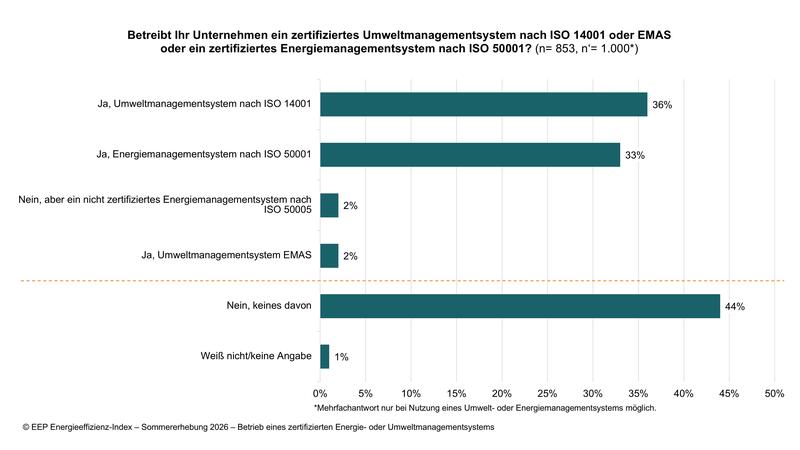
The current index also shows that 55% of the companies surveyed currently use such a system. In addition, companies have expanded their own capabilities and expertise, so they are less likely to need to rely on external assistance for planning and implementing an energy or environmental management system.
Companies recognize the potential and are responding with various technologies
The impact of the changing thresholds resulting from the potential legislative amendment is more apparent when it comes to waste heat. The current EnEfG requires industrial companies consuming 2.5 GWh or more to take measures to prevent and utilize waste heat. 89% of the businesses surveyed are already aware of the potential for such measures. As part of the revision, this will only apply to companies that plan an industrial facility with an average total energy input of more than 8 MWh per hour or that intend to carry out substantial modernization.
As a result, only 5% of the companies surveyed would have to implement measures, instead of 51%. Currently, industrial companies are expected to either prevent or utilize waste heat. With the revision, only technically avoidable waste heat would be considered, and companies would be required to conduct a cost-benefit analysis for this purpose (12% instead of 32% in winter 2023).
Overall, the companies surveyed are addressing the issue of waste heat using a variety of technologies. For more than 70% of the businesses surveyed, heat recovery and insulation have proven effective. About one-third of companies use either heat pumps, absorption chillers, or combined heat and power systems.
The Energy Efficiency Act remains one of the key drivers
Based on the current Energy Efficiency Act (EnEfG), it appears that companies are systematically addressing the issues of waste heat as well as energy and environmental management. The share of investments in energy efficiency measures relative to total investments is increasing. However, when it comes to the payback period for these investments, a new trend is emerging. Currently, companies prefer an average payback period of no more than three years for their investments. Support for long-term investments has fallen from 25% to 2% compared to the winter survey of 2023. At the same time, the EnEfG, which in some cases requires significant investments, is increasingly being called into question. "More and more German industrial companies are calling for the repeal of the Energy Efficiency Act. But it is important that policymakers continue with this approach. After all, it is one of the most important factors driving companies to address the issue of energy efficiency,” Sauer emphasizes.
About the Energy Efficiency Index for German Industry
Since 2013, the Institute for Energy Efficiency in Production (EEP) at the University of Stuttgart has been conducting a biannual survey of current and planned energy efficiency initiatives in German industry. The Energy Efficiency Index (EEI) is compiled in collaboration with the German Energy Agency (dena), the Federation of German Industries (BDI), the Fraunhofer Institute for Manufacturing Engineering and Automation IPA, TÜV Rheinland, and other partners. The special questions in the 2025 winter survey addressed external factors influencing energy efficiency efforts, long-term and strategic objectives, and the importance of energy flexibility. A total of 854 manufacturing companies participated in the survey during the survey period from March 9 to April 30, 2026.
The survey focused on the following questions:
➜ Does your company operate a certified energy or environmental management system?
➜ Does your company have a policy for preventing and utilizing waste heat?
➜ Does your company have sufficient internal capacity and expertise?
➜ What factors led your company to implement an energy management system and to prevent and utilize waste heat?
Wissenschaftlicher Ansprechpartner:
Marie-Christin Grabisch, University of Stuttgart, Institute for Energy Efficiency in Production (EEP), Tel: +49 711 970-1398, email: marie-christin.grabisch@eep.uni-stuttgart.de
Kerim Torolsan, University of Stuttgart, Institute for Energy Efficiency in Production (EEP), Tel: +49 711 970-1493, email: kerim.torolsan@eep.uni-stuttgart.de
Weitere Informationen:
https://www.uni-stuttgart.de/en/university/news/all/The-importance-of-energy-efficiency-is-declining-in-industrial-companies/
https://www.eep.uni-stuttgart.de/en/
https://www.eep.uni-stuttgart.de/eei/ Graphics to download
Ähnliche Pressemitteilungen im idw
