Kohlrabi greenhouse trial shows nutrients recovered from human excreta can replace mineral fertiliser
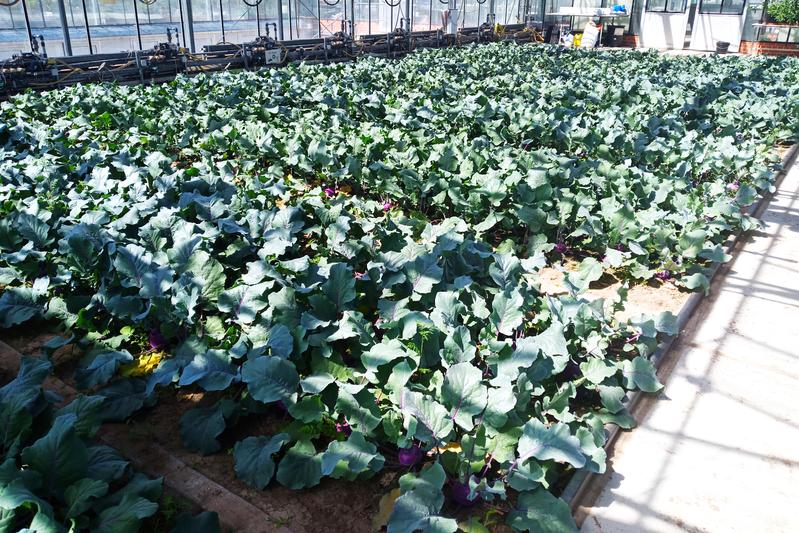
A new study by Caroline Ganglo and Stefan Karlowsky from the Leibniz Institute for Horticultural Sciences (IGZ) investigated whether human excreta-derived fertilisers are suitable for replacing mineral fertiliser in kohlrabi production and how they affect plant N uptake and soil N fluxes. The results gained as part of the Horizon Europe Innovation Action “P2GreeN” underpin that a transition to circular nutrients flows and resilient local food production is possible without compromising food security. The study, titled “Application of nitrified urine fertilizer and faecal compost for growing kohlrabi in a controlled greenhouse environment”, was published in Frontiers in Environmental Science.
The study revealed that human excreta-derived fertilisers (HEDF) can effectively substitute mineral fertiliser in greenhouse-grown kohlrabi, a leafy vegetable with high nutrient demand. The combined use of nitrified urine fertiliser and faecal compost produced comparable marketable yields and biomass to a synthetic multi-nutrient mineral fertiliser. This shows how HEDF can help to reduce the dependence on fossil-based mineral fertilisers that are often imported into the EU, including long transport distances and high price fluctuations due to geopolitical conflicts.
Furthermore, the IGZ researchers found that plant nitrogen uptake was enhanced by 13% with HEDF fertilisation. At the same time, they found that mineral nitrogen content in the soil was fivefold lower and organic nitrogen content was 25% higher at harvest time compared to mineral fertiliser. These findings suggest that HEDF, particularly the humus-rich faecal compost, can have positive effects on soil nitrogen dynamics that are possibly associated with short-term nitrogen immobilisation and reduced accumulation of readily leachable mineral nitrogen.
In addition, the study also examined the fate of contaminants, showing that doxycycline, an environmentally stable antibiotic present in faecal compost, does not transfer to edible crop parts in detectable amounts. Monitoring the contaminant levels of recycling fertilisers is important in addressing potential safety concerns and is necessary as a basis for societal acceptance.
“Our new study is part of the growing evidence that recycled fertilisers derived from human excreta are suitable for the cultivation of a variety of crops without compromising yield levels. For a fast-growing crop with a high nutrient demand like kohlrabi, a good nutrient supply is essential. The combination we used – consisting of nitrogen-rich, nitrified urine fertiliser and faecal compost rich in organic carbon – not only provided the nutrients necessary for plant growth, but also had a significant impact on the short-term nitrogen fluxes in the soil, which could potentially benefit soil health and nutrient retention”, says Dr Stefan Karlowsky, co-coordinator of the P2GreeN project at the IGZ.
The findings demonstrate a feasible pathway for closing the nutrient loop between urban sanitation and food production. Instead of treating urine and faecal matter solely as waste streams, they can become sources of nitrogen and phosphorus for agriculture, thereby reducing the demand on finite or fossil-based fertilisers. The recycling contributes to keeping nitrogen and phosphorous flows in safe planetary boundaries by increasing resource efficiency and reducing nutrient pollution from the linear wastewater system. Consequently, the results from this study could inform future circular economy strategies as well as amendments to existing waste and fertiliser regulations to create a legal framework that facilities nutrient recycling.
For supporting broad implementation, long-term studies are needed to determine the effects of repeated application of nitrified urine fertiliser and faecal compost on soil salinity, soil organic carbon, long-term soil nitrogen fluxes, nitrate leaching, phosphorous dynamics, and the fate of pharmaceuticals and other trace contaminants.
Funding
This work was funded by the European Union under the the Horizon Europe research and innovation programme, grant agreement No. 101081883.
Leibniz Institute for Horticultural Sciences (IGZ)
The Leibniz Institute of Vegetable and Ornamental Crops, which will soon be legally renamed the Leibniz Institute for Horticultural Sciences (IGZ), is a Leibniz Association research institute. It contributes to solving current global challenges by providing science-based findings from basic and applied horticultural research. These include the preservation of biodiversity, combating climate change and the still widespread malnutrition. The institute is jointly funded by the Ministry of Science, Research and Culture of the State of Brandenburg (MWFK) and the Federal Ministry of Agriculture, Food and Regional Identity (BMLEH). The IGZ is based in Großbeeren.
Wissenschaftlicher Ansprechpartner:
Stefan Karlowsky, Project Manager/Scientist | Email karlowsky@igzev.de | Phone +49 (0) 33 701 78 149
Originalpublikation:
https://doi.org/10.3389/fenvs.2026.1856888 Ganglo C and Karlowsky S (2026) Application of nitrified urine fertilizer and fecal compost for growing kohlrabi in a controlled greenhouse environment. Front. Environ. Sci. 14:1856888. doi: 10.3389/fenvs.2026.1856888
Weitere Informationen:
https://igzev.de/download_file/4697dcdf-08f8-4e58-977c-1d3df455b24b/9 Graphical abstract of the Study (Caroline Ganglo & Stefan Karlowsky, created using ChatGPT)
https://p2green.eu/ P2GreeN website
https://linktr.ee/P2GreeN_HorizonProject?utm_source=linktree_profile_share P2GreeN on social Media
Ähnliche Pressemitteilungen im idw
