
Immigrant Employment Rate in the EU at a Record High
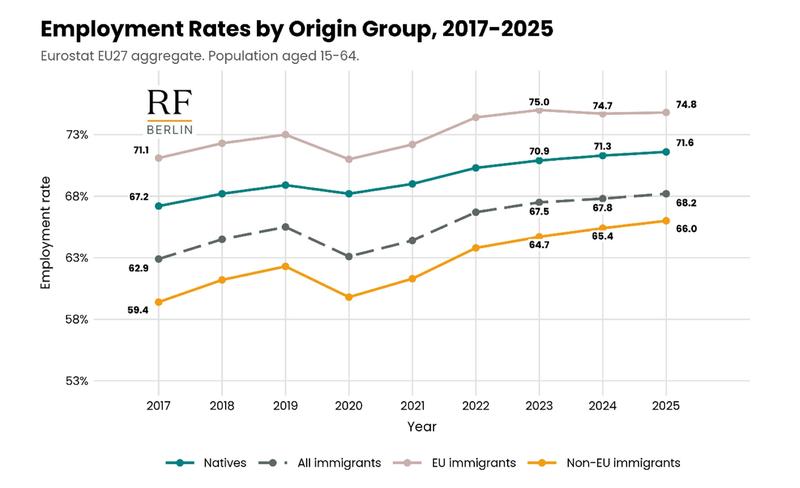
More immigrants than ever are in work across the European Union. Last year the share of employed immigrants rose to 68,2%, from 67,8 %. Thus, the employment rate reached a record high in 2025, continuing the steady progress made over recent years. The largest improvement was among non-EU immigrants, whose employment rate increased by 6.6 percentage points since 2017, from 59.4% to 66% in 2025, narrowing part of the gap with the native-born population. The employment rate among EU immigrants also increased, from 71.1% to 74.8%, while among natives it rose from 67.2% to 71.6%, likewise reaching its highest level over the period.
These are the findings of a report by the Centre for Research and Analysis of Migration at the ROCKWOOL Foundation Berlin (CReAM@RFBerlin), based on EUROSTAT data.
“The proportion of immigrants in employment has been rising for many years, and the figures are close to that of the native population,” says Tommaso Frattini, Deputy Director of CReAM at RFBerlin and Professor of Economics at the University of Milan. Yet, substantial labour market potential remains untapped, particularly among non-EU women and highly educated migrants.
The overall improvement, however, masks substantial differences across areas of origin of immigrants and host countries. Across much of Europe, immigrants born in other EU Member States have employment rates similar to, or even higher than, those of the native-born population. Among non-EU immigrants, however, outcomes vary much more widely across countries. Employment rates for this group are especially high in countries such as Malta (83.7%), Czechia (77.3%) and Ireland (76.1%), and lowest in Belgium (58.5%) and Finland (58.6%).
In Germany and Austria, employment rates of non-EU immigrants are 66.1% and 65.4%, respectively, whereas employment rates among natives are 79.6% and 76.1% and among EU immigrants 78.6% and 76%.
In Italy, non-EU immigrants have an employment rate of 64.2%, higher than of the native rate (62.1%) but lower than that of EU immigrants (67.5%).
In France, the employment rate of non-EU immigrants is 61.5%, whereas the employment rates among natives and EU immigrants are 70.5% and 67.8%, respectively.
In Spain, the employment rate of non-EU immigrants is 65.4%, close to that of natives (67.1%) but lower than that of EU immigrants (72.3%).
In Denmark, the employment rate of non-EU immigrants is 69.6%, compared with 77.5% among natives and 80.6% among EU immigrants.
The remaining employment gap is increasingly concentrated among specific groups rather than immigrants as a whole. By 2025, employment rates among non-EU immigrant men had almost converged with those of native-born men. Persistent disadvantages remain, however, among non-EU women, whose employment rates continue to lag well behind those of both native-born women and EU-born immigrant women.
The report also points to a substantial underutilization of immigrant skills. Across much of Europe, highly educated non-EU immigrants are substantially less likely to be employed than equally educated natives.
“Europe has made remarkable progress in integrating immigrants into employment,” says Christian Dustmann, Director of RFBerlin and Professor of Economics at University College London. “The challenge today is no longer simply getting immigrants into work but ensuring that their skills are fully utilised. Better recognition of foreign qualifications, reducing unnecessary certification barriers, and increasing labour market participation among non-EU women could help ease labour shortages while making better use of Europe's human capital.”
“One of the most striking findings is how differently European countries perform,” adds Frattini. “Some countries have largely succeeded in integrating non-EU immigrants into employment, while others continue to face substantial gaps. This shows that these differences are not inevitable”
The report concludes that Europe possesses considerable untapped labour market potential. Unlocking this potential - particularly among female non-EU and highly educated immigrants - could help address labour shortages facing many EU economies while improving economic integration and making more effective use of immigrants' skills and qualifications.
Wissenschaftlicher Ansprechpartner:
Prof. Christian Dustmann, cd@rfberlin.com; 0044 7818 048 380
Prof. Tommaso Frattini, tf@rfberlin.com; 0039 347 640 38 45
Originalpublikation:
https://www.rfberlin.com/cream-reports/ “Employment of Immigrants in the European Union: Progress, Persistent Gaps, and Untapped Potential”, CReAM Report 6/26 von Christian Dustmann, Tommaso Frattini und Camilla Piovesan;
Ähnliche Pressemitteilungen im idw
