
Collaboration between the Department of Physics at HHU and a major European research facility
Strong-field laser-plasma physics
Heinrich Heine University Düsseldorf (HHU) and the Extreme Light Infrastructure (ELI) are planning to collaborate closely on the development of laser-plasma particle accelerators and new radiation sources in the future. The two institutions have now signed a Memorandum of Understanding.
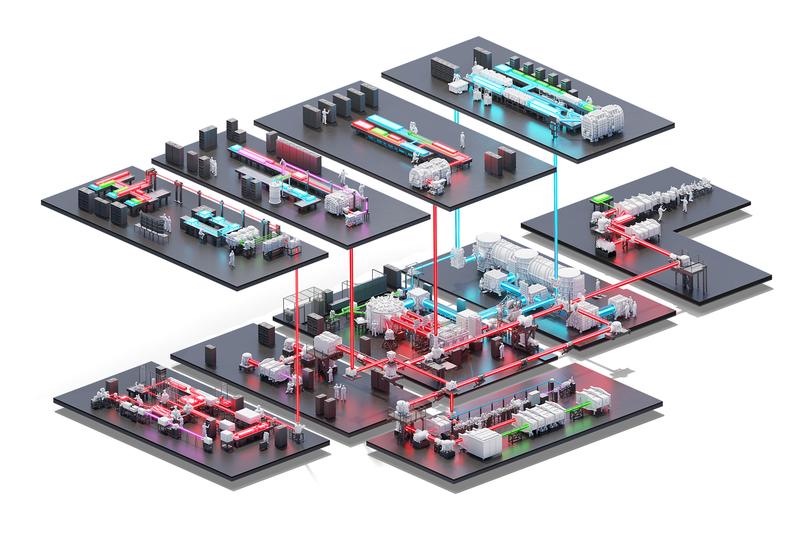
ELI is a major European laser-plasma research facility based at multiple sites. High-power lasers are used to transform matter in less than one trillionth of a second, with an intensity comparable to that of many trillions of suns, in particle accelerators. They are many times more powerful and versatile than conventional, kilometre-long accelerators.
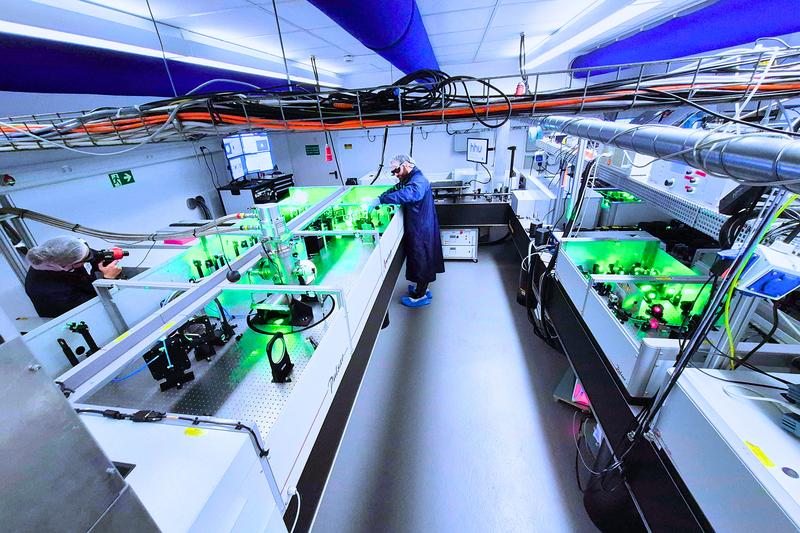
HHU operates a similar laser system called ARCTURUS at the Chair of Laser and Plasma Physics. It is used for research into plasma-based particle acceleration and applications ranging from the medical, life and material sciences to quantum electrodynamics.
Professor Dr Bernhard Hidding, leader of the strong-field laser physics research group at HHU: “Such systems promise a certain ‘democratisation’ of research, so to speak. To date, it has only been possible to operate particle accelerators at a few major research facilities. However, the new systems are just a fraction of the cost and much simpler, meaning that they can also be sited at universities.”
HHU and ELI have now signed a Memorandum of Understanding in order to deepen and expand their collaboration in the fields of laser-plasma interaction, particle acceleration using laser-produced plasmas and associated technological applications. The agreement provides the researchers in Düsseldorf with strategic access to ELI. The objective is to establish a long-term partnership.
Professor Hidding: “ELI is an ideal partner for us at European level. Our expertise, experimental possibilities and strategic plans are an extremely good fit. Our innovations and scientific expertise have already provided important foundations for the design of EuPRAXIA@ELI – another major project on the European Strategy Forum on Research Infrastructures (ESFRI) roadmap with the goal of implementing an x-ray laser at ELI – and the aim is for key developmental aspects to be realised using the infrastructure currently being established in Düsseldorf.
HHU President Professor Dr Anja Steinbeck: “The collaboration that has now been agreed is an important step toward boosting the research field at HHU and becoming one of the first universities in Germany to establish a strategic network with ELI. The physicists in Düsseldorf are already making significant contributions toward the realisation of joint major European projects in the future.”
ELI Beamlines Facility Director Eng. Roman Hvezda: “As a pioneer of strong-field laser-plasma physics in Germany and Europe, HHU is a particularly important strategic partner for us. The innovations, which have originated over the years and can be implemented in Düsseldorf closely complement the long-term development of ELI as a major European research infrastructure facility.”
The Extreme Light Infrastructure (ELI)
ELI is a world-leading research facility based in Europe with an extensive range of high-power laser systems. These lasers generate particle beams of electrons, protons and ions in the plasma. In secondary cascades, they can also produce directed muon beams, neutrons or antimatter beams such as positrons, as well as secondary photon sources in the x-ray and gamma ray range. These research fields are particularly important for the collaboration with HHU.
The European Commission established ELI as a European research Infrastructure Consortium (ERIC) and an ESFRI Landmark project. There are three ELI facilities: ELI Attosecond Light Pulse Source (ELI ALPS) in Szeged/Hungary, ELI Beamlines in Dolní Břežany/Czechia and ELI Nuclear Physics (ELI NP) in Măgurele/Romania. The sites received around one billion euros in initial funding from the EU Cohesion Fund.
European Plasma Research Accelerator with eXcellence (EuPRAXIA)
EuPRAXIA is a further major European project on the ESFRI roadmap. One objective is to realise a laser-plasma-based x-ray laser. HHU heads the development of the “Transformative Innovation Paths” in the EuPRAXIA consortium, in which the aim is to generate ultrabright electron beams using plasma photocathodes implemented in laser-plasma accelerators. Such beams enable the development of ultracompact x-ray lasers, which can be used to examine the inner workings of atoms and matter under extreme conditions, record atomic films and study biomolecules.
In addition to the research groups headed by Professor Hidding and Professor Dr Georg Pretzler at the Chair of Laser and Plasma Physics at HHU, the research groups headed by Professor Dr Dr Carsten Müller and Professor Dr Alexander Pukhov at the Institute for Theoretical Physics I, the groups led by Professor Dr Sebastijan Brezinsek and Professor Dr Markus Büscher (HHU/Jülich Research Center – FZJ), and medical physics research groups at HHU and University Hospital Düsseldorf were also involved.
Ähnliche Pressemitteilungen im idw
