
Faster and more precise diagnostics: AI interprets data from medical sensors
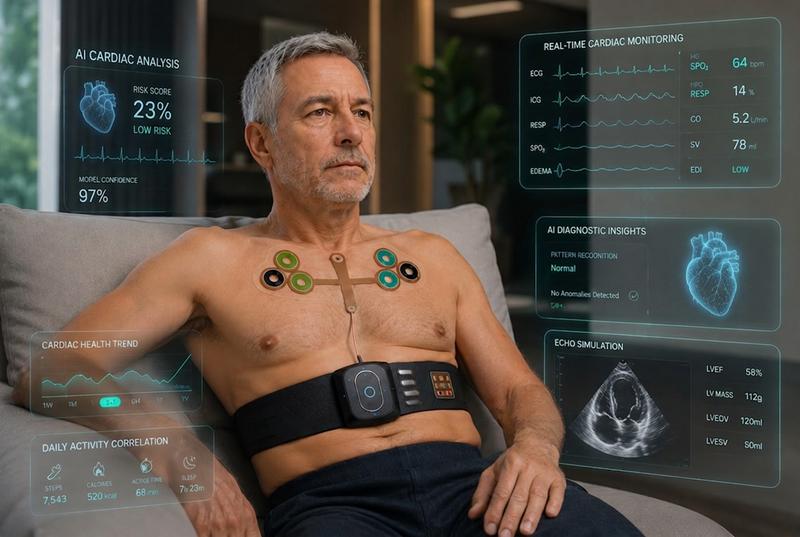
Artificial intelligence promises to read and interpret medical data more efficiently and precisely. A sensor system for monitoring cardiological conditions, developed at Fraunhofer IZM, can become a powerful tool in the cardiologist’s arsenal with the power of AI.
Medical diagnostics can be confusing, even for the most experienced of physicians. The World Health Organization counts no fewer than 55,000 medical conditions with 13,000 separate symptoms.[1] Cardiac problems, ranging from hypertension to chronic heart failure or arrhythmias, are among the most frequent of these problems, and they account for a large proportion of deaths worldwide.
Fortunately, cardiovascular diseases are well understood and can often be detected reliably. Many common wearables, like smartwatches, already come with sensors that alert their users to potential problems. But they cannot replace the full diagnostic scope of a professional cardiologist, and seeing such specialists can mean long waits for appointments.
The pressures of modern healthcare systems often leave little time for physicians with their patients, making it harder for them to get a truly complete and diagnostically reliable picture of their patients’ physical condition. This is where artificial intelligence can offer invaluable assistance. However, researchers trying to introduce an AI framework in cardiological diagnostics faced a chicken-and-egg problem: There is no medical device that can deliver all relevant diagnostic parameters needed to train an AI for cardiological diagnostics. And in turn, not having a specially trained AI meant not having a comprehensive, AI-powered diagnostic system.
A sensor system developed at the Fraunhofer Institute for Reliability and Microintegration IZM promises to solve this conundrum: The data collected by that system is fed into the cloud by an edge PC integrated in the wearable system. In the cloud, the data is analyzed with the power of artificial intelligence.
From sensor readings to medical diagnosis
The readings of the sensors can deliver data for around 240 cardiologically relevant parameters, and they can also be supplemented with measurements from external devices, like ultrasounds. For added reliability, the data is first validated by the traditional tools for signal processing and then fed through the specially trained AI models.
Neural networks work through the morphology of the data, e.g., the shape of ECG readings, to pinpoint anything that is out of the ordinary. In current medical practice, this is usually still done by a human, in necessary, but slow and labor-intensive work, even though studies have long shown that specialized AIs can do this more precisely than even experienced medical professionals.[2]
The patient’s medical history, from issues running in their family to their physical presentation on the day, are added to this. Specially selected Large Language Models (LLMs) with a focus on medical terms can make this step more detailed and can help repeat it when tracking developments over time. The questions, based on current cardiological guidelines, can be answered by text or speech.
LLMs are also used to process the diagnostic findings: The right type of language is chosen for the target audience - medical professionals or patients - to explain any relevant findings, risk factors, or diagnostic suggestions. Several medical LLMs, including Google’s MedGemini, are at work in the background, always checked for consistency by an additional AI agent put in place to monitor the process.
The future of medicine
Using artificial intelligence to support routine processes like this can help make specialist medical care more efficient. Specialized systems could assist general practitioners with catching symptoms and medical risks early on and getting their patients to the right specialists. The specialists themselves would have much larger datasets and can benefit from assis-tance with analyzing and interpreting that data. Finally, patients living with cardiological issues can be supported by the system, e.g., by adjusting the daily medication dose to the patient's current condition.
The evolution of the sensor system to a comprehensive, AI-powered validation, interpretation, and presentation process gives a glimpse of the “medicine of the future”, as promised by the official motto of the Science Year 2026. And cardiology is just the beginning, as similar systems can be envisioned in many other fields, like lung health.
(Text: Steffen Schindler)
[1] https://www.who.int/news/item/18-06-2018-who-releases-new-international-classification-of-diseases-(icd-11)
[2] https://pmc.ncbi.nlm.nih.gov/articles/PMC12808761/
Wissenschaftlicher Ansprechpartner:
Basel Adams I Fraunhofer Institute for Reliability and Microintegration IZM I Research Assistant I Phone +49 30 46403-237 I basel.adams@izm.fraunhofer.de
Originalpublikation:
https://www.izm.fraunhofer.de/en/news_events/tech_news/ai-interprets-data-frommedical-sensors.html
Ähnliche Pressemitteilungen im idw
