
Sugar from the salty ocean can rise high into the atmosphere and plays an important role in the Arctic climate system
Ny-Ålesund/Leipzig. Salt and sugar from the sea can rise as far as the free troposphere, thereby influenc-ing both cloud formation and the Arctic climate. This is the finding of balloon measurements carried out by a team of researchers on Spitsbergen in autumn 2021 and spring 2022. With the Arctic becoming in-creasingly ice-free, more and more of these cloud-forming ingredients from seawater could enter the atmosphere and affect the radiation budget. The new findings therefore contribute to a better under-standing of the complex interactions that lead to above-average warming in the Arctic, the researchers write in the journal Atmospheric Chemistry and Physics (ACP).
The study, led by the Leibniz Institute for Tropospheric Research (TROPOS), also involved researchers from the University of Cologne, the Alfred Wegener Institute, Helmholtz Centre for Polar and Marine Re-search (AWI), the Max Planck Institute for Marine Microbiology, the University of Oldenburg and the Uni-versity of Bremen. It forms part of the German Research Foundation’s (DFG) Transregios 172 programme, which has been investigating climate change in the Arctic since 2016 under the leadership of Leipzig Uni-versity.
The central Arctic is an ocean that is covered in sea ice in winter and features ever-increasing areas of open water in summer. Consequently, sea spray aerosol (SSA) particles play a key role in the climate, as they are a major source of cloud formation in this region. As global warming intensifies and sea ice retreats, the im-portance of these particles from the sea will increase even further. These particles are released from sea-water into the air above by breaking waves and bursting air bubbles. Under certain meteorological condi-tions, these particles can rise further into the atmosphere. They consist of inorganic sea salt ions such as so-dium and chloride, together with organic material originating from the surface film and the underlying seawater. The organic material also includes marine carbohydrates. Most of these sugar-like compounds are complex, highly branched polysaccharides that are produced and released by algae and bacteria. In 2025, a TROPOS study using laboratory and field data provided evidence that the ice-nucleating activity of sea spray particles is significantly influenced by the polysaccharides they contain. Model simulations showed that the ice-nucleating activity of marine polysaccharides is particularly significant in the temperature range be-tween –20 and –15 °C in remote ocean regions where the contribution of terrestrial ice-nucleating particles is minimal or absent altogether. Ice-nucleating aerosol particles promote ice formation in clouds and thus influence their radiative properties and precipitation formation.
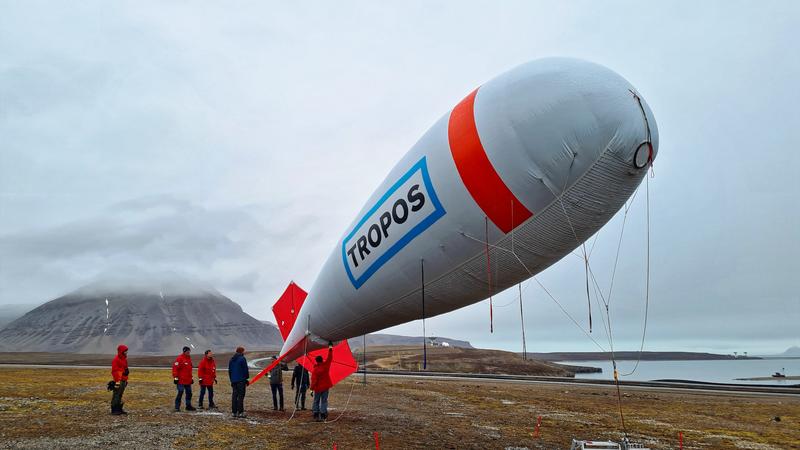
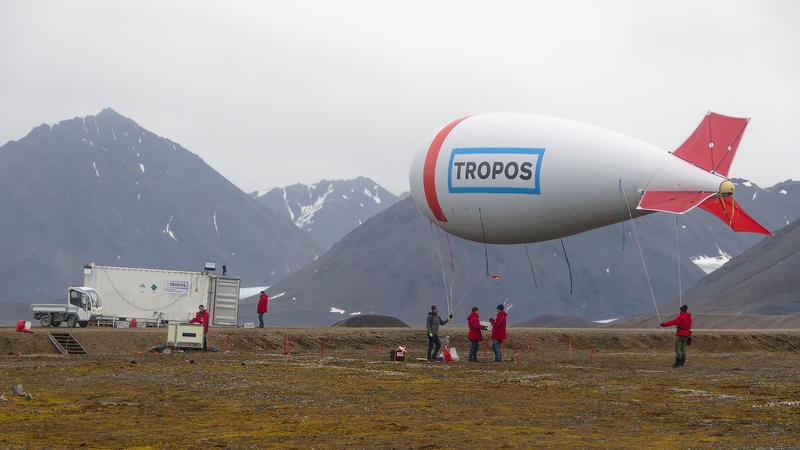
Although the significance of these sugars from seawater is now recognised in research, there has so far been a lack of measurements that actually confirm their presence in the upper layers of the atmosphere. Apart from ship-based measurements at sea level, there have been only a few measurements conducted on moun-tain peaks, and vertically resolved measurements using mobile platforms have been entirely absent until now. As a result, it remained unclear just how significant the influence of marine sugars on the atmosphere actually is. German polar researchers have now filled this gap: in autumn 2021 and spring 2022, they col-lected air samples at altitudes of 300 to 1,000 metres near Ny-Ålesund on Spitsbergen, the world’s north-ernmost permanently inhabited settlement. The filter samples were later analysed in the TROPOS laborato-ries alongside samples of seawater and surface film from the ocean in Kongsfjorden near Ny-Ålesund. “Com-bining the aerosol measurements taken at ground level and at various altitudes with the water samples from Kongsfjorden has enabled us, for the first time, to directly trace the transport of marine sugars from the ocean into the atmosphere,” explains Dr Manuela van Pinxteren of TROPOS, who, together with Dr Sebas-tian Zeppenfeld, was responsible for the expedition’s aerosol and water measurements. The air samples were collected by the BELUGA tethered balloon from TROPOS. In July 2020, the 12-metre-long, 90-cubic-metre helium balloon had already been deployed on the MOSAiC expedition, during which the German re-search icebreaker Polarstern, operated by the Alfred Wegener Institute, drifted through the central Arctic for a year.
Furthermore, recent laboratory and field observations suggest that a molecular transformation or addi-tional formation of these sugars is taking place in the atmosphere, triggered by chemical and biological ac-tivities there. “Under very humid conditions, particularly in clouds with precipitation, we were also able to observe the formation of these sugars directly in the atmosphere, which may be linked to the metabolism of microorganisms in the air. These are the first indications that the sugars in the atmosphere do not originate solely from the sea, but could also be produced by biological processes within the clouds themselves. To-gether with evidence of their vertical transport, this shows that marine organic matter plays a significantly more dynamic role in the Arctic climate system than previously assumed. The atmosphere is therefore much more alive than we had long thought,” concludes Dr Sebastian Zeppenfeld from TROPOS.
The fact that these sugars are transported to altitudes relevant to cloud formation has implications for cloud microphysics. And with the warming of the Arctic and the retreat of sea ice, the importance of sugars from the sea will increase even further. As there are as yet no comparable measurements from Antarctica, the BELUGA team intends to use the 2028 Polarstern expeditions as part of Antarctica-Insync to collect data from the Southern Ocean as well. Clouds and cloud water are also featured in the accompanying exhibition to the ‘Antarctica’ panorama by artist Yadegar Asisi at the Panometer in Leipzig, for which TROPOS provided scientific advice and contributed an exhibit. On 19 September 2026, there will be a special guided tour on this topic entitled ‘Between Ice and Sky – The Secret of Antarctic Clouds’.
Tilo Arnhold
Wissenschaftlicher Ansprechpartner:
Dr Sebastian Zeppenfeld
Research Associate, Department of Atmospheric Chemistry, Leibniz Institute for Tropospheric Research (TROPOS), Leipzig
Tel. +49-341-2717-7360
https://www.tropos.de/institut/ueber-uns/mitarbeitende/sebastian-zeppenfeld
and
Dr Manuela van Pinxteren
Research Associate, Department of Atmospheric Chemistry, Leibniz Institute for Tropospheric Research (TROPOS), Leipzig
Tel. +49-341-2717-7102
https://www.tropos.de/institut/ueber-uns/mitarbeitende/manuela-van-pinxteren
or
Tilo Arnhold
Public Relations, TROPOS
Tel. +49-341-2717-7189
http://www.tropos.de/aktuelles/pressemitteilungen/
Originalpublikation:
Zeppenfeld, S., Schaefer, J., Pilz, C., Ebell, K., Zeising, M., Stratmann, F., Siebert, H., Wehner, B., Wietz, M., Bracher, A., and van Pinxteren, M.: Marine carbohydrates and other sea spray aerosol constituents across al-titudes in the lower troposphere of Ny-Ålesund, Svalbard, Atmos. Chem. Phys., 26, 7235–7260, DOI: 10.5194/acp-26-7235-2026, 2026. (Published 27 May 2026)
https://doi.org/10.5194/acp-26-7235-2026
The research was funded by the Leibniz Institute for Tropospheric Research (TROPOS) and the German Re-search Foundation (DFG, project number 268020496-TRR 172) as part of the Transregio Collaborative Re-search Centre ArctiC Amplification: Climate-relevant atmospheric and surface processes and feedback mechanisms (AC)3 in sub-projects A02, B04, C03 and E02.
Weitere Informationen:
https://www.tropos.de/en/current-issues/press-releases/details/zucker-aus-dem-salzigen-ozean-koennen-bis-weit-in-die-atmosphaere-aufsteigen-und-spielen-eine-wichtige-rolle-fuer-das-klima-der-arktis
Ähnliche Pressemitteilungen im idw
