
Intense light bent out of shape - ultrafast lenses made from gas
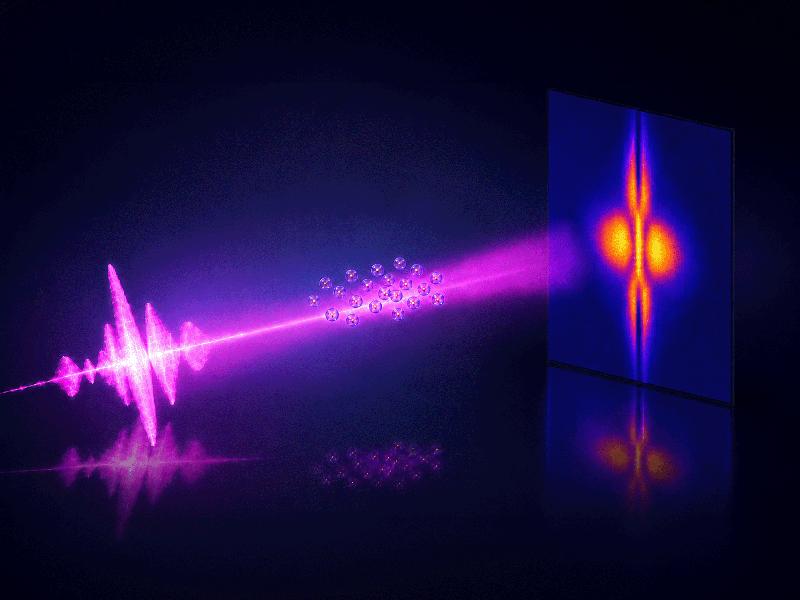

Researchers from the MPIK in Heidelberg used an atomic gas as a time-dependent lens to shape and spectrally manipulate intense high-frequency laser pulses. This gas-based optical element could pave the way toward better XUV- and x-ray pulse control for applications such as chemical reaction steering, quantum computing, and advanced spectroscopy methods for fundamental science.
● High-frequency (XUV) light offers unique insight into fundamental atomic processes, but control of light on microscopic scales in space and time remains a challenge
● Novel beam shaping technique: researchers demonstrate manipulation of XUV pulses spatially and spectrally
● Gas as a laser-controlled optical element: non-linear interactions in helium gas create an intensity-dependent refractive index near resonance – the gas acts like a lens or prism that can be turned on and off extremely fast.
Controlling the Light
The first known man-made lenses to manipulate light dates back to 700 BC: a nearly four-centimetre-wide rock crystal piece, manufactured around that time, was found in Nimrod, Iraq. And while the intended original function of this lens is not entirely clear today, it still shows that as early as this, humans were aware of the light-focusing properties of materials. An important application of this knowledge was the invention of microscopes, more than two millennia later, that utilised the optical properties of focusing glass lenses to explore the previously unknown microscopic world.
With the invention of lasers and subsequently short, intense laser pulses, scientists are now able to produce high-energy light at extreme intensities for very short periods of time, enabling more precise material-processing options, but also opening further insights into microscopic processes. The shorter the wavelength of the light used, the shorter the pulses can be – and the more precisely we can peer into the quantum world of atoms and molecules. In the extreme ultraviolet (XUV) spectral range, which spans wavelengths from a few to several tens of nanometres, this enables pulse durations in the attosecond range (1 Attosecond = 10⁻¹⁸ Seconds)– fast enough to directly track the movement of electrons.
The Challenge of manipulating High-Energy Light
With the rapid development of large-scale free-electron laser (FEL) facilities, scientists can now generate ultrashort, high-brilliance XUV light pulses. However, versatile tools to shape and manipulate these beams remain scarce. While conventional optical elements (mostly made of glas) such as lenses, mirrors or prisms easily bend, focus or spectrally split visible light, high-energy XUV photons are strongly absorbed by such standard optical components rather than reflected or refracted.
But controlling the shape and spectral composition of these short-wavelength pulses is of great interest in modern physics, as many atomic transitions are found within this energy range and specifically addressing them could open up new pathways for example in controlling chemical reactions or the development of ultrafast atomic-scale quantum computers.
Turning Gas into a Dynamic Refractive Element
An international collaboration under the lead of researchers from the Max-Planck-Institut für Kernphysik in Heidelberg (MPIK) have now been able to demonstrate the shaping of such an XUV laser pulse both in spatial dimensions as well as in its spectral composition. They took advantage of the complex non-linear interaction that happens between intense light and matter. When an intense XUV laser pulse passes through an optically dense medium - such as an atomic gas - it quickly excites and de-excites the atoms’ energy levels. This dynamical quantum process is known as Rabi oscillation, rapidly transferring electrons between those quantum levels. Because a laser beam is naturally most intense at its centre and weaker towards its edges, the strength of this interaction varies across the beam profile. The team showed that this radial intensity variation creates a self-induced modification of the medium's refractive index, most pronounced around an atomic resonance frequency.
“The interplay between this intensity dependent light-matter interaction and macroscopic pulse propagation effects that occur while the laser pulse travels through the medium, turns the atoms effectively into a refractive element, such as a lens or prism," explains Dr. Yu He, first author of the study. “The gas target deflects the resonant light – corresponding to an electronic transition - more effectively outwards than other frequencies and therefore reshapes its spectrum”.
Experimental Verification at FLASH
The researchers were able to obtain their observations by focusing high-intensity XUV laser pulses produced at the Free-Electron Laser FLASH at DESY in Hamburg into a gas cell containing helium atoms. The peak photon energy of the pulses was 21.2 eV, corresponding to the energy of the fundamental 1s-2p transition of an electron in the helium atom.
Depending on the intensities of the original laser pulse the scientists were able to see different effects: at lower laser intensity, the light was absorbed in the gas cell around the atomic resonance, but unchanged in its spatial shape. At higher laser intensities and higher gas pressure the beam was, however, deflected away from its original propagation path, especially at two specific photon energies in the spectrum slightly below and above the atomic resonance energy. This led to a characteristic double-peak structure in the spectrum, due to the nonlinear effects and macroscopic pulse propagation effects.
Pathway to future applications
"With this process we were able to produce a time-dependent lens that could be used to steer and shape the beam and its spectral composition on very short timescales”, states Prof. Thomas Pfeifer, director at the MPIK. “This will not only help to further develop optical elements for such high-frequency light applications, but also leads to a more detailed understanding of the complicated processes on how intense radiation interacts with and propagates through resonant media”.
Such knowledge could benefit future spectroscopic techniques, and may enable new approaches for tailoring the spatial and spectral shape of coherent XUV and x-ray pulses, even for applications as diverse and relevant as chemical reaction control by specially structured light and ultrafast (quantum) computing on atomic length and time scales.
Wissenschaftlicher Ansprechpartner:
Dr. Yu He
MPI für Kernphysik
yuhe@mpi-hd.mpg.de
Phone: +49 6221 516-284
PD Dr. Christian Ott
MPI für Kernphysik
christian.ott@mpi-hd.mpg.de
Phone: +49 6221 516-577
Prof. Dr. Thomas Pfeifer
MPI für Kernphysik
thomas.pfeifer@mpi-hd.mpg.de
Phone: +49 6221 516-380
Originalpublikation:
Redirection and reshaping of intense extreme-ultraviolet radiation
Yu He et al.
Science Advances, 29 May 2026, Vol 12, Issue 22, DOI: 10.1126/sciadv.aef5300
Weitere Informationen:
https://www.mpi-hd.mpg.de/mpi/en/research/scientific-divisions-and-groups/quantum-dynamicscontrol Division 'Quantum Dynamics & Control' at MPIK
Ähnliche Pressemitteilungen im idw
