
Improving the quality of life of patients with Parkinson’s Disease with flexible brain implants
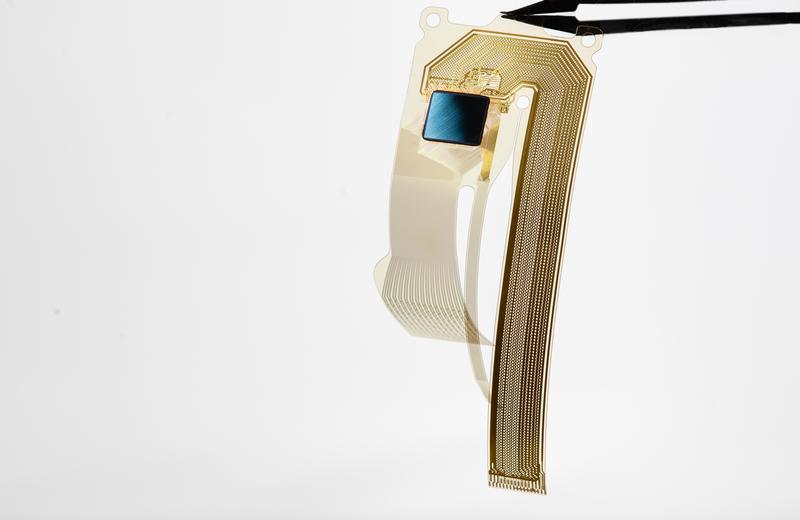
Working with partners from across Europe, Fraunhofer IZM has helped create highly integrated and flexible brain implants as a new, minimally invasive method for treating neurological disorders like Parkinson’s Disease. Patients can benefit from a more comfortable experience and less invasive surgery.
Neurological disorders like Parkinson’s Disease have been on the rise for a quarter of a century. Each case means a real burden and impact on the quality of life of the patients and their families. But medicine has new tools in its arsenal to help them. One potential treatment has shown considerable promise: deep brain stimulation (DBS). DBS works with electrodes in the patients’ brains, which conduct stimuli from a system placed in the upper body, commonly known as brain pacemakers.
Brain pacemakers have already shown their effectiveness as a therapy for compulsive
disorders as much as for the tremors affecting patients suffering from Parkinson’s or multiple
sclerosis. But the current generation of implants also affects the quality of life of their users.
They also typically work with only two electrodes, which limits how precisely the stimulation
can be targeted.
Researchers from across Europe have been working on an alternative implant design as part
of the MINIGRAPH project. Their idea: Combining all of the DBS system’s components in a
single package.
Innovative implant technology
The core of the system is a custom microchip, an ASIC, that enables two-way communication
with neural tissue. The connection is established by microelectrodes made of graphene. A
total of 256 receptor and 32 stimulator electrodes far improve the resolution of the system,
that is, the precision with which the patient’s brain is stimulated. The material can handle
stronger currents, which can counter the tendency of the recipients to build up a tolerance to
the stimuli.
The implant works without the long connectors going from the electrodes placed on the
patient’s brain to the torso. Instead, the entire implant is packaged on a single 200mm wafer
substrate.
When designing the system, the team at the Fraunhofer Institute for Reliability and Microintegration IZM pursued several innovative avenues. The researchers created a dual wiring layer with pitch of a mere ten micrometers. The connection between the two layers is even smaller, created with a laser ablating the structures from a 10-micrometer sliver of biocompatible polyimide. The researchers then created tiny gold nanopore contact pads on this double layer to accommodate the ASIC and capacitors. Their chosen thermal compression process worked at 100 degrees centigrade, compared to the standard 300 degrees.
Uniquely, the project partner ICN2 forms the highly sensitive graphene electrodes in a split
manufacturing process after the nanopore gold. This means that the graphene electrodes are
not exposed to the etching needed for producing the nanopore gold. The microelectronics
are protected further by a special barrier layer of biocompatible parylene and an aluminum
oxide package.
The end product of all of this effort is worth it: After thinning out, the ASIC and no fewer
than 17 capacitors measure a mere 70 micrometers, and the entire implant only 100
micrometers in thickness. This keeps the entire design thin and flexible enough to follow the
shape of the brain.
The Fraunhofer IZM researchers and their colleagues at ICN2 were also able to show, for the
first time, how graphene can be deposited and structured on a micrometer-scale layer of
gold. The project partners also designed a minimally invasive, robot-supported implantation
process that is much faster and less complex than the current two-phase surgery.
About the Project
MINIGRAPH (Minimally Invasive Neuromodulation Implant and implantation procedure based
on ground-breaking GRAPHene technology for treating brain disorders) ran from 1 October
2022 to 30 June 2026 and was supported as part of the EU’s Horizon Europe funding
scheme. Alongside Fraunhofer IZM, the following partners contributed to the project: Catalan
Institute of Nanoscience and Nanotechnology (Projektkoordination), INBRAIN Neuroelectronics, IMEC, Fraunhofer IZM, Multi-Scale Robotics Lab, Nanoflex Robotics AG, Leiden University Medical Center, Czech Advanced Technology and Research Institute.
(Text: Steffen Schindler)
Wissenschaftlicher Ansprechpartner:
Andrei Costina | Fraunhofer Institute for Reliability and Microintegration IZM | Research Assistant | Phone +49 30 46403-124 | andrei.costina@izm.fraunhofer.de
Originalpublikation:
https://www.izm.fraunhofer.de/en/news_events/tech_news/minigraph.html
Ähnliche Pressemitteilungen im idw
