
How did we become the last human species on Earth? New research project on the Palaeolithic
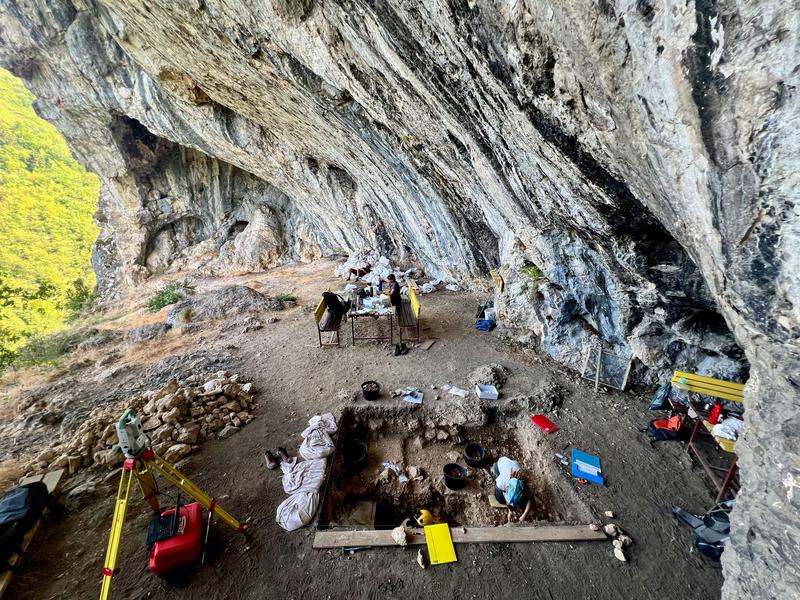
Why did Homo sapiens prevail in the course of human history, while other human forms, such as Neanderthals, disappeared? And what role did climate, the environment, technological advances and encounters between different populations play – as far back as hundreds of thousands of years ago? These are the questions addressed by a new research project at the Leibniz-Zentrum für Archäologie (LEIZA), Germany. Over the next five years, the project will receive €1.5 million in funding through an ERC Starting Grant from the European Research Council.
The global expansion of Homo sapiens began around 50,000 years ago. This process was also shaped by encounters with Neanderthals, who later became extinct, leaving our species as the only surviving human species on the planet. Yet this was not the first contact between the two human forms: they had already encountered one another repeatedly from around 300,000 years ago onwards. However, the traces and consequences of these early encounters remain largely unknown.
This is where the project entitled “Early ENCOUNTERS: Population dynamics and behavioural complexity across the Balkan Peninsula 300,000–100,000 years ago” comes in. It is led by Dr Tamara Dogandžić, a researcher at the MONREPOS Archaeological Research Centre and Museum for Human Behavioural Evolution in Neuwied, Germany, an institution of LEIZA.
“At the heart of our project is the question of how the complexity and diversity of human behaviour emerged. During this early period, Neanderthals and Homo sapiens developed remarkable innovations, ranging from new techniques for producing stone tools to specialised hunting methods. Did such innovations arise through encounters and the exchange of ideas, or did different populations develop them independently of one another? And why did some encounters lead to the continued existence of populations, while others ended in their disappearance? We aim to address these questions by investigating the relationship between population dynamics and cultural change,” explains Dogandžić.
The Balkans as a field of research
The project focuses on the Balkan Peninsula, which was already a region of movement and encounter in early human history. Situated between Europe, Asia and Africa, its diverse landscapes could, depending on the climate, serve as refuges, corridors or barriers. Different populations met here and repeatedly had to adapt to new living conditions, as demonstrated by fossil and archaeological evidence.
“A particularly valuable source of information is the Suhi Dol site in Bosnia and Herzegovina, which serves as a key archaeological site for our extensive fieldwork. Stone tools, animal bones and traces of hearths have been preserved there across several periods. They allow us to reconstruct the everyday lives of early humans step by step – from tool production and hunting and diet to the use of the landscape,” reports Dogandžić.
Interdisciplinary methods for new insights
For their analyses, the archaeologist and her team will employ a broad range of modern methods. Detailed examinations of the finds will provide insights into changes in technology and hunting practices. These results will be combined with analyses of climate and the environment, chemical methods such as isotope and biomarker analyses, and genetic data. Different dating methods can also help establish when humans lived at a particular site. A computer-based eco-cultural niche model will then bring the different strands of information together, making it possible to visualise how environmental conditions and human behaviour interacted.
The research project forms part of LEIZA’s research field “Becoming Human: The Evolution of Human Behaviour”, which addresses key questions concerning human development and ways of life. It builds on many years of research in this field at MONREPOS.
What can we learn from early humans?
“The ENCOUNTERS project will allow us to take a fresh look at one of the most fascinating questions of our prehistory: what made Homo sapiens so adaptable – and why did our species ultimately prevail? The findings from the ERC project will contribute to a better understanding of fundamental processes in human evolution,” explains Univ.-Prof. Dr Alexandra W. Busch, Director General of LEIZA and Vice President of the Leibniz Association. “LEIZA’s research is focused on expanding our knowledge of humankind and its development through an archaeological perspective. The ENCOUNTERS project addresses a central question in this context: how were human populations able to cope with profound changes in their living conditions over very long periods of time, repeatedly adapting to new challenges?” Busch adds.
“Securing an ERC Starting Grant is a particular achievement for outstanding early-career researchers, as this funding recognises innovative research at the highest level,” emphasises Clemens Hoch, Minister of Science, Further Education, and Health for the State of Rhineland-Palatinate. “I warmly congratulate Dr Tamara Dogandžić and wish her every success with the project. We are delighted that this project will also highlight the scientific potential of our state at an international level,” Hoch continues.
Funding from the European Research Council
The European Research Council (ERC) is an institution established by the European Commission to fund excellent, frontier research. It is funded through the EU Framework Programme for Research and Innovation, Horizon Europe. ERC funding aims to support the most talented and creative researchers in discovering and exploring new approaches across all fields of research. In particular, interdisciplinary approaches that cross the boundaries of individual disciplines are welcomed for their potential to drive innovation.
Through Starting Grants, the European Research Council supports outstanding researchers who have completed their PhDs and are at an early stage of their careers. The grants are designed to support their transition towards scientific independence and the establishment of their first independent research group. Projects receive up to €1.5 million over a period of up to five years.
Further information on ERC Starting Grants: https://erc.europa.eu/apply-grant/starting-grant
Wissenschaftlicher Ansprechpartner:
Dr. Tamara Dogandžić
Head of the project “Early ENCOUNTERS: Population dynamics and behavioral complexity across the Balkan Peninsula 300,000-100,000 years ago”
MONREPOS Archaeological Research Centre and Museum for Human Behavioural Evolution, Neuwied, Germany
Leibniz-Zentrum für Archäologie (LEIZA)
Tel.: +49 (0)2631 9772-279 | Mail: tamara.dogandzic@leiza.de
Ähnliche Pressemitteilungen im idw
