Chemicals and energy sectors move away from fossil raw materials
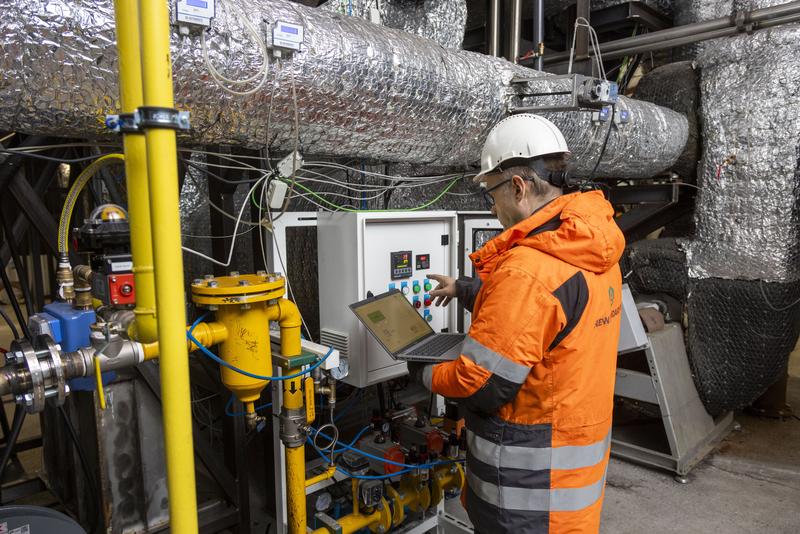
The Estonian deep-tech startup New Standard Oil has integrated thermal biomass valorisation technologies from the German applied research organisation Fraunhofer into a unified modular platform and launched its first industrial prototype. The goal is to convert currently unused biowaste streams across Europe into valuable renewable products.
The global transition towards a circular carbon economy requires technologies capable of converting biomass resources into renewable materials, chemicals and energy products, such as functional biochar, high-quality bio-oil, synthesis gas suitable for fuel production, or functional proteins. Although numerous individual biomass processing technologies already exist, integrating them into economically viable industrial systems capable of producing competitively priced products for the metallurgy, chemicals, construction materials, agriculture and energy sectors remains a major challenge.
New Standard Oil, the Fraunhofer Institute for Interfacial Engineering and Biotechnology (IGB), and the Fraunhofer Institute for Environmental, Safety and Energy Technology (UMSICHT) have jointly launched the validation of the first TRL 6 prototype of the UNIFORMER® concept.
The project is the result of several years of collaboration between the three partners. Fraunhofer IGB contributes expertise in superheated steam processing and biomass valorisation, while Fraunhofer UMSICHT provides know-how in Thermo-Catalytic Reforming (TCR) and other thermochemical processes. New Standard Oil focuses on system integration, reactor development and commercialisation, and has designed the UNIFORMER® platform architecture on which the current prototype programme is based.
Within the UNIFORMER® project, the partners are investigating how existing biomass valorisation technologies can be integrated into a unified industrial process. Unlike conventional systems, which are typically optimised for a single processing pathway, UNIFORMER® allows process configurations to be tailored according to the characteristics of locally available biomass resources. In the future, this could help companies achieve a better balance between economic performance, resource efficiency and environmental impact.
The project is also evaluating a process integration method and device developed by New Standard Oil and protected by a patent application. This approach enables multiple thermochemical technologies to be connected into a continuous production process. Eliminating airlock systems and mechanical transfer points reduces operating costs while increasing energy flexibility.
Project partner comments
Tommy Biene, Founder and CEO of New Standard Oil:
“Successful validation of our platform could help transform millions of tonnes of currently unused biowaste across Europe into valuable renewable products. Today, we are able to investigate how thermal conversion technologies operating under different atmospheric and temperature conditions can be integrated into a single continuous process. Our objective is to demonstrate a flexible platform that can be adapted to different biomass feedstocks and future industrial applications.”
Dr. Antoine Dalibard, Fraunhofer IGB:
“Superheated steam drying and torrefaction provide an efficient way to prepare biogenic residues such as hay or digestate for subsequent thermochemical treatment. Material homogenisation and targeted mild thermal pre-treatment create the conditions required for stable and efficient pyrolysis or Thermo-Catalytic Reforming (TCR). Through the UNIFORMER® project, we are exploring how these technologies can contribute to the production of high-quality renewable carbon products.”
Dr. Robert Daschner, Fraunhofer UMSICHT:
“A circular carbon economy requires solutions that combine process efficiency, feedstock flexibility and industrial scalability. This collaboration provides an opportunity to explore how complementary valorisation technologies can be integrated into a single comprehensive system.”
Contributing to the Bioeconomy
By integrating different biomass valorisation technologies into a modular platform, the project partners aim to increase the utilisation of regional biomass resources close to their point of origin. The results of the ongoing validation programme will help assess the technical and economic potential of two integrated biomass valorisation solutions for future industrial deployment. Testing of two additional system architectures is also planned.
Next steps
Prototype testing is currently being carried out in Tallinn. The results will help define the direction of the next development phase and support future pilot projects and industrial partnerships. New Standard Oil is also exploring opportunities for future collaboration within Bavaria’s bioeconomy ecosystem, including potential activities in the BioCampus area of the Port of Straubing-Sand.
Weitere Informationen:
https://www.igb.fraunhofer.de/en/press-media/press-releases/2026/chemicals-and-energy-sectors-move-away-from-fossil-raw-materials.html
Ähnliche Pressemitteilungen im idw
