
Integrated radar sensors enable safe and flexible environment sensing
Automated Guided Vehicles that can sense and process their environment in all three dimensions: That is the result of a collaborative project funded by the Federal Ministry for Research, Technology, and Space. A radar platform for industrial applications helps improve safety and the flexible allocation of the AI workloads.
Automated Guided Vehicles (AGVs) have become indispensable for industry and warehousing, but they face many challenges in the real world. Especially interacting with humans places extreme demands on 3D sensors and processing systems. Safety is paramount in this respect, as autonomous AGV must not pose a danger to human workers.
Integrating AI promises real advantages. Combined with reliable emergency stop systems, it can keep an eye on the environment and respond to what is happening in the real world. AI-based computing can essentially happen in two ways: It can be done in one central cloud location, but latency makes it impossible to do so for safety-critical features. Or it can be done locally, which, however, limits scalability and efficiency in robot fleet systems. Particularly in dynamic industrial environments, there are often too few flexible distributed systems that could share the computing jobs between multiple devices.
Safe and ready for collaboration
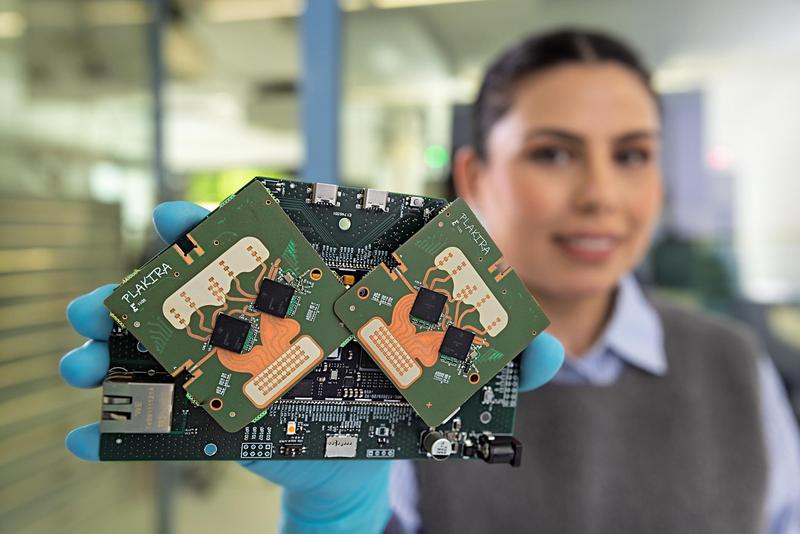
To address this gap, the researchers on the PLATON project came up with the idea of an integrated platform that gives each autonomous system several spatially resolving radar sensors. These measure the distance to nearby objects in all three dimensions, enabling both obstacle detection and spatial orientation of the vehicle. The same radar frontend is also used to capture high-resolution SAR radar images.
This allows safety-critical and time-sensitive signal processing to take place directly in the sensor. And the system can even communicate with other systems and pass on information about obstacles. More complex jobs like mapping the environment can happen in collaboration between the entire fleet. In essence, the platform grows as the fleet grows: Each new DTS adds more computing capacity that can be used dynamically where it is needed.
A digital twin of the system and its sensor technology helps speed up the launch of new AGV fleets, as a virtual environment map can be created before the actual systems are even commissioned.
A heart beating at radar frequencies
To make all of this possible, the Fraunhofer Institute for Reliability and Microintegration IZM joined forces with the Fraunhofer Institute for High-Frequency Physics and Radar Technology FHR to develop hybrid radar hardware that can do two jobs at the same time: a means to measure distance in all spatial directions and a radar imaging system. Two synchronized radar chips form the heart of the system on a PCB that also includes the hardware required for both local and networked functions. Its capabilities and features were already demonstrated in a prototype vehicle. Together with the prototypes developed by the project partners, some of which feature more advanced capabilities for interacting with their surroundings, it shows what interaction between humans and autonomous robots could look like in the future.
The PLATON project, »Distributed computing platform for radar-based 3D environment sensing in safe autonomous driving« (PLATON), ran from 1 November 2022 to 30 April 2026 and was carried out by Pilz GmbH & Co. KG as project coordinator, Creonic GmbH, let‘s dev GmbH & Co. KG, Reeb Engineering GmbH, OFFIS e.V., and Fraunhofer IZM. It was funded under the »Electronic Systems for Trusted and Energy-Efficient Distributed Computing in Edge Computing« (OCTOPUS) program of the Federal Ministry for Research, Technology, and Space (funding ID: 16ME0750).
(Text: Steffen Schindler)
Wissenschaftlicher Ansprechpartner:
Dr. rer. nat. Martin Hempel | Fraunhofer Institute for Reliability and Microintegration IZM | Phone +49 30 46403-159 | martin.hempel@izm.fraunhofer.de
Originalpublikation:
https://www.izm.fraunhofer.de/en/news/platon.html
Ähnliche Pressemitteilungen im idw