
Small Fields, Great Diversity: How a Diverse Patchwork of Crops Helps Birds
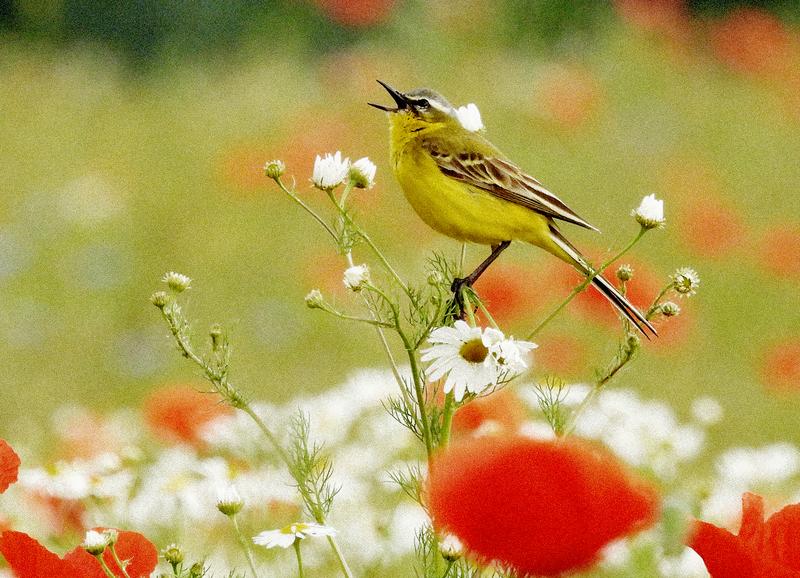
Birds are not only beautiful to look at and listen to; they also fulfill important roles in nature. They eat pests and disperse seeds. They are generally considered an indicator of a healthy environment. When birds thrive, soil and water quality often benefit as well. A new study published in the journal Landscape Ecology impressively demonstrates that diverse cultivation of farmland in small field patches creates better habitats for birds.
The study was conducted under the leadership of the Leibniz Centre for Agricultural Landscape Research (ZALF). Over a period of three years, the scientists investigated how growing a variety of crops on small patches within a field affects bird populations. The diversified experimental field was visited by birds around 70 percent more often than the neighbouring, conventionally managed large reference fields. The result is clear: where fewer pesticides are used and different crops grow in close proximity to one another, birds feel more at home and are more abundant.
The analysis revealed that on the diversely managed fields, birds were not only more frequently encountered but also behaved differently. They formed small groups and preferred to stay in areas characterized by lower pesticide use and greater plant diversity. The skylark in particular—a bird that nests in open areas and is often considered the emblem of the agricultural landscape—benefited from these conditions. Its presence was significantly more frequent in areas with less chemical pesticide use, adjacent flower strips, and more wild plants.
“Our data clearly show that it’s not just about what is cropped, but also how the land is designed and managed,” explains Jenny Kröcher, a researcher on the ZALF team. “If we make the fields smaller, combine different crops, and—wherever it is possible—reduce chemical crop protection or replace it with non-chemical methods, we create habitats that provide birds with food and shelter. It’s like a buffet and a safety net all in one.” Other research groups have reached similar conclusions: A diverse landscape is more resilient and richer in species.
What makes this study unique is its approach of considering not just individual measures, but the entire mosaic of the landscape. While other studies often examine only the effect of individual wildflower strips, the patchCROP experiment demonstrates how the interplay of small field patches, different crops, and sustainable pest management works. The results confirm earlier observations but, thanks to the high spatial resolution of the data, provide an even more detailed picture.
The “patchCROP” experiment was at the heart of the study. In this experiment, many small patches were combined within a large field, on which different crops were grown and various management methods were applied. For comparison, neighboring large fields managed using conventional methods were observed. Over a period from September 2020 to August 2023, the researchers mapped all occurring birds on the small patches and on the control areas in the immediate vicinity.
This analysis was made possible by a method that, in this form, has rarely been applied to bird data before: “Spatial Point Pattern Analysis” (SPPA). The background: Research conducted on actual agricultural land on farms is difficult to evaluate according to classical scientific standards. Unlike in a controlled field experiment, there are no identical, independent replicate plots here—each patch is situated differently within the landscape and differs in its surroundings or soil conditions. Classical statistical methods, however, require precisely such comparable replicates.
The SPPA method circumvents this problem by not relying on predefined comparison plots, but rather by using the spatial distribution of the observations themselves as a basis and examining whether this distribution is random or reveals patterns. This allows various environmental factors—such as the use of plant protection products, soil conditions, or vegetation structure—to be considered simultaneously and their respective effects to be distinguished from one another. The study thus demonstrates that reliable scientific conclusions can be drawn even from non-replicable, real-world field trials—an approach that could place future research on agricultural land on a more scientifically sound footing.
How can these results be applied in practice?
Increasing the diversity of crops grown across a multitude of smaller fields or in patches is difficult to implement with the large machinery currently in use. This could change in the future as autonomous field robots become ready for practical use, as is also being tested in the patchCROP experiment.
Integrating nature conservation into cultivated land, as demonstrated by the patchCROP approach, offers a promising way to combine food security with species conservation. Further research is needed to clarify how these systems will affect farm profitability in the long term and how they can be rolled out widely.
Funding Acknowledgment:
Open Access funding was made possible and organized by the DEAL project. This work was funded by the Federal Ministry of Research, Technology and Space (BMFTR) under grant numbers 031B0729A and 031B1391.
Wissenschaftlicher Ansprechpartner:
Jenny Kröcher
Research Area 4 “Simulation and Data Sciences”
Working Group: Dimensionality Estimation and Reduction
Phone: +49 (0) 33432 82-275
Email: jenny.kroecher@zalf.de
Originalpublikation:
https://doi.org/10.1007/s10980-026-02435-7
Weitere Informationen:
https://ZALF conducts research on the economically, ecologically, and socially sustainable agriculture of the future—in collaboration with stakeholders from academia, politics, and the field.
https://ZALF research is systems research: ranging from processes in soils, plants, and water, through relationships at the field and landscape levels, to global impacts and the consideration of complex interactions between landscape, society, and the economy. www.zalf.de
Ähnliche Pressemitteilungen im idw
