
Aachen Summer School: Textiles become smart through 3D printing and origami
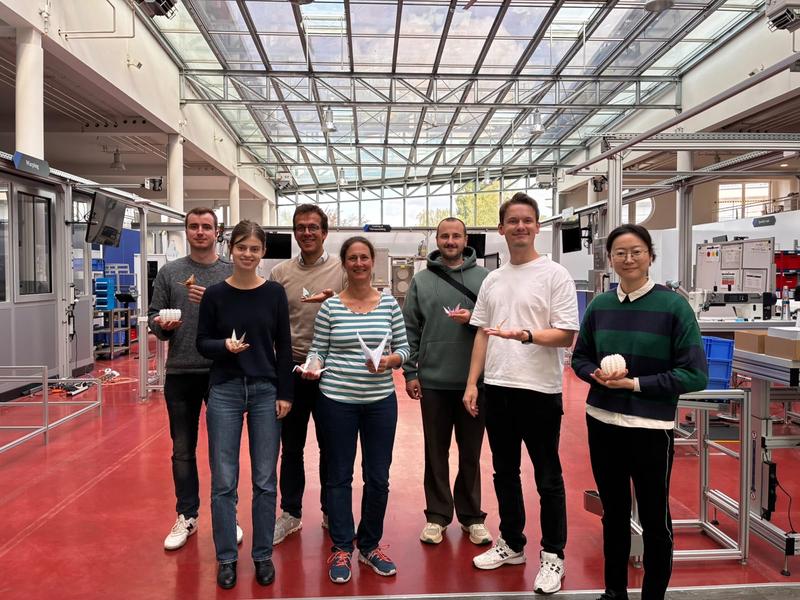
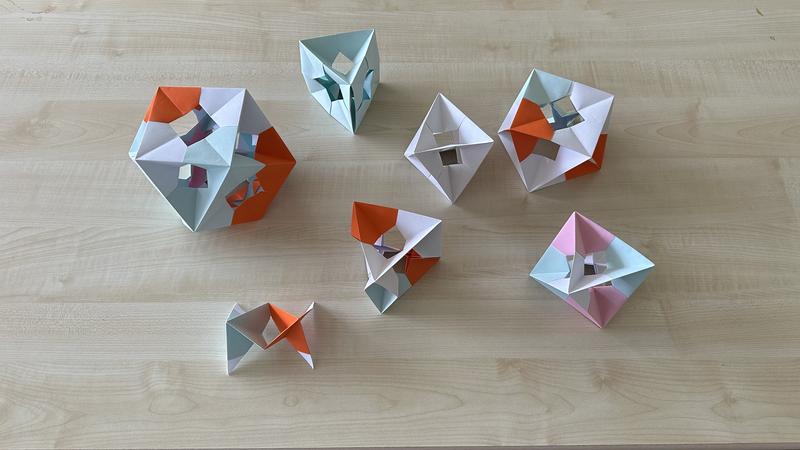
Focus on smart textile structures: RWTH Aachen’s ITA invites stu-dents to an innovative summer school
21–29 September 2026, Aachen, Germany
From 21 to 29 September 2026, the Aachen Summer School will transform Institut für Textiltechnik (ITA) of RWTH Aachen University into a laboratory of the future: over the course of a week, students will use origami folding techniques and 3D printing to develop active texti-le structures capable of performing programmable movements. This interdisciplinary event combines theoretical foundations with practical prototyping – from digital modelling right through to functional textile prototypes.
From folding to robots: textiles are becoming ‘intelligent’
Active textiles that change shape autonomously or react to environ-mental influences – it sounds like science fiction, but it is already a reality. The combination of origami design, 4D textiles (time-dependent shape changes) and additive manufacturing gives rise to ‘intelligent’ materials. In the Summer School, participants learn how to combine textile substrates with printed structures to generate com-plex movement patterns.
The programme guides students through the entire innovation cycle:
• Fundamental knowledge: Experts from the ITA and international guests teach the mathematical principles of origami design, the phy-sics of 4D textiles and the properties of textile substrates.
• Practical skills: Hands-on training in origami techniques and structu-ral design – including 3D printing directly onto textiles. From digital modelling in CAD software to operating machinery.
• Prototyping: Working in interdisciplinary teams, students develop their own concepts – such as a robotic gripper, an interactive garment or bespoke applications in the fields of medicine, architecture or wearables.
A particular highlight: the combination of traditional origami with state-of-the-art additive manufacturing. Participants first fold paper models to understand geometric principles, and then translate these struc-tures into digital 3D models. These are ultimately printed onto textile materials – a process that combines creativity with engineering preci-sion.
International expertise meets RWTH innovation
The programme includes:
• Ordine Lang (origami artist): She will present the mathematical foundations of folding and demonstrate how origami principles can be applied to technical applications.
• Dr Jingyi Yang (SIMTech, Singapore): The expert in 4D textiles and programmable materials brings international perspectives to the Summer School.
“The combination of origami and 3D printing opens up entirely new possibilities for textile structures,” explains Zhen Danchen, a resear-cher at the ITA. “We see potential here for applications in robotics, medicine or even fashion – and that is precisely what we want to convey to the students.”
Background: ITA and RWTH Aachen as driving forces in textile research
Institut für Textiltechnnik (ITA) of RWTH Aachen conducts research at the interface of textile technology, digitalisation and sustainability. Through the Summer School, it promotes interdisciplinary exchange and gives young talents the chance to contribute to pioneering tech-nologies.
RWTH Aachen University is one of the largest and most renowned technical universities in Europe. Its key research areas include textile and plastics engineering, additive manufacturing and sustainable ma-terials – topics that play a central role in the Summer School.
Wissenschaftlicher Ansprechpartner:
Danchen Zhang, danchen.zhang@ita.rwth-aachen.de
Weitere Informationen:
https://www.ita.rwth-aachen.de/go/id/bvvxdr?lidx=1#aaaaaaaaabvvxwq
Ähnliche Pressemitteilungen im idw
