
Biodiversity hotspots in south-west Germany are losing their species richness
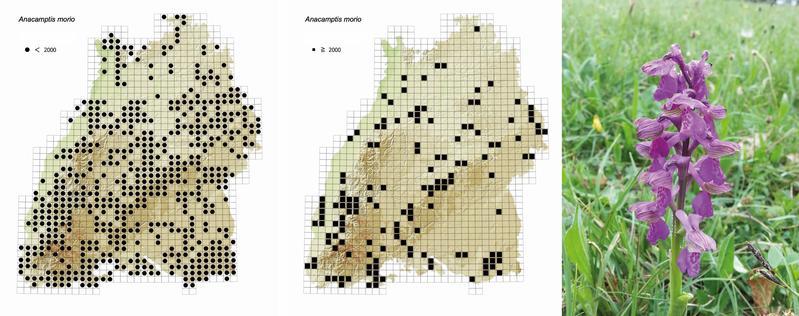

Climate change and shifts in land use are affecting habitats and, consequently, plant diversity. To better understand the consequences of these developments, long-term and comprehensive data are essential. The “Floristic Mapping of Baden-Württemberg”, coordinated by the Stuttgart State Museum of Natural History, provides a unique foundation for this. The data collected over five decades as part of this citizen science project document significant changes in the flora of southwestern Germany drawing on more than 2.5 million plant observations.
A research team from the Stuttgart State Museum of Natural History and the University of Hohenheim has now jointly analyzed these data.
Joint study by the Stuttgart State Museum of Natural History and the University of Hohenheim:
50 years of Floristic Mapping in Baden-Württemberg reveal significant changes in the flora of Southwest Germany
Climate change and shifts in land use are affecting habitats and, consequently, plant diversity. To better understand the consequences of these developments, long-term and comprehensive data are essential. The “Floristic Mapping of Baden-Württemberg”, coordinated by the Stuttgart State Museum of Natural History, provides a unique foundation for this. The data collected over five decades as part of this citizen science project document significant changes in the flora of southwestern Germany drawing on more than 2.5 million plant observations. They also provide valuable insights into changes in plant diversity in Germany and Central Europe. A research team from the Stuttgart State Museum of Natural History and the University of Hohenheim has now jointly analyzed these data.
The results of the joint analysis show that while some areas in southwestern Germany have gained plant species, particularly diverse areas - hotspots of diversity - tend to lose diversity. The analysis underscores how crucial the local context is for biodiversity and effective nature conservation. It is not enough to simply preserve as many species as possible. Conservation measures should be tailored to the specific area and also take into account the ecological characteristics and evolutionary distinctiveness of the plant species found there.
The study was published in the journal Global Change Biology.
More species do not automatically mean greater biodiversity:
The plant data revealed a clear pattern: areas that were particularly diverse at the start of the investigations tended to lose diversity over time. Regions such as the Swabian Alb and the Black Forest have been particularly affected, with characteristic species and ecological features in decline. “The question of whether biodiversity is increasing or decreasing overall does not go far enough. Patterns of change vary depending on the area and the aspect of biodiversity under consideration. An increase in species numbers is not automatically positive. If widespread species expand whilst specialised species disappear, landscapes may lose some of their distinctive ecological character. Biodiversity conservation must therefore take regional characteristics into account,” says Dr Viktoria Ferenc, lead author of the study and a researcher at the Stuttgart State Museum of Natural History and the University of Hohenheim.
One of Europe’s longest-running floristic mapping projects:
The research team analysed more than 2.5 million plant observations from Baden-Württemberg. These were collected by citizen scientists and professional botanists between 1970 and 2023 for the state’s floristic mapping project, one of the oldest projects of its kind in Europe. The dataset, which has been maintained for over 50 years, comprises just under 2,000 vascular plant species.
Ecological diversity may be at risk despite a stable number of species:
In addition to the number of species, the study’s authors analysed the plants’ evolutionary relationships as well as the diversity of their traits, such as height, leaf characteristics and seed size. The various dimensions of biodiversity did not always develop in the same direction. For example, some areas lost distinctive ecological strategies or evolutionary diversity despite a stable number of species. It is therefore crucial to consider not only the number of species, but also which plants are increasing or decreasing over time and what characteristics they possess. “Nitrogen-tolerant and disturbance-adapted species often spread, as do highly competitive or non-native plants. In contrast, habitat specialists – species adapted to wetlands or cool conditions, orchids and species of particular conservation importance – frequently decline. It is therefore crucial to specify exactly what is to be protected,” says Dr Pierre Liancourt, a researcher at the Stuttgart State Museum of Natural History and the study’s senior author.
Local environmental conditions shape development:
The extent to which biodiversity changed depended, amongst other things, on the local climate, land use, atmospheric ammonia pollution, soil conditions and topography. “Using the latest statistical methods, we were able to identify patterns in this extensive data that provide important insights into how environmental factors are associated with changes in local plant diversity. However, there was no single factor that could explain all the patterns. Rather, different aspects of biodiversity responded differently depending on local environmental conditions,” says co-author Dr Jörn Pagel from the Department of Landscape Ecology and Vegetation Science at the University of Hohenheim.
The importance of monitoring projects for research and nature conservation:
The study highlights the exceptional value of long-term, coordinated citizen science and monitoring projects. “The data from the Baden-Württemberg Floristic Mapping project reveal how our region’s flora is changing and form an important basis for biodiversity research, species conservation, Red List assessments and nature conservation planning. Without the decades-long commitment of volunteer botanists, many of these changes would have remained largely invisible,” says Dr Mike Thiv, co-author of the study and Head of the Botany Department at the Stuttgart State Museum of Natural History. In 2028, the Baden-Württemberg Floristic Mapping project will begin its third survey period. Further citizen scientists interested in supporting the mapping effort are welcome to take part. The Stuttgart Natural History Museum is also currently developing an app designed to simplify the digital recording of plant observations and enable faster access to the data.
Wissenschaftlicher Ansprechpartner:
Dr Viktoria Ferenc
Stuttgart State Museum of Natural History, Department of Botany
University of Hohenheim, Division of Landscape Ecology and Vegetation Science
Telephone ++49/(0)711/89 36/203
Email: viktoria.ferenc@smns-bw.de
Originalpublikation:
Viktoria Ferenc, Cornelia Krause, Jörn Pagel, Michael Boxriker, Monika Voggesberger, Arno Wörz, Mike Thiv, Pierre Liancourt: “Five decades of citizen science reveal erosion of hotspots of multifaceted plant diversity”, Global Change Biology, 27 October 2026
DOI: 10.1111/gcb.71150
Publication date: 27 October 2026
URL: http://doi.wiley.com/10.1111/gcb.71150
Weitere Informationen:
https://flora.naturkundemuseum-bw.de/start2.htm Floristic Mapping of Baden-Württemberg
Ähnliche Pressemitteilungen im idw
