
Silent Killers in the Garden Pond: New issue of Forschung Frankfurt explores the biodiversity crisis
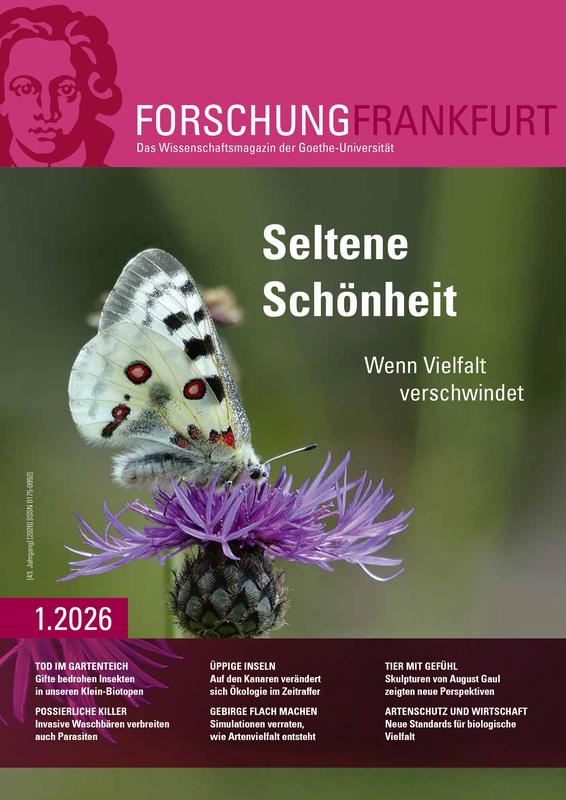
A garden pond could, in principle, be an oasis for insects. Yet even ponds created with the best of intentions can contain such high concentrations of toxic substances that their water is completely devoid of life. In an article in the latest issue of “Forschung Frankfurt”, entitled “Rare Beauty – When Diversity Disappears”, Prof. Jörg Oehlmann reports on the search for the sources of these toxins – and how they can be avoided. Other articles in Goethe University’s research magazine explore the dangers posed by raccoons, despite their endearing appearance, how the emergence of species over geological time can be simulated, and why a lagoon can take legal action.
In the urban desert of a major city, garden ponds are valuable refuges for a wide variety of insects. Even during prolonged droughts, these mini-ecosystems are regularly replenished with water, and amid streets and buildings, they act like chains of islands that insects can move between. An estimated 10,000 to 20,000 garden ponds can be found in Frankfurt am Main. Prof. Jörg Oehlmann and his team have investigated 17 of them.
“Dozens of dragonflies and other insects were flying around one of these ponds, but not a single larva was living in the water,” the biologist reports in the latest issue of Forschung Frankfurt. A thorough analysis revealed that toxins released primarily from certain pond liners were responsible. Garden hoses and wood preservatives were also identified as potential sources of danger. The Frankfurt-based researcher believes that much more needs to be done to raise public awareness of these issues.
Other articles in Forschung Frankfurt examine, for example, how invasive raccoons in Germany threaten populations of snakes, toads and other animals, while also introducing diseases that can be dangerous to humans. In further articles, researchers explain how they use sophisticated computer models to simulate evolution and demonstrate why South America’s rainforests are so much richer in species than those of Africa.
Other research stories explore how a lagoon in Spain has, for the first time, taken legal action against its pollution, setting the legal system in motion, and how the biodiversity crisis can be addressed through a combination of technological and nature-based solutions.
The latest issue of Forschung Frankfurt (1/2026) can be ordered free of charge by emailing presse@uni-frankfurt.de.
A PDF of the issue is available online at www.forschung-frankfurt.de.
Picture download:
https://www.uni-frankfurt.de/190364520
Caption: The cover of Forschung Frankfurt, issue 1/2026: “Rare Beauty”. Image: Goethe University Frankfurt
Weitere Informationen:
https://www.forschung-frankfurt.uni-frankfurt.de/34831594/Aktuelle_Ausgaben___Forschung_Frankfurt?
Ähnliche Pressemitteilungen im idw
