
New Study Finds Future Warming Events Will Outdo the Extreme Heatwaves of the Recent Past
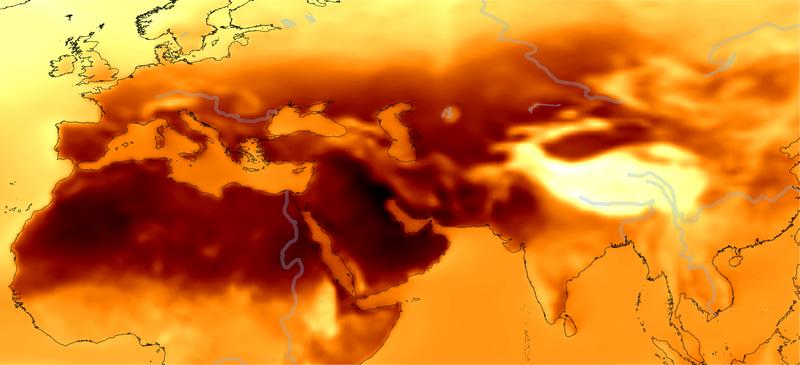
The extreme heatwaves we have seen over the last few years may only serve as a preview of what is to come as a result of climate change. A new study led by researcher Philipp Aglas-Leitner from Freie Universität Berlin, published in Nature Communications, finds that future heatwaves could last longer, impact larger areas, and be much more severe.
In the study “Recent Extreme Heatwaves Are No Match for Future Events,” the research team analyzed twenty-two exceptional heatwaves that occurred between 2010 and 2023 in regions such as Europe, Australia, China, India and Pakistan, North Africa and the Middle East, and South America. Nine heatwaves from between 2015 and 2023 were investigated in depth. The researchers then compared these events with climate model projections for the period from 2020 to 2100.
Extreme Heat Could Become the Norm
Unlike analyses that observe individual temperature records, this new study investigates several heatwave characteristics at the same time, such as duration, cumulative heat, median and maximum event severity, and median and maximum spatial extent of locally heat-affected areas.
Two independent reference data sets from Berkeley Earth and ERA5 were used to analyze the twenty-two exceptional heatwaves. The team used multi-model ensembles from the international model comparison projects CMIP5 and CMIP6 to create climate projections and assessed different scenarios, ranging from substantial emissions reductions through to scenarios with high and very high emissions, as well as a number of different global warming levels.
“The results demonstrate a clear pattern across different climate model ensembles and emission scenarios: A substantial proportion of future heatwaves surpass exceptional events in the recent lived experience. They could last longer, impact larger areas, be more severe, and produce much higher accumulated temperature anomalies. Recent observed events are outmatched by a substantial margin, particularly toward the end of the twenty-first century,” says Philipp Aglas-Leitner, first author of the study from the Department of Physics and Department of Mathematics and Computer Science, Freie Universität Berlin.
The study’s projections of severe heatwaves are especially striking. The authors state that they will become much more frequent in many regions in the period from 2015 and 2054. The majority of the model ensembles for a lot of the regions investigated are projected to have at least one exceptional heatwave period per year between 2060 and 2099. In Europe future heatwaves could stretch out over several months and impact a significant portion of the continent.
Urgent Need for Substantial Emissions Reductions and Climate Adaptation Measures
“Our results clearly demonstrate that many of the extreme heatwaves that people today have experienced in recent years could be outmatched by those of the future. This has far-reaching implications for human health, infrastructure, and ecosystems,” Aglas-Leitner explains. “Even ambitious emission reduction goals offer only limited protection. Without substantial emission reductions and consistent adaptation measures, however, a significant part of the twenty-first century will be defined by heat that goes far beyond our recent experiences.”
The study is a joint project between different international coauthors, including researchers from Freie Universität Berlin and the Australian National University, who collaborated with scientists from the Potsdam Institute for Climate Impact Research, ETH Zurich, Charité – Universitätsmedizin Berlin, Earth Sciences New Zealand, and University of Hamburg.
Wissenschaftlicher Ansprechpartner:
Philipp Aglas-Leitner, Department of Physics and Department of Mathematics and Computer Science, Freie Universität Berlin, Email: philipp.aglas@fu-berlin.de
Originalpublikation:
https://www.nature.com/articles/s41467-026-76809-5
Ähnliche Pressemitteilungen im idw
